Quick Summary
As organizations increasingly rely on contractors, freelancers, temporary workers, and project-based talent, choosing the right staffing model has become a strategic business decision.
Whether you hire talent directly through staffing agencies or manage your contingent workforce through an MSP, the choice can significantly impact cost, compliance, scalability, and workforce visibility.
The Problem: Why Workforce Management Gets Complicated Fast
While it can be relatively simple to hire people when only a few jobs need to be filled, it definitely becomes much more complicated when companies have to manage many workers, such as contractors, temporary staff, and freelancers.
This is normally the situation that business organizations have to deal with:
- Managing multiple staffing vendors with different contracts and pricing structures
- Limited visibility into contingent workforce spending
- Compliance risks due to inconsistent hiring practices
- Decentralized hiring decisions across departments
- Lack of workforce performance and cost-per-hire data
These difficulties can result in high operating expenses and inefficiencies in medium to large companies in North America, Canada, India, and the APAC regions.
That’s where knowledge about the distinction between MSP staffing and direct staffing comes into play.
What Is MSP Staffing and Why It’s Growing?
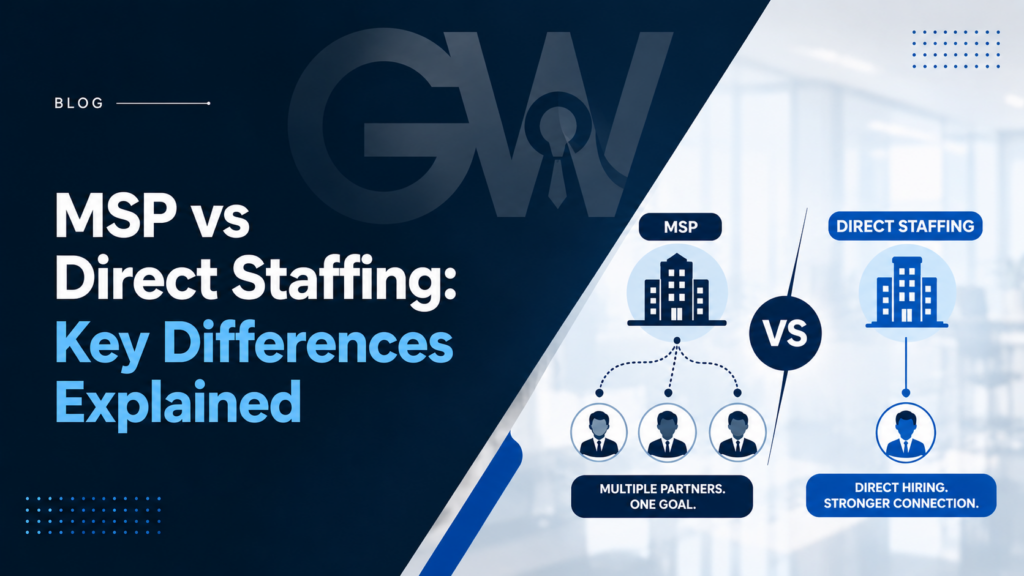
A Managed Service Provider (MSP) is a workforce management partner that oversees an organization’s contingent workforce program, including contractors, freelancers, temporary staff, and staffing suppliers.
In other words, it would be best if you outsourced the management of your entire contingent workforce program to a specific workforce partner known as the MSP.
The MSP will offer services such as recruitment, onboarding, compliance, billing, performance measurement, and supplier management using a central system. This program is commonly run using a Vendor Management System (VMS).
How the MSP Recruitment Model Works
- It is your firm that establishes the boundaries when it comes to budget and workforce.
- The MSP employs the assistance of a team of staffing providers under your name.
- Workforce requests are managed through a VMS platform, improving transparency and process consistency.
- The MSP handles everything from managing contracts to handling compliance management.
- Visibility into the workforce and costs will be made possible.
What Is Direct Staffing?
Direct Staffing is the traditional recruitment model in which organizations work directly with staffing agencies to fill open positions.
This type of staffing does not involve any other entity managing it on behalf of the company. In this case, the company’s internal team will manage this process with the staffing agency.
This strategy is usually faster and more flexible, as the hiring process is quite simple. If the organization does not require an MSP framework for its staffing requirements, then this would be the way to go.
When Direct Staffing Makes Sense
- Only a handful of positions are open.
- Your agency relationship is solid.
- You know what you want, and speed matters most.
- Your firm works on projects, as an SMB or start-up.
- There isn’t enough work for an MSP setup.
MSP Staffing vs Direct Staffing: Complete Side-by-Side Comparison
This staffing partner comparison helps organizations determine which workforce management solution best supports their hiring goals, compliance requirements, and contingent workforce strategy.
| Factor | MSP Staffing | Direct Staffing |
|---|---|---|
| Reporting | Centralized | Limited |
| Workforce Analytics | Advanced | Basic |
| Supplier Consolidation | Yes | No |
| Global Workforce Support | Strong | Limited |
| Risk Management | High | Moderate |
Why More Businesses Are Shifting to MSP Models
A contingent workforce is not just an addition to the working process of a company. Hiring of contractual staff, independent contractors, and temporary staff constitutes a significant portion of total employment in North America and Asia, particularly in IT, healthcare, and financial sectors.
The difficulty in managing such a workforce becomes even more challenging with increasing numbers.
The following are the reasons behind the growing inclination towards MSPs:
1. Cost Visibility and Control
Without a centralized hiring system, many organizations struggle to accurately track contingent workforce spending across multiple vendors and departments. In the case of MSPs, all costs are brought under one roof, making price negotiations easier and eliminating duplicate suppliers.
2. Vendor Neutral Recruitment
Vendor neutrality is one of the most valuable benefits of an MSP program. A vendor-neutral MSP evaluates suppliers objectively and distributes hiring requirements across the most suitable staffing partners. This approach gives organizations access to a broader talent pool while promoting competition, quality, and cost efficiency.
3. Data-Driven Workforce Decisions
MSP programs provide real-time workforce insights through VMS technology, including supplier performance, retention rates, time-to-fill metrics, cost-per-hire data, and workforce spending trends. This level of visibility helps organizations make proactive workforce decisions, improve recruitment process efficiency, and optimize labour costs.
4. Choosing the Right Model: A Practical Framework
Organizations do not always need to choose one model exclusively. Often, companies use a combination approach where MSP services are used for high-volume contingent workers, while direct hiring is utilized for executives and specialists.
The following framework can help determine which approach best aligns with your business needs:
Go With MSP If…
- At any given point in time, you have over fifty temporary workers under your supervision.
- You find it difficult to manage multiple staffing vendors and supplier relationships.
- Your organization faces ongoing compliance, reporting, or workforce visibility challenges.
- You operate your business in several divisions or regions.
- You need a scalable, technology-driven workforce management solution.
Stick With Direct Staffing If…
- You do not employ many staff, and the roles that you do hire for are very easy.
- You have good agency contacts that consistently deliver
- Central oversight is less crucial than efficiency and ease.
- You are an SMB or start-up that does not need a full-fledged MSP platform yet.
The switch to MSP happens quite naturally in most growing firms as soon as employing people becomes more troublesome than helpful. If you can detect that point in time, you are way ahead of other firms in terms of recruitment.
Conclusion:
Choosing between MSP Staffing and Direct Staffing ultimately depends on your organization’s workforce complexity, hiring volume, and business objectives. While Direct Staffing can be effective for straightforward hiring needs, MSP Staffing provides greater visibility, compliance control, scalability, and workforce optimization for organizations managing larger contingent workforces.
The most effective workforce strategy is one that aligns with both your current hiring demands and long-term growth plans.
Build a More Efficient Workforce with GetWorkz
Whether you’re looking to streamline contingent workforce management through an MSP program or fill critical positions through direct staffing, Get Workz provides scalable workforce solutions tailored to your business needs.
With expertise across the United States, Canada, India, and the APAC region, Get Workz supports organizations with MSP/VMS solutions, RPO services, IT recruitment, healthcare staffing, bulk hiring, and overseas hiring.
Ready to optimize your hiring strategy? Contact Get Workz today to explore the right workforce solution for your organization.
FAQs on MSP vs Direct Staffing
1. What is MSP staffing in simple terms?
Outsourcing your entire contingent labour management function, inclusive of all staffing agencies and their contractual agreements, is referred to as MSP staffing. It basically entails outsourcing the management aspect of your hiring function.
2. What is a VMS, and how does it relate to MSP?
A Vendor Management System (VMS) is a technology platform used to manage staffing suppliers, contingent workers, approvals, compliance, reporting, and workforce costs. While a staffing agency supplies talent, a VMS provides centralized oversight of the entire contingent workforce program. Most MSP programs utilize a VMS to streamline operations and improve visibility.
3. Does Get Workz provide both MSP and direct staffing services?
Absolutely. Get Workz provides its services through MSP as well as direct staffing for addressing the diverse needs of the workforce. Companies having significant numbers of contingent workforce can make use of MSP as well as VMS services for the purpose of overseeing the workforce in a more effective manner.
4. Is MSP staffing more expensive than direct staffing?
Not necessarily. While MSP programs involve management services, they often reduce overall workforce costs through supplier consolidation, compliance management, and improved spend visibility.