Quick Summary
Hiring the right people is essential for business growth, but managing recruitment becomes increasingly challenging as a company expands. Longer , rising recruitment costs, difficulty finding qualified candidates, and inconsistent hiring outcomes are common signs that internal recruitment processes may no longer be enough. Recognizing these challenges early can help businesses improve hiring efficiency, reduce costs, and build stronger teams.
This article highlights five key signs that indicate it may be time to partner with an RPO provider. Whether you are a startup experiencing rapid growth, a mid-sized company scaling operations, or an established enterprise hiring across multiple locations, understanding these signs can help you make more informed recruitment decisions.
Key Warning Signs to Watch For
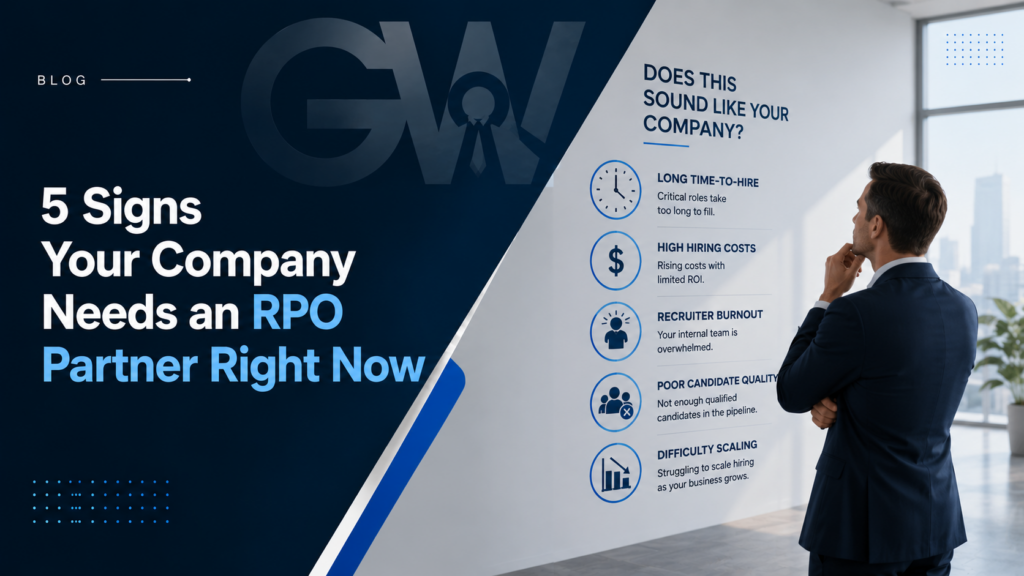
- Your hiring timelines keep getting longer
- Your HR team cannot keep up with business growth
- The quality of new hires is declining
- Recruitment costs are increasing
- You struggle to find specialized talent
If your company is experiencing two or more of these challenges, partnering with an RPO provider can help streamline recruitment, improve hiring quality, and reduce overall hiring costs
The Real Problem: When In-House Hiring Starts Breaking Down
The first stage in most firms is a tiny HR department, which performs recruitment in conjunction with payroll, regulatory compliance, training, and no fewer than ten other jobs. It is good for a while, but it becomes unsustainable as the firm grows, making the hiring process increasingly complex with more openings, new regions, stricter deadlines, and more challenging qualifications. The cost of bad recruitment management is clearly outlined in the statistics below:
Costs of Bad Recruitment Management in USD Per Hire in the US, Canada, India, and APAC:
| 42+ Days | 30% | $4,700 | 3× |
| Average Time to Fill | New Hires Leave Within 90 Days | Average Cost Per Hire | Cost of a Bad Hire |
Sources: SHRM Talent Acquisition Benchmarking Report 2024; BambooHR Employee Onboarding & Retention Survey 2023; Glassdoor / SHRM Cost of a Bad Hire Studies.
These are not just theoretical figures. These are real dollars and cents, real losses in production, and real harm to your company’s brand. If you see your company exhibiting any of the warning signs outlined below, it probably costs more to do nothing than it does to work with an RPO vendor.
5 Signs Your Company Needs an RPO Partner Right Now
Sign 1: Your Hiring Timelines Keep Getting Longer
The average time-to-fill role in the US is now over 42 days – and for specialized positions, it often stretches to 60 or 90 days (Source: SHRM, 2024). When roles sit open that long, productivity takes a hit, workloads pile up on existing staff, and your ability to serve clients is directly affected.
Slow hiring usually happens because internal recruiters are stretched too thin – they are managing too many open roles at once while also handling HR admin tasks. An RPO partner assigns dedicated recruiters who focus solely on your positions. They maintain an active talent pipeline so candidates are ready before your needs become urgent, not after.
Sign 2: You Are Scaling Fast, But Your HR Team Is Not
Business expansion is indeed exhilarating, except that you will soon find yourself unable to keep up with the increased need to recruit talent. It could be in the case of entering a new market, introducing a new product, bulk recruitment to start a new initiative, or expanding your business into APAC or Canada.
With RPO services, you can hire and fire through recruitment processes depending on your requirements. With RPO services, you can get access to the entire recruitment function – from sourcing to screening candidates and reporting. All these benefits make RPO very useful to startups and growing organizations in countries like the USA, India, and APAC.
Sign 3: Quality of Hires Has Dropped
When recruiters are under pressure to make appointments fast, they tend to take shortcuts. This makes interviews more hasty and screening less rigorous, leading to employees who are either underqualified or who tend to leave the organization within 90 days. According to BambooHR statistics, 30% of new hires quit within the first three months – numbers that rise exponentially if the recruitment process is reactive, as opposed to structured.
RPO vendors follow proven processes to ensure that they achieve quality, regardless of time constraints. Moreover, they have specialized knowledge of certain verticals, whether it be information technology, healthcare, business process outsourcing or executive search.
Sign 4: Your Recruitment Costs Are Out of Control
Multiple postings in several job portals, payments for each successful placement in staffing agencies (between 15% and 25% of the employee’s first year’s pay), and recurring onboarding of employees who will exit just a few months later are some ways in which recruiting expenses pile up very fast.
RPO solutions typically offer predictable and less expensive recruitment than traditional recruiting activities. For instance, while in the traditional recruiting process, payments are made per placement to an outside agency (cost-per-placement model), RPO offers you recruiting capacity, technology, sourcing, and processes. The typical cost-per-hire is around $4,700 in the United States, according to SHRM (2024). A bad hire may cost you up to 3x his or her annual salary.
Sign 5: You Cannot Find Niche or Specialized Talent
There will always be jobs that are difficult to find; for example, senior cloud engineers, healthcare professionals, finance leaders, or bilingual BPO agents. These candidates will not come from traditional recruitment platforms and will likely not have strong networks within the specific field in question.
Recruitment Process Outsourcing firms possess extensive, industry-specific candidate networks and expert-level sourcing skills. Get Workz’s RPO solutions, for example, cover IT Recruitment, Healthcare Recruitment, Executive Search, Accounting Outsourcing, BPO Recruitment, and Offshore Recruitment all of which provide companies access to passive candidates who cannot be accessed otherwise.
RPO vs. Traditional Recruitment – A Side-by-Side Comparison
If you are trying to decide between keeping hiring in-house, using a staffing agency, or moving to an RPO model, this table summarizes the key differences:
| Factor | In-House Recruitment | Staffing Agency | RPO Partner |
| Cost Model | Fixed (salaries + tools) | Per-placement fee (15–25%) | Scalable – fixed, per-hire, or hybrid |
| Scalability | Limited by team headcount | Moderate | High – scales with business demand |
| Process Ownership | Full ownership | Shared/limited | Fully managed or co-managed |
| Hire Quality | Depends on team capacity | Speed-focused, not quality-focused | Structured, quality-driven process |
| Niche Talent | Difficult without specialist knowledge | Niche agencies can help | Deep network + industry expertise |
| Best For | Stable, low-volume hiring | Short-term or urgent gaps | Growth, bulk, global, or niche hiring |
Note: Cost and scalability data based on industry benchmarks from SHRM, LinkedIn Talent Trends, and NelsonHall RPO research.
Key Benefits of Working with an RPO Partner
Once you decide to move forward with an RPO partner, here is what you can expect provided you choose a partner with the right expertise and flexible delivery model:
Faster, More Consistent Hiring
- Dedicated recruiters focused only on your open roles
- Active talent pipelines that reduce time-to-fill by 30–50% (Source: NelsonHall RPO Market Analysis 2023)
- Scalable capacity – ramp up for bulk hiring, scale back during slower periods
Lower Total Cost of Recruitment
- Predictable cost model – no surprise per-placement fees
- Reduced dependency on expensive external staffing agencies
- Lower re-hiring cost due to better hire quality and higher retention
Access to Specialized Expertise and Talent
- Deep vertical expertise: IT, healthcare, BPO, finance, executive, bulk, overseas
- Access to passive candidate networks not reachable through job boards
- Global reach with local market knowledge for APAC, Canada, India, and US markets
Better Data, Process, and Employer Brand
- Real-time dashboards and hiring analytics to track performance
- Structured candidate experience that improves your employer brand
- Compliant, documented processes that reduce legal and HR risk
Is RPO Suitable for Small Businesses and Startups?
Yes, and small firms frequently gain more from RPO than do huge corporations. It’s a prevalent misperception that RPO is exclusive to Fortune 500 firms that make hundreds of recruits annually.
You may hire an RPO partner for a specific hiring drive (let’s say 20 jobs over three months) without committing to a long-term contract because modern RPO models provide flexible, project-based delivery. This allows startups and mid-sized companies to have access to enterprise-level hiring skills without having to establish a costly internal department.
From sponsored startups in India and Asia to well-established firms in North America, Get Workz offers flexible RPO services regardless of what stage your organization is at. Our engagement models revolve around your staffing goals, not vice versa.
Conclusion
Hiring is one of the most critical areas of business operations and also one of the costliest when something goes wrong. Delays in the process, higher costs, low quality of hires, and an overextended HR department are not passing issues. Instead, they are signals for you to realize the need to rethink your hiring process.
It all begins with knowing the right time to consider implementing the RPO model. When two or more signs from this blog apply to you, you might need to talk with the right RPO provider. The right RPO partner will become an extension of your team, learn about its values, and set up the recruitment process.
If you have an Indian startup, a US staffing firm, a Canadian healthcare organization, or an APAC-based BPO company whatever your requirements – Get Workz has the experience, network, and adaptability to fulfil your hiring needs.
Ready to Fix Your Hiring Process?
Struggling with slow hiring, rising recruitment costs, or hard-to-fill positions? Speak with our recruitment specialists and discover how Get Workz can build a scalable hiring strategy tailored to your business goals.
FAQs About RPO Services and Recruitment Outsourcing
These are the most common questions HR leaders, hiring managers, and business owners ask about RPO services and when to use them:
1. What is an RPO partner?
RPO or Recruitment Process Outsourcing Partner is basically an outsourcing firm or organization which manages the recruitment process for you, either partly or entirely. These organizations perform functions like candidate search, screening, interview scheduling, and onboarding, among others.
2. When should a company use RPO?
It is worth considering RPO in situations where:
- Time to fill is usually higher
- The internal recruitment department is overburdened
- Recruitment quality has been deteriorating
- Recruitment expenditure is increasing
- You need rare and specialized talent
Additionally, this method is highly recommended when entering new markets or during high-volume recruitment processes.
3. What are the main benefits of RPO services?
Benefits include lower cost per hire, faster hiring, better candidate quality, access to niche talent pools, and having a scalable, data-driven recruiting operation without the need for a costly in-house team build-out.
4. How does Get Workz deliver RPO services?
Get Workz is known to offer scalable RPO services across various industries throughout North America, India, and APAC. Get Workz’s services include IT Recruitment, Healthcare Staffing, BPO Recruitment, Executive Search, Bulk Hiring, Overseas Hiring, and Accounting Outsourcing. Get Workz will be your dedicated recruitment partner.