
Quick Summary
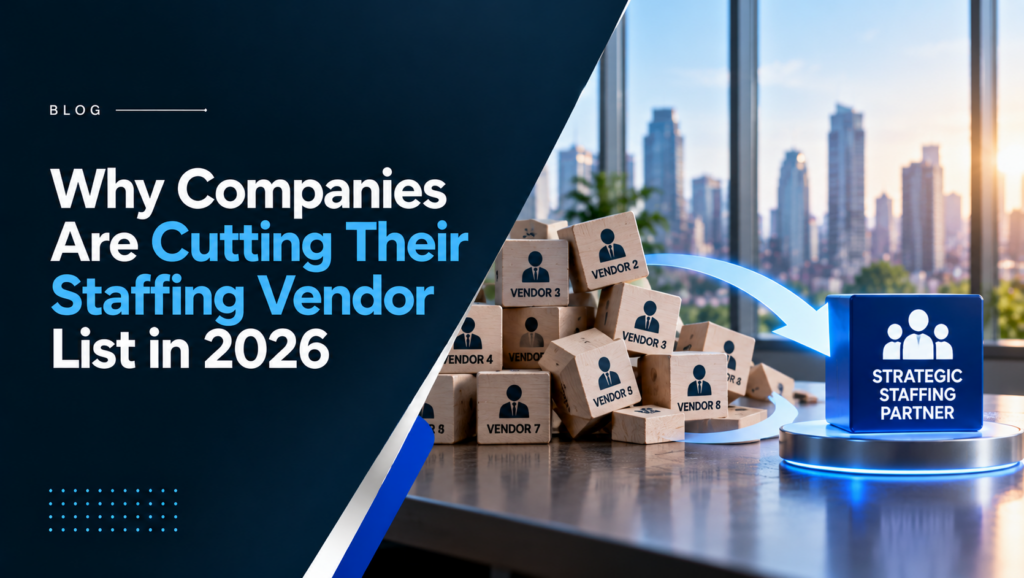
Companies are trimming their staffing vendor list from 8–12 partners down to just 3–4. This shift is not about saving money for one quarter it is becoming the standard way large and mid-sized companies hire. The core issue is coordination, not quality: too many vendors create too many reports, too many contacts, and too little accountability. Full-service partners who cover several hiring needs at once such as recruitment process outsourcing are the ones picking up this business.
A Hiring Setup That Grew Without a Plan
Most companies never sat down and designed their staffing vendor list on purpose. It built up over time, decision by decision, without anyone stepping back to look at the whole picture. A tech role opened, so an IT-focused agency got added. A hospital contract needed nurses, so a healthcare recruiter joined the list. A leadership vacancy came up, so an executive search firm got a call. A seasonal spike needed 150 warehouse workers fast, so a bulk-hiring agency was brought in too.
None of these decisions were wrong on their own. Each one solved a real, immediate problem at the time it was made. But add them up over two or three years, and a company that believes it has “a hiring process” actually has eight or ten separate ones, each run by a different outside partner with its own habits, its own paperwork, and its own idea of what good communication looks like.
In 2026, HR leaders are finally looking at this list as a whole instead of one vendor at a time and most of them don’t like what they see when they do. The list that once felt like flexibility now feels like fragmentation.
The Cost That Never Shows Up on an Invoice
A long vendor list doesn’t fail because any single agency is bad at its job. It fails because of what happens in between them in the gaps that no single vendor is responsible for filling.
Every Vendor Needs a Babysitter
Each agency needs someone internally to explain the company’s standards, answer their questions, track their progress, and check their invoices. Ten vendors means ten separate relationships to maintain, and that work eats into time that should go toward actual hiring decisions rather than vendor administration.
No Two Reports Look the Same
One agency sends a spreadsheet. Another sends a PDF once a month. A third calls and expects someone to take notes. Without a shared format, comparing vendor performance becomes guesswork rather than a real evaluation, and leadership ends up making decisions on incomplete or inconsistent information.
Blame Spreads, Ownership Disappears
When a role stays open too long and leadership asks why, a company with six different vendors involved often gets six different explanations, and none of them add up to a clear answer. Each vendor handled their small piece. Nobody owns the result, and nobody feels responsible for fixing the pattern going forward.
Contracts Multiply Quietly
Every agency has its own fee structure flat fee, percentage of salary, or monthly retainer. Reconciling ten different billing models, and renegotiating each one as market rates shift, becomes its own hidden expense that rarely gets tracked properly until someone finally audits total vendor spend and finds the real number.
What the Shift Actually Looks Like
| Factor | Many Specialist Vendors | Few Broad Partners |
| Contacts to manage | 6 to 10 | 1 to 2 |
| Reporting style | Different from every vendor | One shared format |
| Accountability | Easy to deflect | Owned by one partner |
| Setup effort | Repeated for each new vendor | Done once |
| Contract terms | Multiple, inconsistent | Simplified |
| When something breaks | Vendors point elsewhere | One partner responds |
Seen side by side, this isn’t really a trend. It’s a company fixing a structural flaw it built for itself, one vendor at a time, without ever intending to.
The New Question HR Leaders Are Asking
The old question was, “who is the best specialist for this one hiring category?” The new question is different: “can one partner reliably cover most of what we need, without us managing five separate relationships to get there?”
This is exactly the gap that recruitment process outsourcing is built to close putting hiring across multiple departments under a single accountable structure instead of splitting it across disconnected agencies. Companies comparing a managed service provider setup against direct staffing are asking the same thing in a different form: not which model is cheaper, but which one removes the daily burden of running too many vendor relationships at once.
Warning Signs a Company Has Outgrown Its Vendor List
A few patterns tend to show up right before a company decides it’s time to consolidate:
- No one can say, without checking several inboxes, how many roles each vendor is actively working
- Hiring managers start contacting their own preferred agencies directly, bypassing HR entirely
- A hiring performance report takes longer to compile than the hiring itself
- Vendor invoices describe the same service using completely different terms
- A role fills late, and there’s real confusion about which vendor was responsible
These are the same patterns companies mention when explaining why they eventually chose to outsource their recruitment process instead of adding yet another vendor to an already crowded list. It’s rarely one big failure. It’s a small friction piling up until it costs more than anyone expected, and by the time it’s noticed, the list has already grown too large to manage casually.
Why Broader Partners Are Winning This Business
A vendor that only covers one category forces a company to keep most of its old list just to cover the gaps around it. A partner with real range removes that need almost entirely, and that’s precisely why full-service staffing partners are gaining ground this year.
Get Workz has built its model around this kind of breadth, covering IT recruitment, healthcare staffing, and executive search under one roof, alongside bulk hiring, accounting and finance roles, and BPO recruitment. For companies with global teams, overseas hiring support covers the international piece too. For a company trying to move from ten vendors to three, this kind of coverage is what actually makes the math work one relationship replacing what used to take five or six, with none of the reporting confusion that came with the old setup.
How Companies Are Making the Switch
The cleanup doesn’t need to happen overnight, and most companies that go through it don’t try to fix everything at once. They work through it in stages instead.
They start by auditing which vendors are actually being used some haven’t filled a role in months and are just sitting on the list out of habit, still receiving occasional emails but adding no real value. Next, they map every hiring category against the vendors covering it, which usually shows heavy overlap and easy cuts right away. Then they check whether a broader partner can absorb several of those categories at once, rather than replacing one narrow specialist with another narrow specialist. Finally, they start with whichever vendor relationship causes the most friction, the one generating the most confusion or the most missed deadlines rather than trying to fix everything at the same time.
Companies deciding if now is the right moment can review how to choose the right RPO partner or the signs that a company needs an RPO partner right now before making any
Final Thought
For years, the belief was that more vendors meant more safety. What has become clear in 2026 is closer to the opposite: more vendors usually means more coordination cost and less clarity about who is actually responsible for results. Fewer, broader partnerships are winning because they fix a problem the old model created in the first place, not because they are trendy.
Ready to Simplify Your Hiring Partnerships?
Companies rethinking how many staffing partners they actually need can start by mapping their current vendor list against their real hiring categories that one exercise usually makes the next step obvious.
FAQs About Staffing Vendor List in 2026
1. Why are companies reducing staffing vendors instead of adding more?
More vendors used to mean more coverage. In practice, it created more coordination work, inconsistent reporting, and unclear accountability without actually improving hiring outcomes.
2. Does using fewer vendors mean less hiring coverage?
Not if the remaining partners have broad enough capability. A full-service partner covering multiple hiring categories can replace several narrow specialists at once.
3. What is usually the first vendor a company replaces?
Typically the one causing the most reporting confusion or the most missed deadlines not necessarily the most expensive one.
4. Is this shift only for large enterprises?
No. Mid-sized companies feel vendor sprawl the most, since they often lack a dedicated team to manage many separate agency relationships.
5. How long does a typical vendor consolidation take?
Most companies phase it in over a few months rather than switching all at once, starting with the highest-friction vendor first and expanding from there.