
Quick Summary
High-volume hiring is about making hires for many positions in a short amount of time without compromising on the quality of the candidates. This is important in retail, health care, BPO, and other sectors where there is continuous need for talent due to growth and high turnover rates. In 2026, with the challenge of tighter budgets and skill gaps prevailing, structured recruitment becomes more necessary than ever before. The people who benefit the most from this are the human resource managers and chief human resource officers since they face the challenge of filling their talent pipelines.
Get Workz can help in that with Bulk Hiring Solutions and Recruitment Process Outsourcing, based on tips provided in 12 Smart Candidate Sourcing Strategies to Hire Better Talent in 2026.
Recruitment teams working in the current market environment in 2026 face contradictory trends. While job vacancies stay high compared to other times in history, the pace of hiring slows down, and skills shortages exist alongside lay-offs becoming headline news for certain industries. When an organization grows its business, launches seasonal initiatives, or opens new facilities, it finds that high-volume hiring becomes the most difficult challenge for the recruitment team. Hiring a large number of people in a short period is much more complex than hiring additional recruiters. Those companies that try to handle high-volume hiring just as any other recruitment process face slower time-to-fill and higher early turnover. This guide explains all the details related to high-volume hiring, the importance of this process in 2026, and best practices to help HR managers hire successfully on a large scale.
What Is High-Volume Hiring?
High-volume recruitment is a form of recruitment where there is the recruitment of many applicants who have similar job positions in a short time period. This is contrary to regular recruitment, whereby the recruitment of an individual applicant for every single job position is done manually.
Why High-Volume Hiring Matters in 2026
High-volume hiring is relevant in 2026 because the labor market is characterized by both shortages and a slow pace. In February 2026, the number of job vacancies in the United States reached 6.9 million; however, the hire rate dropped to only 3.1%, the lowest number since April 2020 (U.S. Bureau of Labor Statistics). Meanwhile, according to the 2025 SHRM benchmarking data, average time-to-fill increased from 33 days in 2021 to about 44 days in 2025, and the average cost of hiring per person is approximately $4,700–$4,800. For companies hiring in large volumes, such data accumulate very fast: A slow manual process increasing hiring time by several days can make the whole seasonal launch impossible.
The second frequently asked question concerns the difference between high-volume hiring and mass hiring. There are many similarities between them, but high-volume hiring usually implies having a certain capacity, whereas mass hiring means a one-time activity, like launching a new facility.
Best Practices for High-Volume Hiring
In order for recruitment to be scaled effectively, some techniques are required to determine the difference between a recruiting team that is functioning effectively and a recruiting team that is overwhelmed. These techniques are concerned with the areas in which large-scale recruiting often fails.
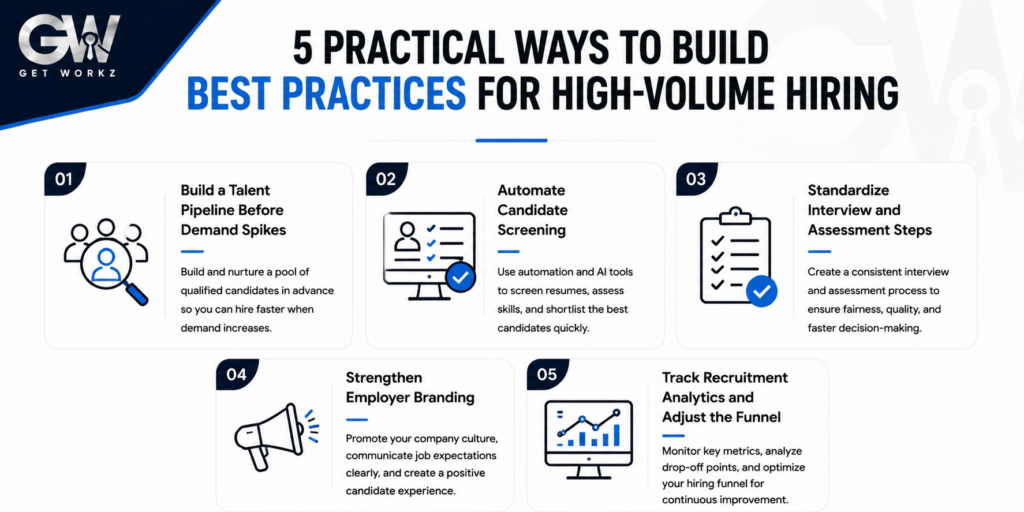
1. Build a Talent Pipeline Before Demand Spikes
Being dependent on waiting for a position to become available before commencing the recruitment process is the major reason behind inefficient hiring practices. Those organizations that keep a warm candidate pool that is continuously being updated with new contacts can begin hiring within days and not weeks. Our Building a Future-Ready Workforce Strategy for Staffing Firms and Employers in 2026 guide explains how to predict demand.
2. Automate Candidate Screening
Scouring through all those resumes manually can drain your recruiting staff dry quicker than anything else and leave you with some top prospects having walked away thanks to the slower pace. Automated resume screening and preliminary pre-qualification, discussed further in How AI in Recruitment Is Reshaping Modern Staffing Infrastructure in 2026, will help your recruiters to concentrate on the final assessment phase only.
3. Standardize Interview and Assessment Steps
Volume interviewing remains both fair and efficient only if all applicants go through the same process of interviews and testing. The process ensures objectivity, saves time on decision-making, and allows for better comparison among numerous applicants.
4. Strengthen Employer Branding
Weak employer branding will hinder the recruitment process of recruiting at all stages because candidates will leave the process due to their uncertainty about it. Good job descriptions, timely responses, and clear job expectations can help avoid last-minute drop-outs from the recruitment process.
5. Track Recruitment Analytics and Adjust the Funnel
Time to fill, cost per hire, and offer acceptance rate must be analyzed on a constant basis instead of quarterly during high-volume recruitment efforts. Real-time analysis of drop-off at the different stages of the funnel allows addressing any problems, like scheduling delays, that could jeopardize overall recruiting effort.
High-Volume Hiring vs Traditional Recruitment
| Hiring Aspect | High-Volume Hiring | Traditional Hiring |
| Speed | Days to a few weeks per cohort | Weeks to over a month per role |
| Candidate Volume | Dozens to hundreds simultaneously | One role at a time |
| Automation | Heavy use of screening and scheduling tools | Largely manual review |
| Recruiter Workload | Process-driven, shared across a funnel | Individually managed per requisition |
| Cost per Hire | Lower per hire through shared process | Higher per hire on average (SHRM) |
| Scalability | Built to flex with demand | Difficult to scale quickly |
Source: SHRM 2025 Benchmarking.
Hiring Statistics to Know (2025–2026)
| Metric | Latest Statistic | Verified Source |
| Average time-to-fill | ~44 days (up from 33 days in 2021) | SHRM 2025 Benchmarking |
| U.S. hires rate | 3.1% – lowest since April 2020 | U.S. BLS, Feb 2026 JOLTS |
| Average cost per hire | $4,700–$4,800 | SHRM |
| Candidates who disengage from slow processes | 57% of job seekers | SHRM |
High-Volume Hiring Workflow
Hiring Demand → Workforce Planning → Candidate Sourcing → Automated Screening → Interview Scheduling → Assessment → Selection → Offer → Onboarding
Common High-Volume Hiring Mistakes
| Mistake | How to Fix It |
| Reactive sourcing after a role opens | Build pipelines before demand hits |
| Manual screening at scale | Automate resume triage and pre-qualification |
| Inconsistent interview steps | Standardize scorecards across the funnel |
| Ignoring funnel data | Review analytics weekly, not quarterly |
| Weak employer branding | Clarify job posts and respond faster |
| No outsourcing support at peak demand | Bring in RPO to absorb surges |
Conclusion
Hiring in high volumes in 2026 will favor firms that look at the process as a repeatable operational model, as opposed to an unpredictable activity. Pipelining, automation, and analytics are all what differentiate groups that have succeeded in meeting their hiring objectives from groups that have yet to reach these objectives. As seen from our previous analysis of Why India Is the Preferred Destination for Recruitment Process Outsourcing, many organizations today use a combination of their own in-house hiring department along with outsourcing vendors to meet the need of hiring in high volumes without increasing staffing levels.
Scaling your hiring in 2026?
Get Workz provides HR services to companies in the US, Canada, India, and APAC with respect to high-volume hiring. Our services range from Bulk Hiring Solutions to Recruitment Process Outsourcing. Regardless of what your requirements are, Get Workz can come up with a suitable hiring strategy for your business.
FAQs About High-Volume Hiring
1. What is high-volume hiring?
Bulk Hiring refers to the practice of sourcing and evaluating a high number of individuals for similar positions, but within a shorter time frame. This can be achieved through automating the process, making it repeatable.
2. How does AI improve high-volume hiring?
Recruitment through Artificial Intelligence enhances high-volume recruitment because of automation of resume screening, candidate selection, and interview scheduling, among others, reducing the manual effort involved as well as time-to-fill.
3. When should a business consider outsourcing bulk hiring?
Businesses should consider outsourcing bulk hiring when internal recruiting capacity can’t match demand – such as during seasonal peaks, new facility launches, or rapid geographic expansion – without permanently expanding headcount.
4. Why should businesses choose Get Workz for High-Volume Hiring?
Get Workz makes it easier for firms to handle mass recruiting by providing scalable recruitment solutions, efficient sourcing of candidates, effective screening procedures, and a faster hiring process. If you have rapid growth or need to hire for temporary or seasonal work, we can help you with our experienced recruiters to source quality candidates.