
Quick Summary
However, today’s use of AI in recruitment encompasses all the stages, including sourcing, screening, and scheduling, but only proper governance can ensure ethical AI usage. Here, we explore all the potential problems, including bias, black-box decisions, lack of candidate data protection, and measures that can mitigate them: human oversight, bias testing, transparency in communication, and proper accountability. For a practical example of how such an approach works, check How AI in Recruitment Is Transforming Modern Staffing Infrastructure in 2026, which outlines what lies ahead for the technology. Companies that plan to integrate all the above measures in the recruitment process from the very beginning often start with the help of an RPO.
Why Ethical AI in Recruitment Matters More Than Ever
Recently, an average-sized healthcare recruitment team found out something very strange: their resume screening tool powered by AI began to negatively rank resumes with employment gaps, despite there being no such requirement. The algorithm learned this particular pattern based on previous hires’ data. This is the kind of AI in recruitment that most HR executives will find out when they face discrimination charges or trust issues raised by candidates.
Recruitment teams operate under huge pressure to make hires quicker and in higher numbers. AI makes that easier and more efficient but it can also create vulnerabilities for companies if not handled properly lack of explainability of some decisions, security threats related to unsecured candidate data, and decisions that can be challenged and potentially lead to bad PR. According to the 2026 State of AI in HR report by SHRM, nearly 27% of organizations today utilize AI in their recruitment process, but at the same time, other research suggests that only 25% of applicants believe it can be fair enough to consider their application.
What Is AI in Recruitment?
AI in Recruitment is all about using software that helps, but does not replace, recruiters in candidate sourcing, resume screening, matching, scheduling interviews, communicating with candidates, and workforce analytics. The program detects patterns in data and helps perform recurring tasks. It is important to understand that help is not the same as making a decision autonomously: an outcome in the hiring process involves human involvement.
What Does Ethical AI in Recruitment Mean?
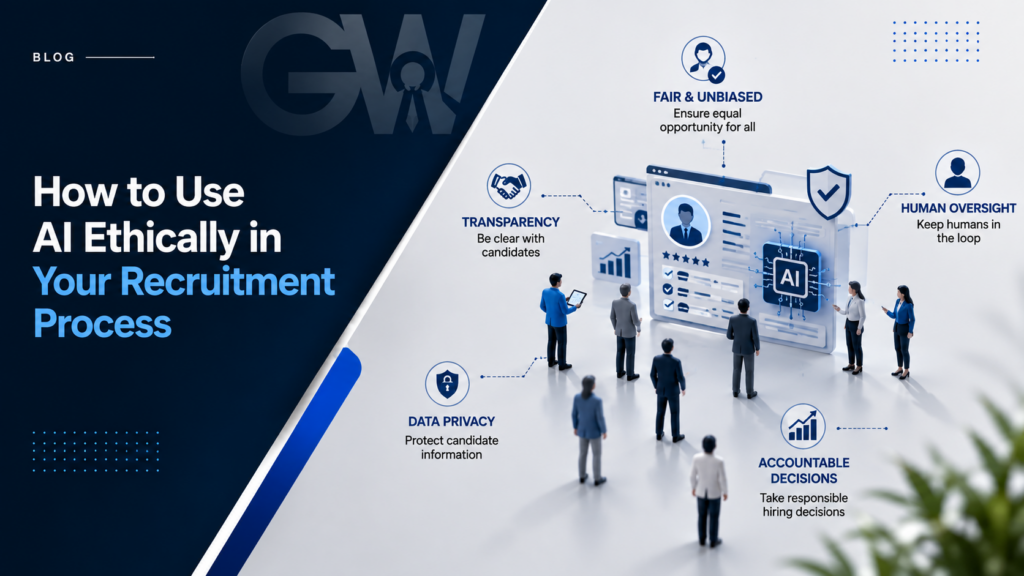
Efficient use of AI implies the fact that it saves time. Ethical use of AI, on the other hand, implies the fact that the organization will be able to justify, clarify, and correct its actions. This is possible based on several guiding principles such as fairness in the scoring of candidates, transparency in the use of AI technology, accountability for the final decision, privacy concerning the storage and sharing of candidate information, and finally, the person who can override the process. However, all of these principles cannot be ensured by the software itself; they are provided by the organization.
Where the Real Risks Sit – and How to Manage Them
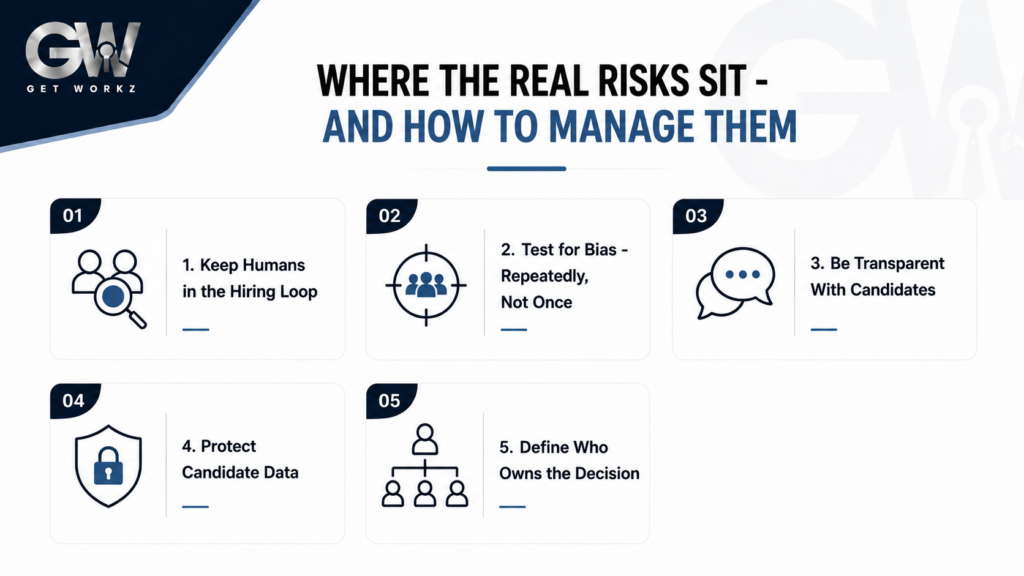
1. Keep Humans in the Hiring Loop
An AI recommendation cannot be used as the basis for the recruitment decision automatically. In cases where the AI screening program rates and screens applicants, it should be the responsibility of the recruiter to go through the applicants who seem to fit into the margin and detect any discriminatory patterns in order to make the final decision. Otherwise, AI in the recruitment process silently transforms itself from a supporting role to that of a decision-maker.
2. Test for Bias – Repeatedly, Not Once
Exclusion of names, gender, or age will not help avoid discrimination, since other features such as zip code, school, time between jobs, or resume language could serve as substitutes for protected information. A tool tested for bias upon its development could still change with changes in candidate pools and job requirements, which is why testing should be regular and not just done once. When developing a sourcing strategy, an organization could use the structured methods suggested in 12 Smart Candidate Sourcing Strategies to Hire Better Talent in 2026.
3. Be Transparent With Candidates
It has become common for candidates to be told whether or not an AI system plays a role in the screening, interviewing, and evaluation process of their application. The obligations for transparency in terms of disclosure will depend on the jurisdictions – what will be required in the EU is different from the US or India so employers operating in multiple jurisdictions must approach transparency as an issue of compliance, not simply good manners.
4. Protect Candidate Data
Any AI recruiting tool deals with data about candidates, and it is essential for the organization to know how the vendor handles its collection, storage, and reuse, even to what extent it uses resumes and/or interview data to build its model. The same issue is important for both internal tools and outsourcing, and when there are multiple vendors and tools used in the process, then it is in MSP and VMS Support where the data flow will be standardized and analyzed.
5. Define Who Owns the Decision
“The AI recommended the decision” is not an accountability structure. There should be someone – generally a designated HR/TA executive, supported by legal and IT who takes responsibility for the use of a specific AI application. Without that someone, bias checks and complaints from candidates will slip through departmental cracks.
Where AI Can Be Used Safely in Recruitment
Low-risk, administrative uses of AI carry far less exposure than uses that directly determine who advances or gets rejected. The table below draws that line.
| Recruitment Activity | Risk Level | Human Control Needed |
| Candidate sourcing | Low | Spot-check reach and diversity of results |
| Interview scheduling | Low | Minimal – confirm accuracy |
| Resume screening / ranking | High | Recruiter reviews before any rejection |
| Candidate matching | Medium | Recruiter validates fit, not just score |
| Recruitment analytics | Low–Medium | Check for skewed or incomplete data |
Common Mistakes to Avoid
● Viewing an AI’s rankings as the last call rather than one of many calls.
● Utilizing historical data from hiring to train or fine-tune the recruitment technology without first ensuring there is no inherent bias in it.
● Selecting recruitment software that has certain automated processes but not understanding what data it uses and how.
● Rolling out without a monitoring system that would indicate whether any bias is present.
Conclusion
AI in hiring can make the process more efficient, scalable, and productive for the recruiter, although the ethical use of this innovation rests with how it is governed. There should be human governance, bias testing, transparent workflow, and candidate data control in order for the process to remain efficient without sacrificing its ethicality. In light of the increasing number of hires to be made, the concepts discussed in Building a Future-Ready Workforce Strategy for Staffing Firms and Employers in 2026 become more relevant.
Talk to Get Workz
If you are looking at the use of artificial intelligence in recruitment and aiming to increase the efficiency of hiring without losing the aspects of equality, transparency, and candidate experience, then Get Workz will be able to analyze your current recruiting process.
Whether it’s a single stage in the recruiting process or the whole pipeline that you need to automate with the help of Recruitment Process Outsourcing, a good solution begins with recognizing where automation makes sense and where human recruiters are needed.
FAQs About AI in Recruitment
1. Can AI be used ethically in recruitment?
Yes. Artificial intelligence can be used in recruitment in an ethical way as long as there is a combination of the technology with human intervention. The trick here is not on what technology to use, but rather how to use it.
2. Can AI reduce hiring bias?
When AI is properly designed, tested, and audited for biases, it can be effective in reducing some types of hiring biases. Nevertheless, AI that was developed using biased historical hiring data will replicate the same biases.
3. Should AI make the final hiring decision?
Properly designed, tested, and audited AI will be effective in mitigating hiring biases. However, any AI program that has been designed based on biased historical hiring data will carry forward the same biases.
4. Why Choose Get Workz for AI-Supported Recruitment?
Get Workz leverages recruitment know-how together with scalable workflows through technology to assist firms with sourcing, scr eening, and hiring processes. The Get Workz recruitment offerings can assist firms that wish to achieve scalability in their hiring while still including human recruitment professionals at crucial points.