Quick Summary
Hiring the right talent is one of the biggest challenges businesses face in 2026. Many companies struggle to decide whether they should work with a recruitment agency or choose Recruitment Process Outsourcing (RPO). While both hiring models help businesses find talent, they work in very different ways.
A recruitment agency focuses on filling specific positions quickly. An RPO partner, on the other hand, manages part or all of your recruitment process and acts as an extension of your internal hiring team.
In this guide, we’ll compare Recruitment Agency vs RPO, including costs, scalability, hiring efficiency, and long-term business value. This will help you choose the right hiring model for your organization.
Why Choosing the Right Hiring Model Matters in 2026
Hiring in 2026 is not only about filling open positions but creating a talent acquisition process that can be scaled according to business needs. In light of the existing talent shortage, rising costs of recruiting, and growing competition in the market, it is necessary to have an effective recruiting strategy.
Businesses across the world are facing longer hiring cycles and rising recruitment costs.
Some significant trends that are influencing recruitment today include:
1. Shortage of Talent:
The current competition for talent is intense because employers compete for a finite source of talent, mainly in sectors such as IT and healthcare.
2. Remote Recruitment:
Employers are looking outside their geographic boundaries when recruiting, thus increasing access to talent while at the same time making recruitment more complicated.
3. The Role of Employer Brand:
Employer branding has a positive impact on recruitment by improving recruitment results and decreasing costs.
4. The Use of Recruitment Technology:
This entails AI-based candidate sourcing, ATSs, and recruitment analytics.
As the demand for recruitment increases, firms have to determine if the conventional recruitment service offered by recruiting agencies is enough or if there is a need for a more strategic approach, such as RPO.
Choosing the correct recruitment model will help in achieving lower cost-per-hire, high-quality hires, employer branding, and scalability of the recruitment process.
What Is a Recruitment Agency?
Recruitment agencies, which are also known as staffing agencies or headhunters, serve as a middleman between employers and potential job applicants. They listen to your requirements for a specific position, search their database and network, and introduce potential candidates to you.
Fee structure explanation:
1. Contingency fee:
15%-25% of the total compensation of the placed candidate as a percentage of one year’s annual salary; this is paid only when there is success in placing the candidate.
2. Retained search:
Retainer fee (30%-35% of annual salary) spread across key milestones; this is generally applied in case of hiring for an executive position.
3. Contract staffing:
Markup on the contractor’s hourly/daily rate, generally 20%-40%.
Agencies work best when the requirement is specific, urgent, and narrow. Recruitment agencies are ideal for filling specialized or hard-to-find roles quickly.
Recruitment Agency Services When They Fit the Scenario
There are specific situations where calling an agency is the right call:
1. Executive Search:
C-suite and VP-level hires where relationships and discretion matter. A retained executive search firm has the networks and gravitas that a volume RPO partner may not.
2. Niche Technical Roles:
A highly specialized cybersecurity architect or a rare regulatory affairs expert – roles where a specialist agency’s candidate database is genuinely valuable.
3. One-off or Low-frequency Hiring:
If you hire fewer than 10 people per year, the economics of RPO may not justify the setup investment.
4. Urgent Vacancies:
A key engineer resigned with two weeks’ notice. You need someone now, not in 90 days
Example:
A Series A SaaS startup in Austin needs a VP of Engineering with experience in HIPAA- compliant architecture. They have one shot to get it right. A specialized tech executive search firm charging a 25% retained fee makes complete sense – the hire is strategic, one-time, and requires deep network access.
What is Recruitment Process Outsourcing (RPO)?
The RPO model refers to the process of subcontracting all or a portion of the company’s recruitment process to an external recruitment service provider.
The role of the RPO service provider will not only be limited to taking care of the open positions, but he would also become the recruitment team for the company and serve as a representative of the company regarding its branding and processes.
Based on the stats revealed by Everest Group, the global RPO market witnessed a growth in the CAGR rate of 15% in 2024-25, owing to the demand for RPO services from organizations located in the US, UK, India, and Global businesses to boost their recruitment process without adding headcounts in HR.
Core Features of Modern RPO Services
1. End-to-End Talent Acquisition & Candidate Sourcing
Comprehensive sourcing through job boards, LinkedIn, employee referrals, talent communities, and passive candidate networks to build a strong talent pipeline.
2. Candidate Screening & Assessment
Structured interviews, skills assessments, and role-specific evaluations that improve hiring accuracy and quality of hire.
3. Interview Management & Coordination
End-to-end interview scheduling, candidate communication, and stakeholder coordination to reduce administrative workload and improve hiring efficiency.
4. ATS Management & Recruitment Technology
Management and optimization of Applicant Tracking Systems (ATS) such as Workday, Greenhouse, Lever, and Taleo for streamlined recruitment operations.
Recruitment Agency vs RPO: Side-by-Side Comparison
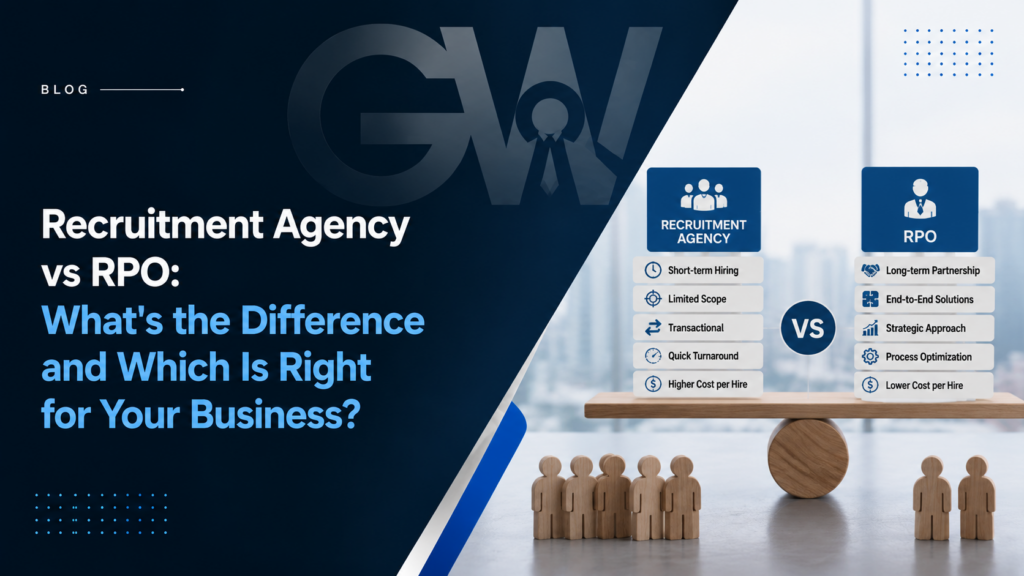
Both recruitment agencies and RPO providers help companies hire talent. However, their approach, pricing model, scalability, and long-term value are very different.
The table below highlights the major differences between the two hiring models.
| Criteria | Recruitment Agency | RPO Partner (Recruitment Process Outsourcing) |
| Engagement Model | Transaction-based, focused on individual placements | Strategic partnership managing part or all of the recruitment process |
| Cost Per Hire | Typically, 15–25% of annual salary per hire | Lower long-term cost-per-hire through fixed, project-based, or hybrid pricing models |
| Time-to-Fill | Effective for urgent and niche hiring requirements | Optimized for continuous hiring through established talent pipelines |
| Scalability | Limited scalability for large hiring volumes | Highly scalable for bulk hiring and workforce expansion |
| Employer Branding | Limited involvement in employer branding | Actively strengthens employer branding and candidate engagement |
| Candidate Experience | Candidate Experience Varies by recruiter and agency process | Consistent and standardized candidate experience aligned with company values |
| Recruitment Technology | Uses agency-owned sourcing tools and databases | Access to ATS platforms, AI-driven sourcing, recruitment automation, and analytics |
| Reporting & Analytics | Basic hiring reports with limited visibility | Comprehensive recruitment analytics, dashboards, and performance insights |
| Talent Pipeline Ownership | Candidate database remains with the agency | Organization retains ownership of talent pipelines and recruitment data |
| Quality of Hire | Effective for niche and executive-level positions | Improved hiring quality through structured recruitment processes and assessments |
| Long-Term ROI | Costs increase as hiring volume grows | Delivers greater ROI through process optimization and reduced hiring costs over time |
| Best Suited For | One-time, urgent, executive, or specialized hiring needs | Volume hiring, IT recruitment, healthcare staffing, and long-term workforce planning |
RPO Cost vs Recruitment Agency: Which Delivers Better ROI?
When it comes to choosing either a Recruitment Agency or RPO Partner, most companies will base their final decision upon the three major factors of cost, scalability, and ROI. Although recruiting agencies may offer excellent results when recruiting people for single roles, the overall costs tend to skyrocket with increased volumes of hiring.
On the contrary, RPO is specifically designed to minimize hiring costs, increase efficiency, and provide sustainable recruitment.
Consider the following example:
Scenario: A company plans to hire 50 employees annually, with an average salary of $70,000 per hire.
| Cost Factor | Recruitment Agency | RPO Partner |
| Pricing Model | 15–25% placement fee per hire | Cost-per-hire, management fee, or hybrid model |
| Estimated Cost per Hire | $10,500–$17,500 | $1,200–$2,500 |
| Total Recruitment Cost (50 Hires) | $525,000–$875,000 | $60,000–$125,000 |
| Recruitment Technology | Usually not included | ATS, sourcing tools, and analytics included |
| Employer Branding Support | Limited | Included as part of the recruitment strategy |
| Talent Pipeline Development | Agency-owned candidate database | Company-owned talent pipeline |
| Recruitment Analytics | Basic reporting | Real-time dashboards and performance metrics |
| Long-Term Hiring ROI | Declines as hiring volume increases | Improves through process optimization and scale |
Why RPO Delivers Better Long-Term Value
When hiring demand goes up, economic considerations associated with recruiting alter as well. Employers that hire in various departments, regions, or even other countries usually discover that RPO Services help cut the cost of recruiting and increase the success of the hiring process.
The benefits include:
- Lower cost-per-hire when it comes to volume recruiting and regular recruiting efforts
- · Fast time-to-fill thanks to proactive candidate sourcing
- · Better-quality candidates by virtue of systematic recruiting practices
- · Coherent employer brand and consistent candidate experience
- · Access to recruiting technology, ATS software, and recruiting metrics
Recruitment Agency vs RPO for Startups: Which Is the Better Choice?
Hiring is a major factor for all startups because it affects growth, productivity, and cash flow. The best choice for your startup between the Recruitment Agency and the RPO Partner will depend on your hiring needs, growth stage, and objectives in terms of hiring.
1. Early-stage Startups (Pre-seed to Seed)
Early-stage startups are characterized by their focus on hiring a core group that will include the founders, early engineers, product experts, and essential business positions. At this stage, there are no significant hiring needs, which means a Recruitment Agency would be suitable.
Best fit: Recruitment Agency
2. Growth-Stage Startups (Series A to Series B)
With growth, the need for hiring rises in many different areas, such as tech, sales, ops, customer success, and marketing. The process of managing the recruitment process via several different agencies becomes expensive and less effective.
Here comes the time when RPO Services make the most impact.
Ideal fit: RPO Partner
3. Scale-Up & Expansion Stage (Series C and Beyond)
High-growth companies often find themselves in situations where they need to recruit several dozen, perhaps hundreds of employees per year while entering into new markets. At this stage, recruitment is no longer an operational function but a business one.
Best Fit: RPO + Selective Recruitment Agency Partnership
4. Startup Hiring Decision Framework
| Startup Stage | Annual Hiring Volume | Recommended Model |
| Pre-Seed to Seed | 1–10 hires | Recruitment Agency |
| Series A to B | 10–50 hires | RPO Partner |
| Series C and Beyond | 50+ hires | RPO + Specialized Agency Support |
For most startups, the Recruitment Agency vs RPO decision is not about choosing one model forever. It is about selecting the right recruitment solution for your current stage of growth while building a hiring strategy that can scale with the business.
RPO vs Recruitment Agency for Large Companies
For large companies that hire more than 100 employees each year or handle a multi-location/ multi-country workforce, RPO is definitely the smarter option.
According to LinkedIn Talent Solutions, enterprises adopting RPO have been found to have 28% shorter time-to-fill and 22% better satisfaction from hiring managers than agencies-only solutions.Advantages of enterprise RPO are:
Advantages of enterprise RPO are:
- Global talent acquisition that leverages a unified approach to govern the process of recruiting from the US, Canada, India, and Organizations worldwide regions.Global businesses
- The importance of risk management and compliance is especially high in industries such as finance and healthcare that are regulated.
- Workforce planning integration: aligning the strategic vision for many years ahead with the recruiting pipeline.
- VMS integration and MSP management of contingent staffing, alongside permanent recruitment activities.
Future of Recruitment Outsourcing in 2026
There are some developments in RPO that are driven by technology more rapidly than ever before. Below is a list of technologies already implemented by leading RPO partners:
AI-based sourcing & matching: Language models have started sourcing thousands of candidates within seconds, finding people that human recruiters wouldn’t find. Gartner notes that AI-based sourcing leads to an increase in pipeline quality by up to 35%.
- Predictive hiring analytics: Modern machine learning algorithms can predict candidates’ chances to accept the offer, their productivity in 12 months, and their readiness to start working.
- Skills-based hiring: According to the LinkedIn Future of Recruiting 2025 report, 73% of recruiting experts have stated that skills-based hiring is one of the major trends.
- Global talent sourcing platforms: Cross-country candidate sourcing, specifically from North America to India/Global businesses in case of technical positions, is becoming a standard practice.
- Recruitment automation: Scheduling interviews, sending emails to candidates, generating offers, and performing background checks are being fully automated by mature RPO partners.
How Get Workz Helps Businesses Hire Smarter
Get Workz is a professional global recruiting firm that caters to firms around the world, including those in the US, Canada, India, and the APAC regions. Whether you need to hire for a single specialized position or require the development of a whole labor force, our team works as an extension of yours.
We provide comprehensive recruitment outsourcing services ranging from:
| Service | What It Covers | Best For |
| RPO Services | End-to-end recruitment outsourcing, embedded talent teams | Companies hiring 20+ roles per year |
| IT Staffing | Software engineers, DevOps, data, cloud, cybersecurity talent | Tech teams scaling globally |
| Healthcare Staffing | Credentialed nurses, allied health, clinical, and non-clinical roles | US and Canadian healthcare providers |
| Executive Search | C-suite, VP, Director-level retained search | Strategic leadership hires |
| Bulk / Volume Hiring | High-volume campaigns – 50 to 500+ hires | Seasonal expansion, new market entry |
| Overseas Hiring | Cross-border talent acquisition with compliance support | US/Canada sourcing from India and APAC |
| MSP / VMS Solutions | Contingent workforce management, supplier governance | Enterprises with a mixed permanent/contract workforce |
Conclusion
In the comparison of Recruitment Agency VS RPO, depending on the recruiting objectives, either can be selected. Recruitment agencies are ideal for quick and specific requirements, while RPO services offer flexibility and value to handle recruiting needs over an extended period of time.
Choose the Right Hiring Solution for Your Business
The Get Workz recruitment solutions help companies from the USA, Canada, India, and APAC to simplify hiring using services like RPO Services, IT Staffing, Healthcare Staffing, Executive Search, and Bulk Hiring Solutions.
Whether you’re hiring 10 employees or scaling a team across multiple countries, Get Workz provides flexible RPO Services, IT Staffing, Healthcare Staffing, and Executive Search solutions designed to reduce hiring costs and improve recruitment outcomes. Speak with our recruitment experts today and discover the right hiring model for your business.
FAQs About Recruitment Agency vs RPO
1. Is an RPO Partner Better Than a Recruitment Agency for Scaling Businesses?
The choice will depend on the hiring requirements of your company. If you require someone to fill one or more vacancies promptly, then the choice should be made for a recruitment agency. In case your business is constantly facing problems with recruitment and hiring, then an RPO would be the perfect solution for your organization.
2.What Is the Difference Between Recruitment Agency Costs and RPO Costs?
Generally, recruiting firms make their money on the basis of earning a commission on an annual salary percentage basis, which is typically 15%-25%. The RPO pricing structure normally includes cost per hire, management fee, or some combination of the two. The cost-per-hire is much lower using the RPO model when there are ongoing hiring requirements.
3.Why Choose Get Workz as Your RPO Partner?
Get Workz delivers scalable recruitment services that cater to companies in the United States, Canada, India, and APAC. These include everything from RPO and IT staffing services to healthcare recruitment and executive search. Get Workz enables clients to save on hiring costs, enhance time-to-hire metrics, and source qualified candidates by means of a technology-infused recruitment process.
4.When Should a Business Choose an RPO Partner Instead of a Recruitment Agency?
Businesses should consider an RPO partner when they have ongoing hiring needs, rapid growth plans, or require support across multiple roles and departments. Unlike recruitment agencies that focus on filling individual positions, RPO providers help build a scalable recruitment process, improve hiring efficiency, and support long-term workforce planning. For companies hiring regularly throughout the year, RPO often delivers better value and stronger recruitment outcomes.