

Quick Summary
Cost per hire continues to increase, yet trimming back on the wrong aspects of the talent acquisition cycle will only transfer the costs further down the pipeline in the form of poor quality recruits and premature turnover. In reality, waste needs to be stripped out of the recruitment process by tightening job requisitions, focusing on top performing recruiting sources, streamlining administration, and being proactive rather than reactive when making hiring decisions. Employee referral programs, internal mobility, and RPO Recruitment Process Outsourcing can contribute to more predictable recruitment economics.
Why Reducing Recruitment Costs Requires More Than Cutting Spend
Six weeks pass before a hiring manager receives three qualified resumes. A recruiter revises the same job posting twice because the initial version attracted the wrong candidates. A job offer is rejected after four rounds of interviews, and the process begins anew. No one writes off those expenses individually, but each adds much more to cost per hire than any paid job site listing possibly could. With tighter recruitment budgets come the demands to cut costs, but reducing them isn’t always the same thing as maximizing efficiency. Those who understand how to do both know better than to focus on making cost per hire smaller.
What Is Cost Per Hire?
The cost per hire measures the average cost incurred by a firm to recruit one new employee. The measure takes into account both the direct costs (such as advertising and agent fees), and indirect costs (including recruiter and hiring manager’s time). The cost is useful for human resources managers but is only relevant when the costs are measured consistently.
Cost Per Hire = Total Recruitment Costs ÷ Number of Hires
What Counts as a Recruitment Cost?
Companies tend to underreport the cost of recruiting talent. Direct expenses will encompass job postings, recruitment agencies or RPO, recruitment technology services subscription, background checks, and assessment tests. Internal expenses will be represented by recruiter compensation, recruiter and hiring manager’s time, and HR administration. The expenses that can harm the company the most are invisible ones, namely prolonged vacancy periods that reduce team efficiency, multiple interviewing stages, dropping candidates at the later stages of the process, declined offers, and early departures due to a rapid hire. What appears to be a “cheaper” position can turn out to be the most expensive hire in the company’s records.
Why a High Cost Per Hire Isn’t Always a Problem
The high cost per hire is justifiable where there is an executive level of hiring, specialist technical jobs, health care jobs, or where there are geographical limitations to the job search process. The aim is not necessarily to keep cost per hire down at all costs
Practical Ways to Reduce Recruitment Costs
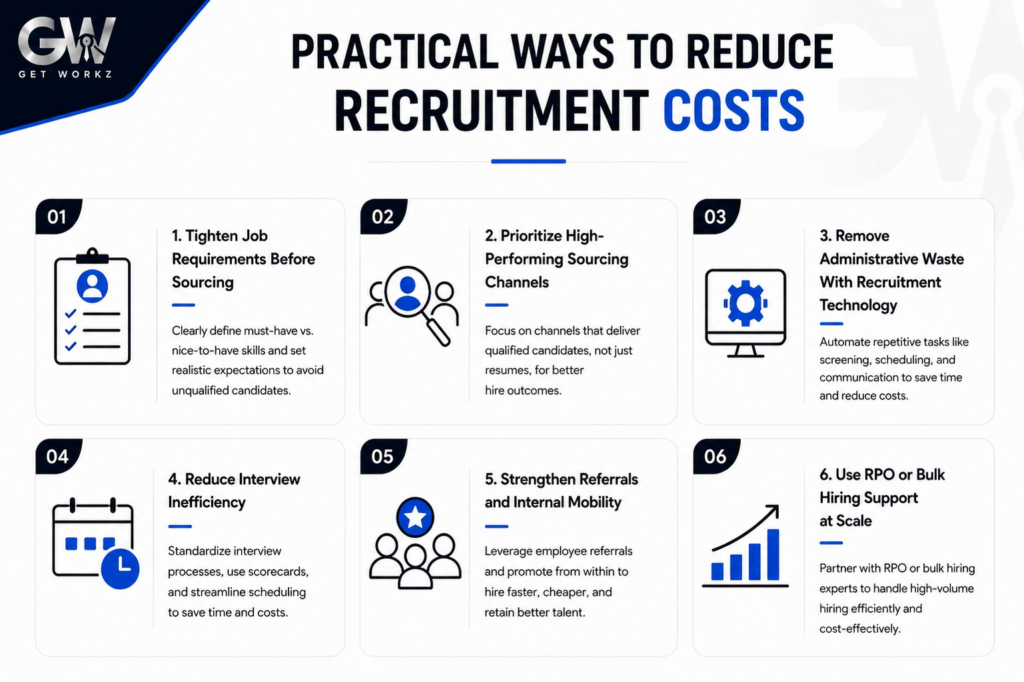
1. Tighten Job Requirements Before Sourcing
Ambiguous job descriptions attract candidates who don’t meet the qualifications and leave the recruiting process to recruiters who have their plates full. Specifying what is essential versus non-essential, creating realistic requirements, and ensuring that the pay is competitive from the outset helps avoid wasted time on recruiting.
2. Prioritize High-Performing Sourcing Channels
All sources of candidates cannot be considered as equally important. Evaluating the cost of recruitment per applicant against the cost of recruiting a qualified candidate not just the cost of hiring a person – reveals channels that deliver hires, not CVs. Get Workz’ guide on 12 Smart Candidate Sourcing Strategies to Hire Better Talent in 2026 can be used as an audit checklist.
3. Remove Administrative Waste With Recruitment Technology
Automated screening, scheduling, and candidate interaction give recruiters time to concentrate on tasks which cannot be accomplished by technology. Get Workz highlights the How AI in Recruitment is Reshaping Modern Staffing Structure in 2026 in order to illustrate where technology helps and where it just moves the bottle neck somewhere else.
4. Reduce Interview Inefficiency
Too many interviews, delays in scheduling, and lack of consistency in scoring create weeks of additional time – and expense – for each open position. Structured interviews using a scorecard and scheduled interviews save time and create consistency in hiring.
5. Strengthen Referrals and Internal Mobility
Employee referrals and internal promotions tend to be faster and cheaper recruitment options compared to purely external recruitment processes. Embedding that within a bigger Building a Future-Ready Workforce Strategy for Staffing Firms and Employers in 2026 ensures that recruitment is proactive rather than reactive.
6. Use RPO or Bulk Hiring Support at Scale
If there is any large-scale or repeat hiring required, it may be possible to overload an internal team. Bulk Hiring Solutions and RPO offer cost predictability in hiring along with scalability in hiring without the necessity of growing the internal team although again, economics depends on hiring volume, position complexity, and geography.
Cost vs. Quality vs. Speed
| Approach | Sourcing | Screening | Likely Outcome |
| Cost-focused | Lowest-cost channel | Minimal | Fast, but higher hiring risk |
| Quality-focused | Premium channels only | Extensive | Thorough, but slow and costly |
| Optimized | Best-performing channel | Risk-based | Balanced cost, quality, and speed |
What Recent Benchmarking Data Shows
Current benchmarking by SHRM reveals that median non-executive hiring cost per hire is about $1,200 while the median cost per hire for executives is about $10,625 with the time taken for filling up of non-executive positions being about 39 days. While the above numbers change every year, it can be safely used as a measure to remind us that “cost per hire” should be interpreted within the context of position and hiring volumes.
Common Mistakes That Drive Costs Back Up
- Selecting the most economical recruiting channel without evaluating candidate suitability
- Reducing recruiting staff without changing the volume of recruitment
- Eliminating screenings rather than optimizing them
- Conducting additional interviews “just in case”
- Focusing on only cost per hire, without considering time to fill and retention
- Working with staffing agencies without evaluating their performance
- Recruiting reactively rather than planning workforce requirements in advance
Conclusion
It does not have to be at the expense of recruiting in order to lower recruitment costs. What needs to be done is to find out where and what processes waste time, money, and hiring budget, and optimize them to make sure that no unnecessary costs are incurred without compromising on the caliber of candidates. From improved recruitment to the use of recruitment technology and even outsourcing of recruitment processes, everything counts.
Reduce Your Recruitment Costs with Get Workz
If you wish to reduce your cost per hire while ensuring that you do not compromise on the quality of hires, Get Workz can help. We help organizations simplify their hiring process through hiring and Recruitment Process Outsourcing solutions. Reach out to us to assess your hiring process and increase efficiency.
FAQs About Cost Per Hire and Recruitment Costs
1. What is the cost per hire?
Cost Per Hire is a metric that shows the total amount spent on recruiting and hiring someone. This metric takes into account salaries of recruiters, job ads, recruiting software, fees, evaluations, background checks, and other expenses. The Cost Per Hire allows businesses to optimize their spending without reducing their hiring quality.
2. How can companies reduce recruitment costs?
Organizations can cut down on their recruiting costs through improved job descriptions, effective channels for sourcing talent, employee referrals, automation of tedious recruiting processes, minimal rounds of interviews, and analysis of hiring data. The objective is to eliminate inefficiencies in the process without compromising the quality of candidates recruited.
3. Does reducing Cost Per Hire affect hiring quality?
Decreasing Cost Per Hire does not automatically mean lowering the quality of hiring if the reduction is due to the elimination of wasteful processes. Organizations must be careful not to eliminate important aspects of screening, evaluation, or sourcing. They need to ensure that their recruiting process flows effectively.
4. How can Get Workz help reduce recruitment costs?
Get Workz provides companies with opportunities to improve their recruitment by providing such tools as Recruitment Process Outsourcing, specific recruitment, and hiring assistance. Through enhanced recruitment sourcing, increased capacity of recruiters, and efficient recruitment processes, companies will be able to manage their recruitment costs more effectively while ensuring good-quality candidates.