Every staffing firm and HR leader is asking the same question this year: does it still make sense to pay a full-time recruiter close to $100K a year, or can a $20K AI agent do the job for a fraction of the cost? The honest answer isn’t as simple as either side wants it to be and getting it wrong is an expensive mistake either way. This isn’t about salary versus subscription price on paper; it’s about what each option actually costs once benefits, tools, quality-of-hire, and turnover are factored in. That distinction matters more than most cost comparisons admit, and it’s exactly where we’ll start.
Why This Comparison Matters Right Now
Recruitment budgets are under more scrutiny than ever in 2026. Hiring costs have climbed, time-to-fill windows have shrunk, and AI recruiting tools have gone from experimental to mainstream almost overnight. For staffing firms and internal talent teams alike, the pressure to cut cost-per-hire without hurting candidate quality is real.
That’s exactly why the AI recruiter vs human recruiter cost debate has become one of the most searched topics in the staffing industry this year. Everyone wants a straight answer before they commit a budget to either side. But most of the numbers floating around online compare a recruiter’s base salary to a software subscription, which isn’t an apples-to-apples comparison. Let’s fix that.
The Real Cost Breakdown (Clarified)
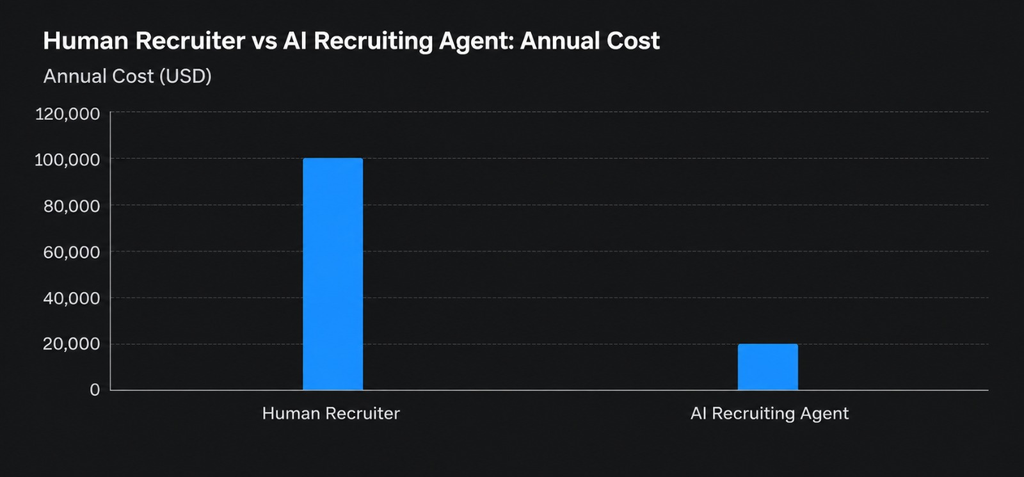
Here’s the part most comparisons get wrong: the “$100K recruiter” figure isn’t a base salary, it’s the fully-loaded cost of employing one. A recruiter’s actual base salary in the US typically runs $65K–$90K. Once you add payroll taxes, benefits, and the recruiting tool stack (ATS access, LinkedIn Recruiter seat, job board subscriptions), the fully-loaded cost climbs to roughly $95K–$130K which is where the “$100K” figure genuinely comes from.
On the AI side, a proper recruiting stack that handles screening, sourcing, and automation typically runs $15K–$30K per year, depending on hiring volume and feature depth so $18K-$20K is a realistic mid-range estimate, not an outlier.
The Real Cost Breakdown” section me Comparison Table
| Factor | Human Recruiter (Fully-Loaded) | AI Recruiting Agent |
| Annual Cost | ~$95K–$130K (base salary $65K–$90K + benefits + tools) | ~$15K–$30K (software + setup) |
| Candidates Screened/Week | 15–25 (manual) | Hundreds (automated) |
| Best For | Senior, executive, technical roles | High-volume, repetitive roles |
| Relationship Building | Strong | Limited |
| Bias Reduction | Depends on training | Consistent (if configured well) |
| Scheduling & Follow-ups | Manual, time-consuming | Instant, automated |
A cheaper tool that fills the wrong roles ends up costing more in turnover and re-hiring than it saves upfront, cost-per-hire only tells half the story if quality-of-hire drops.
What a $100K Recruiter Actually Delivers
A skilled human recruiter brings things AI still can’t replicate:
- Reading between the lines in an interview cultural fit, soft skills, hesitation
- Building long-term relationships with passive candidates
- Negotiating offers and handling counter-offers
- Making judgment calls on ambiguous or senior-level hires
For executive search, healthcare leadership roles, or highly specialized technical hires, this human judgment is often non-negotiable. No AI tool today can fully replace the instinct a seasoned recruiter builds over years of placements.
What a $20K AI Agent Can (and Can’t) Do
AI recruiting tools genuinely excel at:
- Screening thousands of resumes in minutes
- Removing unconscious bias from initial shortlisting
- Automating interview scheduling and follow-ups
- Handling high-volume, repetitive hiring (call centers, warehouse staff, entry-level roles)
Where they still fall short: nuanced judgment calls, candidate relationship-building, and roles where “gut feel” genuinely matters. Our earlier breakdown on how AI is transforming recruitment in 2026 covers exactly which parts of the hiring process AI has actually improved and which parts still need a human.
Where Companies Get This Decision Wrong
The most common mistake isn’t choosing AI or humans, it’s going all-in on one without a plan for the other. Companies that replace their entire recruiting team with automation often see quality-of-hire drop within two quarters, because AI can’t yet handle relationship-heavy or judgment-heavy hiring on its own. Companies that resist AI entirely end up paying full recruiter salaries to do work a tool could handle in seconds screening resumes, scheduling interviews, sending follow-ups.
We’ve seen this play out closely with clients rushing automation without a rollout plan. Our piece on recruitment automation: what to do and what to avoid breaks down the most common rollout mistakes in detail, including where teams over-automate and lose candidate experience quality.
The Hybrid Model: Why Most Winning Staffing Firms Use Both
The firms getting the best results in 2026 aren’t choosing sides; they’re using AI to handle volume (sourcing, screening, scheduling) and freeing up human recruiters to focus on relationship-building, negotiation, and senior hires. This hybrid approach is essentially what a well-run RPO (Recruitment Process Outsourcing) model already does, combining technology and human expertise under one system instead of forcing companies into a binary choice between the two.
If you’re unsure whether your current setup needs this kind of restructuring, these signs indicate it may be time to outsource your recruitment process altogether rather than trying to solve it piecemeal in-house.
So What Should You Actually Choose?
| Hiring Scenario | Recommended Approach |
| High-volume/repetitive roles | AI-first |
| Senior/executive roles | Human-first |
| Growing company, no infra | Hybrid RPO model |
The right answer depends entirely on what you’re hiring for and how much volume you’re managing, not on which option has the lower sticker price.
Need Help Deciding What’s Right for Your Hiring Needs?
Every company’s hiring mix looks different. If you’re weighing whether to build an internal team, adopt AI tools, or bring in an RPO partner that already combines both book a free 15-minute consultation with Get Workz and we’ll map out what actually fits your hiring volume and budge
FAQs About AI Recruiters vs Human Recruiters
1. Is AI cheaper than hiring a recruiter?
Yes, on direct cost. A full AI recruiting stack typically runs $15K–$30K/year, versus $95K–$130K for the fully-loaded cost of an in-house recruiter (salary, benefits, and tools combined). But cost-per-hire also depends on fill rate and quality-of-hire, which AI alone doesn’t always match for senior or specialized roles.
2. Can AI completely replace human recruiters?
Not yet, and not for every role. AI handles high-volume, repetitive hiring well, but human recruiters remain essential for relationship-driven, judgment-heavy hiring like executive search and leadership roles.
3. What’s the best hiring model for growing companies in 2026?
Most growing companies benefit from a hybrid approach using AI for volume and automation, paired with human oversight or an RPO partner for strategic and senior hiring.