Quick Summary
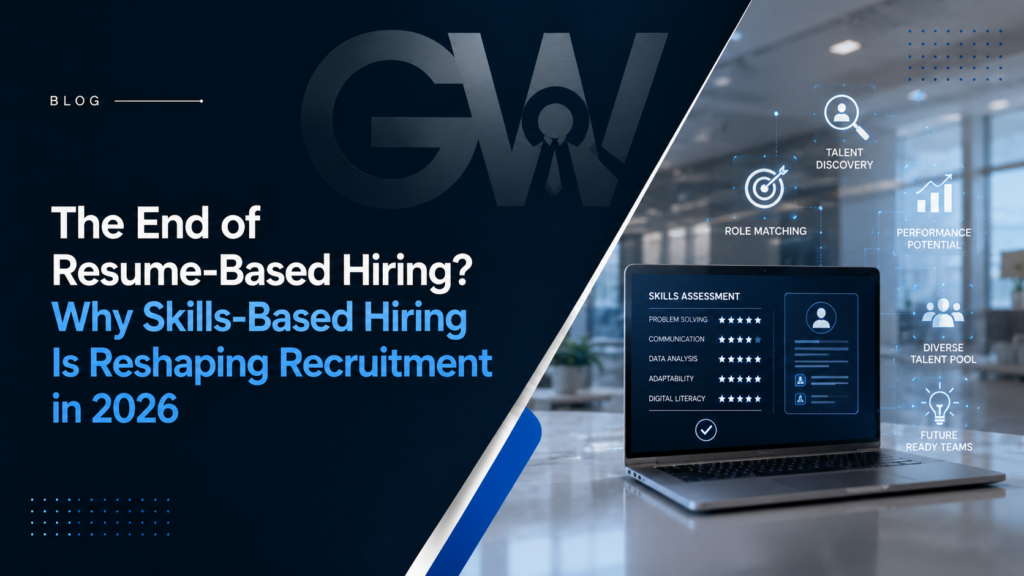
While a resume continues to open the doors for prospective employees, there is no guarantee that they will prove successful in their roles once hired. Indeed, the trend towards skill-based recruitment practices is becoming increasingly popular.
LinkedIn revealed that 85% of employers today consider skills rather than degrees to be the priority in hiring, whereas according to SHRM, the use of skill-based techniques grew from 56% to 73% within a year (SHRM, LinkedIn).
The rise of AI hiring tests is further driving that trend by offering the tools for recruiters to make sure of candidates’ skills in an efficient and consistent manner. While resume scanning isn’t going away completely, it is certainly losing its importance.
Businesses looking to improve hiring efficiency are increasingly partnering with specialized Recruitment Process Outsourcing (RPO) providers to implement skills-first recruitment strategies.
Why Skills-Based Hiring Is Becoming the New Recruitment Standard
Recruitment has gone through more changes in the last three years than in the past two decades. Reasons include the adoption of AI in the process, too many resumes making it impossible to manage the recruitment process, and the rapid change in skills required by most companies compared to training pipelines. Against this background, skills-based recruitment has gone from being a progressive discussion to a necessary step.
According to the SHRM 2026 Talent Trends, the organization has advised firms dealing with a cooling labour market and wider skills gaps to transition from traditional hiring to skill-based, data-driven strategies (SHRM). This advice is not only based on a theory, as SHRM indicates that 69% of organizations find it difficult to recruit people for full-time jobs, and about 4 out of 5 have problems identifying people with certain skills (SHRM).
Furthermore, according to LinkedIn, 85% of firms prioritize skills above degrees in their recruiting processes (LinkedIn). Therefore, the challenge for talent acquisition professionals is to transform how candidates are evaluated.
What is Skills-Based Hiring?
Skill-based hiring is a recruitment strategy whereby individuals are assessed based on their skills and capabilities, which include testing and competency assessment, and not by degrees, job titles, and keywords. This is not to say that the resume is removed, but just that its function is altered.
Organizations adopting this approach often combine skills assessments with professional recruitment support to reduce hiring time and improve candidate quality. This model is especially effective through RPO Services for growing businesses.
Why Traditional Resume Screening Is Losing Relevance
The was developed for an age of hiring long gone and is struggling to cope with current conditions. The SHRM research on how difficult it will be to recruit in 2025 has shown that the classical approach to job advertisement and resume screening process cannot address the current number and level of competition (SHRM). There are three factors contributing to that collapse.
First, resumes can be easily optimized but not verified. Nowadays, candidates have learned how to adapt their resumes to defeat applicant tracking systems, but not how to present their true capabilities. Second, there is a credential inflation that has expanded the distance between what a degree conveys and what a position requires. This factor SHRM has also been identified as one of the reasons why employers begin relaxing their education requirements for positions (SHRM).
Finally, verification has become more complicated because of online hiring. The Gartner study of candidate fraud shows that only 26% of applicants trust AI to give them a fair assessment, which indicates weakening trust in the remote verification process by candidates and recruiters (Gartner).
This does not mean that resumes are useless. They are simply inadequate for the decision-making process anymore.
Why Skills-First Hiring Is Growing Rapidly
1. AI Can Measure Skills More Effectively
Assessment based on structured skills evaluations and AI recruiting technology provides the recruiters with a quick and uniform method of evaluation for qualities that a resume can merely claim. According to Gartner, by 2027, at least 75% of recruitment processes will incorporate certification or evaluation for the knowledge of AI at work, not only in technical jobs but also in general recruiting (Gartner). This would be relevant to an IT Recruitment client where the single technical interview is substituted by an assessment-based exercise, generating an identical score for all applicants.
2. Employers Need Job-Ready Talent
Training budgets are far behind the speed at which job requirements change, and that is why companies require people who can be productive right off the bat. As per SHRM, 54% of businesses cite their growth and 53% the changes in technology as the reason for the emergence of new or modified skill sets among employees (SHRM). Thus, the hiring manager looking to fill a data analytics position is more concerned about the ability of a person to create a dashboard than his or her educational background.
3. Skills Gaps Continue to Increase
The gap between the skills companies need and the skills candidates possess continues to widen. According to SHRM, nearly four out of five organizations struggle to hire professionals with emerging skills. As a result, recruiters take longer to fill open positions unless they redesign their hiring and sourcing strategies around skills and competencies.
4. Remote Hiring Requires Better Assessment
Remote and distributed teams have transformed the hiring process, reducing face-to-face interactions and making structured candidate assessments more important than ever. One industry that stands out in this regard is healthcare Recruitment.
5. Candidate Potential Matters More Than Credentials
Companies concentrating on assessing skill rather than lineage present a larger pool of qualified applicants to draw from. According to SHRM’s 2025 Talent Trends study, 76 percent of companies that scrapped the degree requirement for certain positions have been able to recruit at least one candidate due to the change (SHRM). In the case of the role of accounting outsourcing, this could mean recruiting an experienced bookkeeper who lacks a four-year degree over a graduate without any accounting practice.
How AI Recruitment Supports Skills-First Hiring
AI-based recruiting tools, most commonly offered through AI-based hiring platforms, are the technology framework making skills-based hiring feasible, not an ideal expressed in the careers pages of organizations. Most modern platforms incorporate several critical capabilities:
Skill-based ranking of candidates based on valid skill markers, as opposed to resume-based matching. Skills matching: connecting a candidate’s abilities with the role requirements
- Assessment modules – coding test, simulations, structured work sample
- Automated interview scheduling and increasingly structured interview analysis
- Predictive hiring analytics detecting which combination of skills correlates with job performance
- Hiring analytics dashboards showing time to hire and quality of hire by skills categories instead of source alone
When used effectively, they save recruiters’ time and increase the consistency of evaluation. However, they cannot replace the judgment. According to HR-related research performed by Gartner, the use of AI-based tools without HR participation in the development process results in a low adoption rate and poor alignment between the expectations of employees and executive management (Gartner).
The most efficient application of the tools requires recruiters’ understanding of what makes candidates skilled in a particular position before the tool starts ranking them.
Businesses experiencing rapid growth often combine AI-powered hiring with Bulk Hiring Solutions to manage large-scale recruitment while maintaining candidate quality
The Data Behind the Shift
Chart 1: Employers Prioritizing Skills Over Degrees
| Year | Percentage | Source |
| 2022 | 56% | SHRM |
| Last Year | 73% | SHRM |
| Current | 85% |
The data clearly shows that employers are placing greater importance on verified skills than academic qualifications. This steady increase demonstrates that skills-first hiring is becoming a long-term recruitment strategy rather than a temporary trend.
Chart 2: Top Recruiting & Talent Challenges
| Hiring Challenge | Percentage | Source |
| Difficulty Filling Full-Time Roles | 69% | SHRM |
| Skills Gap Among Qualified Candidates | 80% | SHRM |
| New Skill Requirements from Business Growth | 54% | SHRM |
These hiring challenges explain why recruiters are redesigning their hiring processes. Organizations are investing in skills assessments and AI-powered recruitment to reduce hiring delays and close critical talent gaps.
Chart 3: AI and Candidate Trust in Hiring
| AI Hiring Insight | Percentage | Source |
| Employees Excited to Use AI at Work | 65% | Gartner |
| Candidates Who Trust AI to Evaluate Them Fairly | 26% | Gartner |
| Hiring Processes Expected to Test AI Proficiency by 2027 | 75% | Gartner |
Although organizations continue to invest in AI-powered hiring, candidate trust remains an important factor. Companies that combine AI with human decision-making create a more transparent and reliable recruitment experience.
Chart 4: Outcomes of Removing Degree Requirements
| Outcome | Percentage | Source |
| Organizations That Eliminated Degree Requirements for Some Roles | 27% | SHRM |
| Organizations That Successfully Hired at least One Candidate After Removing Degree Requirements | 76% | SHRM |
Removing unnecessary degree requirements allows employers to access a larger talent pool. Instead of focusing only on academic qualifications, organizations can identify skilled professionals based on their practical abilities and experience.
Practical Framework
A skills-first hiring process generally follows a consistent workflow, regardless of role or industry:
Business Hiring Need
↓
Identify Required Skills
↓
AI Candidate Assessment
↓
Skills Validation
↓
Structured Interview
↓
Real-World Task
↓
Hiring Decision
↓
Continuous Skill Development
Recruitment Trends Shaping 2026
1. AI-Powered Talent Acquisition
Recruiting teams are using artificial intelligence not only as an auxiliary function but as an integral component of the process of recruitment, scheduling, and assessment. The talent acquisition trends for 2026 presented by Gartner state that generative AI, interviewing tools, and recruiting AI agents are the most prospective technologies for changing the role of the recruiter (Gartner).
2. Skills Passports
Dynamic documents that verify an individual’s capabilities, often in relation to testing or certification but not necessarily employment by one particular firm, are being increasingly seen as a replacement for traditional CVs.
3. Internal Mobility
Whereas external recruitment was once the go-to choice for each of these open positions, leading companies are now sourcing candidates internally to fill those roles. This is one of the many findings revealed by LinkedIn’s study of the 2026 Top Companies.
4. Continuous Learning
As required skills shift faster than job descriptions can be rewritten, employers are treating ongoing upskilling as a retention strategy as much as a capability strategy.
Conclusion
The era of resume-based hiring hasn’t ended, but its dominance over the hiring process is definitely fading away rapidly. This trend is evidenced in several ways, including SHRM tracking the increasing adoption of skills-based approaches every year, LinkedIn proving that the vast majority of employers believe that skills outweigh degrees when it comes to recruitment decisions, and Gartner’s findings that the role of AI in testing skills is becoming much more prominent than in filtering out resumes.
For HR executives, the key message is to view skills-based hiring as infrastructure, not as policy, which means building the assessment tools, training recruiters, and leveraging AI for judgment assistance rather than automation.
Ready to Modernize Your Hiring Strategy?
If resume screening continues to play a major role in your hiring, then it’s time you ponder how many good candidates get eliminated before they even meet a real person’s eyes.
Get Workz can assist your organization to incorporate skills-based hiring in its recruiting process through a combination of AI recruitment solutions, candidate evaluation, and Recruitment Process Outsourcing for IT, healthcare, and enterprise hiring.
Regardless of whether your hiring needs consist of one specialized candidate or revamping your entire hiring pipeline, Get Workz can assist you in hiring based on skills rather than credentials.
FAQs About Skills-Based Hiring
1. What is skills-based hiring?
Skills-Based Hiring refers to a form of recruiting that judges applicants based on their proven capabilities as opposed to their degrees or resumes. The process involves carrying out skills assessment or conducting a work simulation in order to determine an individual’s capabilities, and using the information along with the resume in order to make the hiring decision. Both SHRM and LinkedIn consider skills-based hiring among the rapidly growing recruitment practices going into 2026 (SHRM, LinkedIn).
2. Is resume-based hiring becoming outdated?
Resume-based hiring is not going away; however, it is no longer the only means of selection. According to SHRM, the percentage of companies that use skill-based hiring is 73%, which is an increase from just a few years ago, when the number was 56%. The change is that the resumes will be supplemented by skills verification.
3. How does AI recruitment improve hiring?
AI recruiting – which is usually made possible through AI recruiting systems – helps hasten the process of screening, standardizes skills testing, and identifies applicants that could have been overlooked through resume screening based on keywords. Based on Gartner research, more and more businesses today are making use of AI in skill matching and predictive analysis in hiring, although even with the use of such technology, human supervision is still needed, since only 26% of candidates today trust AI in fairly evaluating them (Gartner).
4. What is the difference between skills-based hiring and resume screening?
Screening of the resume is an assessment process carried out using the job titles, keywords, and credentials stated in the document by the applicant himself/herself. Skills-based hiring is a process where applicants are assessed using structured interviews, testing of competencies, and testing of their skills. These two processes are not mutually exclusive; most firms make use of both.