Quick Summary
With the help of AI in recruitment, the process of hiring becomes faster, but there are risks that HR professionals can’t overlook. The use of GenAI in recruitment increased from 27% to 37% in one year (LinkedIn Future of Recruiting 2025).
Cost per hire and time-to-hire were found to be increased by the SHRM 2025 Benchmarking Survey compared to the same period of the previous year (SHRM 2025). These are some of the risks that remain hidden and are included in the following guide.
Why AI Recruitment Demands Greater Attention in 2026
By 2025, the percentage of companies using GenAI in recruitment reached 37%, whereas a year earlier it stood at 27% (LinkedIn Future of Recruiting 2025). The AI-driven recruitment solutions have been widely applied in sourcing, screening, and scheduling in all industries; however, the implementation was not followed by proper governance.
According to the SHRM’s 2025 Benchmarking Survey, both cost-per-hire and time-to-hire have increased during the past three years, and they were associated with increased usage of generative AI (SHRM 2025), implying that AI is not a solution to the problems within the recruiting process. Moreover, only 26% of job candidates think that AI-based recruitment software can fairly evaluate them (Gartner). The absence of faith affects the image of employers negatively.
Additionally, regulation is approaching – the high-risk requirements regarding employment systems introduced by the EU AI Act and scheduled for implementation in August 2026 have been pushed to December 2027 due to the Digital Omnibus agreement (European Commission).
What Is AI Recruitment?
AI Recruitment Solutions uses machine learning, natural language processing, and generative AI for activities like sourcing candidates, evaluating resumes, ranking candidates, and scheduling interviews. It supplements the work of recruiters, not substitutes for them.
Hidden Risks of AI Recruitment
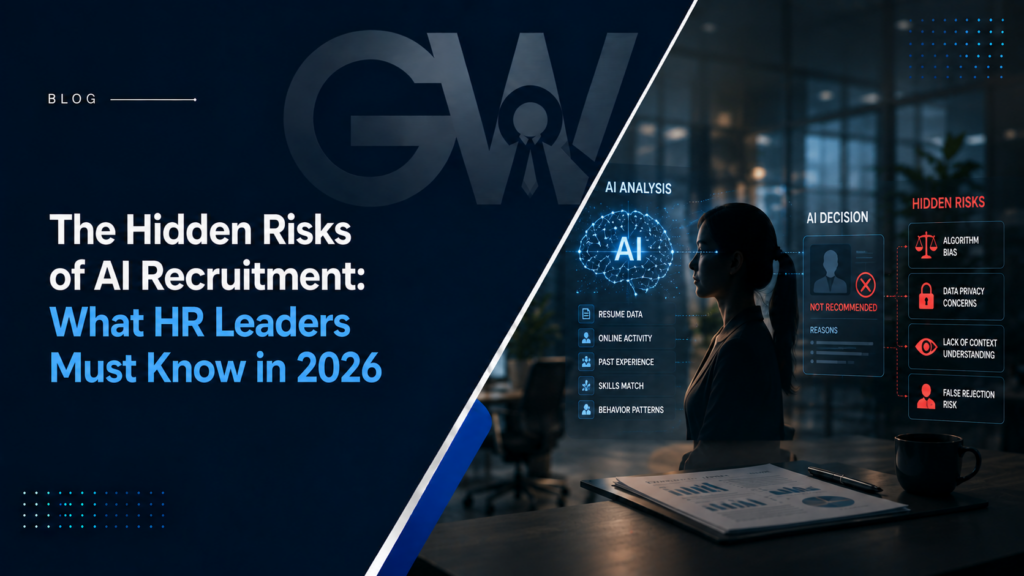
1. Algorithmic Bias
AI hiring solutions use historical hiring trends to make decisions, so there is always a risk of inheriting past biases. As organizations move toward resume-free and skills-based hiring, they must ensure AI supports fair candidate evaluation instead of reinforcing historical patterns.
2. Lack of Transparency
AI recruitment systems usually function like a “black box,” making it difficult for employers and applicants to understand the reason behind the rejection of a CV. Explainability is becoming equally important to accuracy as the use of AI in hiring becomes more advanced.
3. Data Privacy and Compliance Risks
Recruitment software is governed by the GDPR, among other acts, as it handles personal data of an extremely sensitive nature. Recruiters and screening tools are considered high-risk according to the EU AI Act. They have been mandated to conduct risk assessments, bias tests, human oversight, and transparency (European Commission). The deadline, originally set for August 2026, has now been postponed to December 2027 due to the Digital Omnibus agreement, but not the obligations (European Commission).
4. Over-Reliance on Automation
The Deloitte 2026 Global Human Capital Trends survey found that many organizations still struggle to turn AI investments into measurable hiring outcomes. This is especially true in Executive Search, where leadership hiring requires human judgment, industry expertise, and cultural fit assessment alongside AI-powered insights.
5. Candidate Experience
Candidate trust remains one of the biggest challenges in AI-powered hiring. According to Gartner, only 26% of candidates believe AI-based recruitment systems evaluate them fairly. Organizations should also monitor recruitment metrics such as candidate satisfaction, application drop-off rates, and offer acceptance rates to improve the overall hiring experience.
How Companies Can Reduce AI Hiring Risks
Reducing AI hiring risks requires more than implementing new technology. Organizations need the right hiring strategy, experienced recruiters, and well-defined processes to ensure AI improves recruitment without compromising fairness or compliance.
1. Keep Humans in the Decision Loop
Require the recruiter to sign off on every AI-generated shortlist or rejection so judgment isn’t lost to automation.
2. Audit AI Models Regularly
Schedule bias audits comparing pass-through rates across gender and ethnicity to catch drift early.
3. Test for Bias Before Deployment
Request disparate-impact documentation from every AI recruiting tools vendor before signing a contract.
4. Improve Data Quality
Clean training data and remove proxies like zip codes that can stand in for protected characteristics.
5. Maintain Transparency with Candidates
Disclose AI use plainly and offer a human review option to build trust and meet emerging EU AI Act rules.
Industry Data & Insights
| Risk | Business Impact | Best Practice |
| Algorithmic Bias | Legal exposure, narrower talent pool | Regular bias audits |
| Lack of Transparency | Difficulty proving compliance | Explainable AI models |
| Compliance Gaps | Fines, forced system withdrawal | EU AI Act readiness |
| Over-Automation | Weaker culture-fit decisions | Human-in-the-loop review |
| Poor Candidate Experience | Lost top talent, brand damage | Transparent AI disclosure |
AI Recruitment Framework
Hiring Need → Job Description → AI Candidate Sourcing → Human Review → AI Screening → Recruiter Validation → Structured Interviews → Hiring Decision → Continuous AI Audit
Future Trends (2025–2026)
Responsibility and explainability in AI are increasingly becoming the norm. According to Gartner, by 2027, 75% of all recruitments would involve certification or tests to evaluate the candidate’s ability to operate with workplace AI (Gartner). As per Deloitte’s study in 2026, this represents a turning point towards the adoption of intentional and governed AI design (Deloitte 2026).
Conclusion
Recruitment with the help of AI has changed the way organizations recruit employees. They have now become more efficient and faster than before. But there is always a risk involved if the process of using AI is not properly supervised. The organizations that adopt AI successfully are those where AI acts as an aid to human judgment. With the help of ethical use of AI, audits, and a transparent recruitment process, HR managers can build their recruitment strategy accordingly.
Ready to Build a Smarter AI Recruitment Strategy?
With the advent of AI revolutionizing the world of recruitment, it is becoming increasingly essential to have the right recruitment partner. With Get Workz, organizations can benefit from leveraging the power of AI in recruitment in an ethical manner, using our expertise in recruiting, recruitment solutions, and process management in RPO, Executive Search, IT Recruitment, Healthcare Staffing, Bulk Hiring, and many other sectors
If you wish to optimize the process of recruiting or minimize recruitment risks, we will assist you in creating a future-ready recruitment strategy.
Why Businesses Trust Get Workz
Get Workz combines the experience of recruitment and recruitment using technology responsibly under RPO, IT Recruitment, Healthcare Staffing, Bulk Hiring, MSP & VMS Solutions, Overseas Hiring, and Executive Search.
We use our team to ensure that we combine AI-based recruitment tools with human guidance and compliance understanding to serve US, Canada, India, and APAC companies.
FAQs About AI Recruitment
1. What are the risks of AI recruitment?
The main hazards include algorithmic bias, poor transparency with respect to decision making, issues related to data privacy and compliance, excessive dependence on automation, and deteriorating candidate experience with the use of artificial intelligence.
2. Can AI hiring be biased?
Yes. AI recruitment tools built using the previous records for recruiting can reinforce biases based on gender, race, age, or disabilities. Auditing, testing, and diverse data sets help minimize such risks.
3. Is AI recruitment better than traditional hiring?
AI recruitment can be more efficient in recruiting and selecting, but it doesn’t necessarily produce superior outcomes. According to SHRM 2025 figures, cost-per-hire and time-to-hire have increased due to AI adoption, making success contingent upon its management.
4. How can companies reduce AI hiring risks?
Firms need to ensure that there is human involvement in making decisions, conducting audits of the AI model, conducting bias testing before implementing it, enhancing the quality of training data, and being transparent with candidates on AI usage.
5. How does Get Workz help businesses implement AI recruitment responsibly?
Get Workz integrates sophisticated AI recruiting technology with skilled recruiters in order to make sure that the hiring process is impartial and compliant. With the help of Get Workz’s people-centric approach, companies can achieve greater efficiency in their recruitment process while maintaining high standards of compliance.