
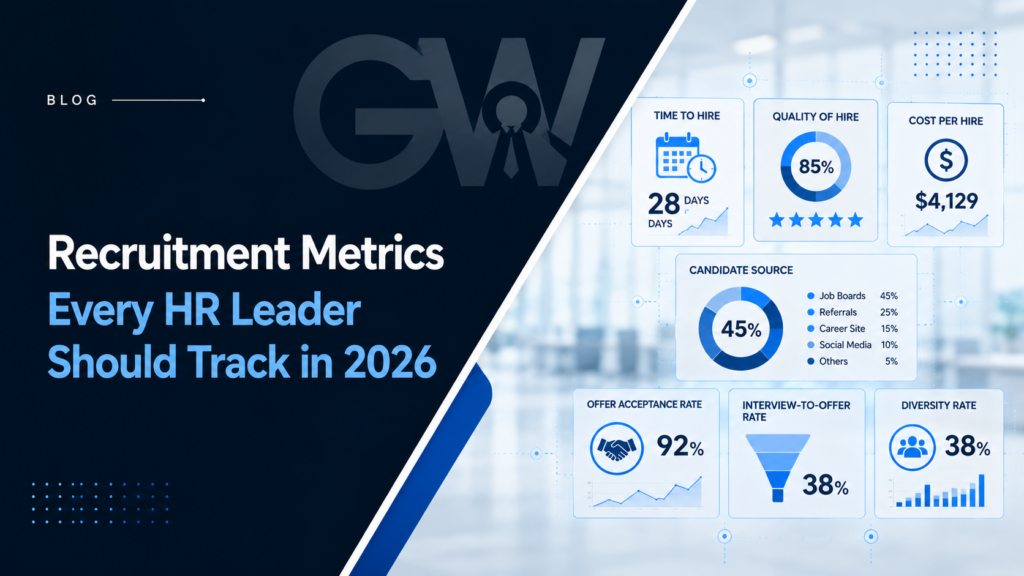
Quick Summary
Recruitment metrics help HR leaders measure and improve every stage of the hiring process. By tracking key metrics such as Time to Hire, Cost per Hire, Quality of Hire, and Offer Acceptance Rate, businesses can make faster hiring decisions, reduce recruitment costs, and improve candidate quality.
In this guide, you’ll learn the 12 most important recruitment metrics for 2026, how to calculate them, why they matter, and how HR teams can use them to build a more efficient, data-driven recruitment strategy.
Why Recruitment Metrics Matter More Than Ever in 2026
Recruitment in 2026 has become a matter of concern compared to ever before in this decade. There is a growing skills shortage in various industries like technology, healthcare, finance, and professional services. As per Mercer, 70 per cent of executives in 2025 consider talent shortage as one of the top risks for businesses, as against 51 per cent in 2022. At the same time, there is a potential cost of 150 per cent of the annual salary of mis-hiring in the mid-management position as per SHRM.
Though recruitment AI has made certain aspects faster, like screening, predictive match making, and scheduling using chatbots, however, they have added certain complexities. The HR team will need to understand whether the use of AI technology has resulted in improvements or just increased speed without improving results.
On top of all this, there is a fundamental change in the way people perceive the recruitment process. The candidate has become more knowledgeable, has more choices and less patience. As per the LinkedIn Talent Solutions Report in 2025, 60 per cent of candidates have abandoned the application process if they feel it is too lengthy and obscure.
That’s exactly what has brought recruiting metrics from back-room reports to front-of-the-boardroom consideration. The moment you start tracking the right recruiting metrics, you turn gut feeling into data that can drive your decision-making process and make your recruiting process faster, smarter, and less expensive.
What Are Recruitment Metrics?
Recruitment metrics are measurements that are taken to assess the performance of recruitment activities in terms of their efficiency and success. Recruitment metrics are taken throughout the entire recruitment process, starting from the advertisement of the position until it is accepted by the employee, and he/she joins the organisation.
Why businesses use recruitment metrics
✔ Lower hiring costs
✔ Higher quality of hire
✔ Faster hiring process
✔ Improved workforce planning
Benefits of Tracking Recruitment Metrics
Many HR departments continue to depend on gut feelings and informal inputs to measure their hiring effectiveness. This strategy is becoming less and less sustainable. Here is what measurement based on data provides:
Superior Recruiting Decisions. If you know from which recruiting sources come the best performing people, you could reallocate your budget to them. The Gartner 2025 HR Leaders Survey states that companies which leverage data in their sourcing make hires for crucial positions 35% faster than those that do not.
Recruitment ROI. Directors and Chief Financial Officers demand answers regarding investments in people. Recruitment metrics let HR show business results in monetary terms -cost per hire, time-to-productivity, retention rate, instead of simple headcounts.
Accurate Workforce Planning. Analysing the Time to Fill metric from the past helps HR forecast future recruiting schedules and prevent project delays because of unanticipated openings. According to the McKinsey 2024 Workforce Report, organisations with advanced talent analytics tools are 2.2 times more likely to hire on time.
Quality of Candidate. Quality of Hire, which might be considered the most important key performance indicator (KPI), will not be seen until a standardised measurement system is in place. Without such a system, one will not know whether candidates hired by an organisation are good hires or not.
Productivity of Recruiters. Measuring the productivity of individual recruiters allows one to find bottlenecks, training gaps, and inefficiencies of the recruiting process.
Recruitment Reporting for Executives. By using data-driven recruiting reports, HR can change its image from that of a supporting department into a strategic business partner – something that both CHROs and Talent Acquisition Leaders see as the main goal for 2026.
12 Recruitment Metrics Every HR Leader Should Track
1. Time to Hire
Time to Hire quantifies the total number of days taken from the date a candidate submits an application (or becomes part of your pipeline) until the candidate accepts the job offer.
Formula: Offer Acceptance Date Candidate Pipeline Entry Date
Business Effect: Low Time to Hire causes the loss of valuable candidates due to the slow recruitment process compared to the competition. According to LinkedIn Talent Solutions (2025), the global average Time to Hire in all industries stands at 41 days.
The average time to hire for technology jobs is 49 days, while healthcare has 55 days.
Companies that manage this ratio excel in candidate satisfaction and offer acceptance.
Example: Candidate applied on 1 March and accepted the offer on 22 March. Thus, the Time to Hire was 21 days.
2. Time to Fill
Time to Fill is the number of days taken to fill the position, starting from the opening of the job requisition until the candidate has accepted the offer letter.Time to Fill takes into consideration all the delays in the organisation, like the approval process, preparation for sourcing, and management of the job requisition.
Formula: Date Offer Accepted – Date Requisition Opened
The major difference between Time to Hire and Time to Fill is that Time to Fill covers all the pre-sourcing activities, too. According to SHRM benchmarking, Time to Fill has a median value of 42 days across industries; however, there is much variation based on the function and level of the role.
3. Cost per Hire
Cost per Hire refers to the total cost incurred in filling one position. It is one of the recruitment KPIs that has immediate application from a financial perspective.
Formula: (Internal recruiting cost + External recruiting cost) ÷ Total number of hires
Internal recruiting costs are recruiter compensation, HR technology, interviews, and onboarding. External recruiting costs consist of online job postings, agency costs, background checks, and relocation assistance.
For example, if your team incurred internal costs of $120,000 and external costs of $80,000 in the course of a quarter during which there were 50 hires, then the Cost per Hire is $4,000. According to the SHRM’s Talent Acquisition Benchmarking Survey for 2025, the Cost per Hire stands at $4,683 on average.
4. Quality of Hire
The Quality of Hire is viewed by experts as the most strategically significant recruitment metric. This metric gauges how much value an employee adds to the company in comparison to the costs of employing him or her.
Being composite in its essence, it is assessed on the basis of several metrics performance scores during the first 6-12 months, time to productivity, 90-day retention rate, hiring manager satisfaction, and cultural fit.
According to a survey conducted by LinkedIn Talent Solutions in 2025, 88% of talent acquisition specialists view the Quality of Hire as the most valuable metric, but only less than 40% of them have a methodology to assess it.
5. Offer Acceptance Rate
Acceptance Rate of Offer refers to the percentage of offers made that have been accepted by candidates. A falling acceptance rate is a good indicator of issues that exist in terms of employer branding, competitiveness of the pay offer or candidate experience during the recruitment process.
Calculation: ((Offers Accepted / Offers Made) * 100)
An offer acceptance rate less than 80% is an indication for you to conduct a thorough analysis of your pay benchmarking, interview process and communications about the value of the position/organisation.
6. Source of Hire
Hire Source shows where your successful applicants are coming from: referrals by employees, LinkedIn, job boards, direct sourcing, recruiting firms, college relations, or promotions within the company.
Advantages: This metric helps the talent acquisition team to distribute their budget on channels that give them better returns on investment. According to the Deloitte 2025 Global Human Capital Trends study, employee referrals always result in better hires at 55% reduced Cost per Hire than job board sourcing.
7. Recruitment Funnel Conversion Rate
Recruitment Funnel Conversion Rate refers to the efficiency with which potential employees progress from one point in the recruitment process to another, from application to screening, to interview, to job offer, and finally, to acceptance.
Usage Scenarios: Identifying the conversion rate at each stage in the funnel helps you pinpoint precisely where in your process you are failing. Should 60% of applicants fall through the cracks between the phone screen and the first interview, there is an obvious problem that needs to be solved with data.
8. Candidate Drop-Off Rate
Candidate Drop-Off Rate indicates the proportion of candidates who start but fail to complete the recruitment process at your firm, or who drop off at a certain point in the process without formally withdrawing.
Implications: If you have high candidate drop-offs, especially at the application stage, it shows that your recruitment process is too lengthy, complicated, or not optimised for mobile devices. A survey by PwC in 2025 on the Future of Work revealed that 73% of candidates abandon complicated applications mid-way through.
9. Hiring Manager Satisfaction
Satisfaction of Hiring Managers is an assessment of the quality with which the recruitment function performs its duties towards its internal customers business leaders, for whom the positions are created.
It is measured through questionnaires completed after the hiring process. This metric assesses communication quality, candidate’s calibre, process speed, and partnership effectiveness. Poor scores indicate a likelihood of workarounds when hiring managers hire candidates without the HR department.
10. Candidate Experience Score
Candidate Experience Score measures the extent to which your organisation impressed the candidates throughout the entire hiring process from initial contact through to offers (or rejections).
The Business Case for Candidate Experience Score: This is more than just an intangible metric. In the 2025 Talent Intelligence report conducted by PwC, it was found that 78% of candidates who had a poor experience would share their experience online and via social media.
11. Diversity Hiring Metrics
Diversity Hiring Metrics measure representation in terms of gender, ethnicity, disabilities, age, and other protected statuses at all stages of the hiring process, from application through shortlisting, interviewing, making an offer, and finally hiring.
Importance for Strategy: There are two reasons why you would want to use diversity hiring metrics. First, these metrics are important for compliance with equal opportunity laws. But secondly, and perhaps more importantly, diversity hiring metrics can show whether there is some sort of systemic bias at the level of recruiting, filtering, or selection that is preventing you from accessing the entire pool of talent.
12. AI Recruitment Efficiency Metrics
As more and more AI technologies are integrated into hiring practices, there is an emergence of new metrics of talent acquisition efficiency.
The accuracy rate of AI screening is how many candidates from the list selected by AI actually clear human screening a quality assurance metric for your automated screening step. Automation rate calculates how much of the administrative recruiting activities (screening, scheduling, communication with candidates) is completed without human input. Recruiter productivity improvement is the difference in hires per recruiter per month before and after implementing AI.
According to the Gartner 2025 HR Technology report, companies that keep track of AI recruiting efficiency achieve 28% improvement in recruiter productivity in 12 months of deployment provided that they measure results, not adoption rates.
Recruitment Metrics Performance Benchmark (2026)
Benchmarks for performance levels for each of the six key recruiting metrics are shown in the table below for those top performers who measure them in 2026. The benchmarks are based on industry insights provided by SHRM, Gartner, Deloitte, and LinkedIn Talent Solutions between 2024 and 2026. All the metrics together form a practical benchmark of the success in recruitment.
| Recruitment Metric | Industry Benchmark Performance | Benchmark Score |
| Time to Hire | Hiring speed and process efficiency | 75% |
| Quality of Hire | New hire performance, retention, and cultural fit | 88% |
| Offer Acceptance Rate | Percentage of candidates accepting job offers | 82% |
| Candidate Experience | Candidate satisfaction throughout the hiring journey | 78% |
| Recruiter Productivity | Recruiter efficiency and output effectiveness | 85% |
| Cost Efficiency | Ability to optimise recruitment spending | 76% |
Key Insights
What These Benchmarks Mean for Your Hiring Strategy
A Time to Hire above the industry benchmark often indicates delays in approvals, sourcing, or interview scheduling. Review each hiring stage to identify bottlenecks.
A low Offer Acceptance Rate may indicate issues with compensation, employer branding, or candidate communication.
High Cost per Hire often means your recruitment budget isn’t being used efficiently. Focus on sourcing channels that deliver the best return on investment.
Quality of Hire (88%), out of all the KPIs for recruitment, stands out, owing to an increasing focus on achieving long-term success through effective hiring rather than just filling the positions as quickly as possible. It is becoming common for businesses to measure the performance, retention rate, and fitment of recruits to evaluate the recruitment process.
Recruiter Productivity (85%), on the other hand, is being used widely owing to the emergence of various AI-based recruitment tools that help recruiters automate their work and spend more time interacting with candidates and hiring managers.
Despite the impressive achievements of organisations in enhancing the quality of their hiring processes, metrics such as Time to Hire (75%) and Cost Efficiency (76%) are still problematic. Long approval times, tough market conditions, and growing expenses associated with hiring make these metrics challenging to achieve.
Similarly, Candidate Experience (78%) and Offer Acceptance Rate (82%) continue to be critical metrics for measuring employer competitiveness. As candidates have more options available to them, they also have higher standards; companies that provide a quick, clear, and personal experience in recruiting are able to attract the best talent.
Sources: SHRM Talent Trends Report 2025, Gartner HR Technology Report 2025, Deloitte Global Human Capital Trends 2025, LinkedIn Talent Solutions Global Talent Trends Report 2025.
Recruitment Metrics Framework for HR Leaders
It is important to measure effectively. The model presented below shows how the recruitment metrics align throughout the entire recruiting process, from planning to retaining employees and constantly improving performance.
| Workforce Planning |
| ↓ |
| Talent Sourcing |
| ↓ |
| Candidate Screening |
| ↓ |
| Interview Process |
| ↓ |
| Offer Management |
| ↓ |
| Hiring |
| ↓ |
| Retention Tracking |
| ↓ |
| Recruitment Optimisation |
Each one of these stages in your framework is responsible for the generation of data, which will paint the picture of your recruiting metrics. Workforce planning determines headcount requirements and predictions on Time to Fill.
Talent acquisition delivers Source of Hire information. Recruitment drives funnel metrics. Offer process results in Offer Acceptance Rates and Candidate Experience Scores. Finally, the retention process will close the loop by confirming the Quality of Hire. It is only through consistent measurement of these stages that HR executives receive a live view of their recruiting process rather than a post-mortem report.
Recruitment Analytics Trends for 2025–2026
AI-Powered Recruitment Analytics
It is no longer a future topic for discussion that AI is actually a part of recruiting processes in 2026. Companies use machine learning for analysis of their past hiring data, prediction of the success of candidates, analysis of the efficiency of recruitment channels, and detection of any form of bias in screening. As reported by Gartner, 62% of large companies have adopted at least one AI-enabled recruiting solution by 2025, compared to 38% in 2022.
Predictive Hiring Models
Recruitment predictive analytics models employ historical recruitment information, along with employee performance information, in order to predict the success of future recruits. Predictive models have been adopted by many firms in order to minimise the risk of mis-hiring and speed up the process of adaptation. Deloitte’s “2025 Human Capital Trends” report states that the companies that adopt predictive recruiting models experience 19% better 12-month retention rate of new hires.
Skills-Based Hiring
There has been a remarkable increase in the move from competency-based hiring to skill-based recruitment. According to the LinkedIn 2025 Future of Recruiting Report, there has been an increased use of skill-based tests by 75% of talent acquisition managers within the last two years because of the need for a more accurate match of skills and roles. There is the emergence of new talent acquisition metrics to measure skills match at the time of hire.
Recruitment Automation
There are a lot of changes in high-volume and administrative recruitment through the use of automation technology. Scheduling interviews, communicating with candidates, gathering references, and document generation are now done through automation processes without any intervention from the recruiter. According to PWC, the use of automation can cut down administrative recruitment time by up to 40%.
conclusion
In today’s competitive labour market environment, recruitment success is not only about recruiting people fast enough. By collecting the right Recruitment Metrics, one can have greater insight into how effective their recruiting efforts were, hire candidates of a higher calibre, save money spent on recruiting, and make better-informed decisions when it comes to their workforce.
Such metrics like Time to Hire, Cost per Hire, Quality of Hire, and Offer Acceptance Rate can bring you useful information regarding building a hiring process for your organisation. With the continuous development of technologies and their impact on the recruiting industry in 2026, it will be even more important to track and optimise your hiring performance.
Next Steps for HR Leaders
Start by tracking 5 core metrics:
- Time to Hire
- Time to Fill
- Cost per Hire
- Quality of Hire
- Offer Acceptance Rate
Review them monthly and use the data to improve your hiring strategy over time.
Ready to Improve Your Recruitment Metrics?
Do you want to have an effective recruitment process for your business?
Look into the service provided by Get Workz that assists organisations with enhancing their Recruitment Metrics through dedicated services such as Recruitment Process Outsourcing (RPO), IT Recruitment, Healthcare Staffing, Executive Search, and Bulk Hiring.
FAQs About Recruitment Metrics
1. What are recruitment metrics?
Recruitment metrics are quantifiable measures that gauge the performance, effectiveness, and quality of the recruitment process. Metrics range across the whole recruitment life cycle from sourcing to selection, offer, and even new hire retention. Thus, recruitment metrics provide HR management with objective, measurable information on the success of their recruitment activities.
2. Why are recruitment metrics important for HR leaders?
The role of recruitment metrics is important since it allows the process of recruitment to be changed from a subjective process into a quantifiable one. This provides HR professionals with an opportunity to find out about inefficiencies in cost, increase the quality of candidates, speed up the hiring process, show the value of recruitment to senior executives, and make better plans for workforce planning.
3. How can Get Workz help businesses improve recruitment metrics?
With Get Workz, you can access a collection of workforce solutions that will help improve your recruitment key performance indicators. We provide recruitment process outsourcing services that will optimize your recruitment process by minimising the Time to Fill, Cost per Hire, and improving the Quality of Hire for you.
4. What recruitment services does Get Workz offer?
Get Workz offers a wide range of recruitment solutions, including Recruitment Process Outsourcing (RPO), IT Recruitment, Healthcare Staffing, Executive Search, and Bulk Hiring. Our industry-focused recruitment specialists help businesses find qualified talent quickly while maintaining hiring quality, compliance, and a positive candidate experience.