
Hiring is expensive. But choosing the wrong recruitment pricing model can make it even more costly.
Imagine your company needs to hire 20 employees over the next six months. One Recruitment Process Outsourcing (RPO) provider offers a fee for every successful hire. Another charges a fixed monthly amount. A third proposes a combination of both.
Which option makes the most financial sense?
The answer depends on your hiring volume, recruitment needs, and the services included in each agreement.
Understanding RPO pricing models helps employers compare recruitment costs, plan budgets, and avoid paying for services they don’t need.
This guide explains per-hire, monthly fee, and hybrid RPO pricing, with simple examples to help you choose the right approach.
Quick Summary
Per-hire pricing: Pay an agreed fee for each successful hire.
Monthly fee pricing: Pay a recurring amount for defined recruitment services.
Hybrid pricing: Combine a fixed base fee with variable charges.
Per-hire models may suit occasional hiring, while monthly arrangements can work well for consistent recruitment.
Hybrid pricing may offer flexibility when hiring demand changes.
The best model depends on total recruitment costs, service scope, and hiring requirements.
What Is RPO Pricing?
RPO pricing is the fee structure an employer pays a recruitment outsourcing provider to manage some or all of its hiring activities.
These activities may include candidate sourcing, screening, interview coordination, recruitment reporting, and offer management.
Unlike traditional recruitment agencies that generally focus on filling individual vacancies, RPO providers can support broader recruitment operations.
However, the pricing structure depends on the services included.
If you’re unfamiliar with the model, our guide on RPO vs Traditional Recruitment explains how recruitment outsourcing differs from conventional agency hiring.
Employers looking for ongoing recruitment support can also explore Get Workz’s Recruitment Process Outsourcing (RPO) services.
Three Common RPO Pricing Models Explained
Per-Hire RPO Pricing
Under a per-hire RPO pricing model, employers pay an agreed fee for each successful hire.
The payment may be triggered when a candidate accepts an offer, joins the company, or reaches another contractual milestone.
Example:
A company needs 10 employees, and its RPO provider charges $1,500 per successful hire.
10 hires × $1,500 = $15,000
The total provider fee would be $15,000, assuming no additional charges.
This is a hypothetical example, not an actual Get Workz price.
Advantages: Costs are linked to hiring outcomes, and employers can estimate spending based on planned hires.
Limitations: Expenses may rise significantly with higher hiring volumes. Employers should also check whether sourcing, screening, and recruitment tools are included.
Best suited for: Businesses with occasional, project-based, or unpredictable hiring requirements.
Monthly Fee RPO Pricing
With a monthly RPO fee, employers pay a recurring amount for an agreed level of recruitment support.
This may include dedicated recruiters, sourcing activities, candidate screening, and recruitment reporting.
Example:
A company agrees to pay $4,000 per month for six months.
$4,000 × 6 months = $24,000
If the company hires 20 employees during that period, the provider fee averages $1,200 per hire.
However, if only 10 employees are hired, the average rises to $2,400.
Advantages: Predictable monthly spending and consistent recruitment support.
Limitations: Employers may continue paying during slower hiring periods. Additional capacity may also cost extra.
Best suited for: Organizations with regular recruitment needs and relatively stable hiring volumes.
Businesses experiencing repeated hiring delays should also consider the operational challenges discussed in Signs It’s Time to Outsource Your Recruitment Process.
Hybrid RPO Pricing
A hybrid RPO pricing model combines a recurring base fee with variable charges.
For example, an employer may pay a smaller monthly fee for ongoing recruitment support, plus an additional amount for every successful hire.
Example:
A company agrees to:
- Monthly base fee: $2,000
- Fee per successful hire: $600
- Contract duration: 6 months
- Total hires: 20
Base fee: $2,000 × 6 = $12,000
Hiring fees: $600 × 20 = $12,000
Total RPO cost = $24,000
Advantages: Combines ongoing recruitment support with charges linked to hiring activity.
Limitations: Agreements may be more complicated, particularly when additional hiring volumes or specialist roles involve separate fees.
Best suited for: Growing companies that need consistent recruitment support but experience fluctuating hiring demand.
Per-Hire vs Monthly Fee vs Hybrid RPO: Cost Comparison
Let’s compare all three pricing models using the same six-month hiring period.
| Pricing model | Example fee structure | Total for 20 hires |
| Per-hire | $1,500 per hire | $30,000 |
| Monthly fee | $4,000 per month | $24,000 |
| Hybrid | $2,000/month + $600/hire | $24,000 |
Illustrative calculations only. These figures are not market averages or Get Workz quotations.
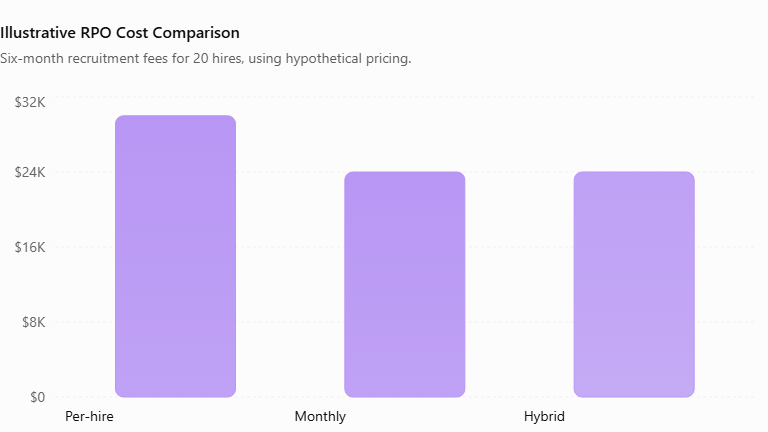
In this example, monthly and hybrid pricing produce the same total cost.
But that doesn’t mean they provide the same value.
One provider may include dedicated recruitment resources and technology, while another charges separately for those services.
The important question is not simply, “Which model is cheaper?”
It’s “Which model provides the recruitment support we need at a sustainable total cost?”
For a broader understanding of recruitment expenses, read How to Reduce Cost Per Hire Without Compromising Recruitment Quality.
What Factors Affect RPO Pricing?
RPO pricing varies because every organization has different recruitment requirements.
Hiring Volume
The number of employees a company needs to recruit affects the resources required.
High-volume recruitment may benefit from dedicated recruitment teams and more predictable fee arrangements. However, additional capacity can also increase costs.
Job Complexity
Specialized IT, healthcare, and leadership positions may require more extensive sourcing and assessment than general administrative roles.
The complexity of each position can influence recruitment fees.
Recruitment Service Scope
Some employers only need candidate sourcing and screening.
Others want support throughout the hiring process, including interview coordination, reporting, and offer management.
The broader the scope, the more important it becomes to understand exactly what the quoted price covers.
Technology and Additional Expenses
Applicant tracking systems, job advertising, candidate assessments, and recruitment software may be included in the fee or billed separately.
Employers should confirm these details before signing an agreement.
How to Calculate the True Cost of RPO
The quoted provider fee is not always the complete recruitment cost.
To understand the actual expense, employers should consider provider charges, additional recruitment spending, and internal resources still involved in hiring.
Total Recruitment Cost = RPO Provider Fees + Additional Recruitment Expenses + Retained Internal Recruitment Costs
Once the total is known, calculate cost per hire:
For example, if an employer spends $30,000 in total and hires 20 employees:
$30,000 ÷ 20 = $1,500 per hire
This calculation is useful when comparing recruitment methods, provided the same cost categories are used.
Cost should also be considered alongside hiring speed and candidate quality.
Our guide on Recruitment Metrics Every HR Leader Should Track in 2026 explains how businesses can evaluate recruitment performance beyond spending alone.
Which RPO Pricing Model Should You Choose?
The right RPO pricing model depends on your organization’s hiring patterns.
| Your hiring situation | Model worth considering |
| Occasional or project-based recruitment | Per-hire |
| Regular hiring throughout the year | Monthly fee |
| Ongoing recruitment with changing volumes | Hybrid |
| High-volume recruitment | Monthly or hybrid, depending on capacity |
| Uncertain future hiring requirements | Flexible per-hire or hybrid agreement |
These are starting points, not fixed rules.
For example, a company with steady hiring needs may still prefer per-hire pricing if it wants to avoid a recurring commitment.
Similarly, a business with seasonal hiring requirements may benefit from a monthly agreement that allows recruitment capacity to increase or decrease.
Before making a decision, review the provider’s experience, service scope, reporting process, and contract flexibility.
Our article on How to Choose the Right RPO Partner for Your Business explains what employers should evaluate before selecting a recruitment outsourcing provider.
Questions to Ask Before Signing an RPO Agreemen
Before choosing an RPO pricing model, ask your provider:
- What recruitment activities are included in the quoted fee?
- Are there setup, advertising, or technology charges?
- When does a successful hire become billable?
- What happens if hiring volume increases or decreases?
- Are specialist positions charged differently?
- What performance metrics and reports will we receive?
- Are there minimum commitments or termination fees?
Clear answers help prevent misunderstandings and make competing proposals easier to compare.
How Get Workz Supports Your Recruitment Needs
Choosing the right RPO pricing model is an important part of building an efficient hiring process.
But pricing alone cannot solve recruitment challenges.
Businesses also need clear job requirements, effective candidate sourcing, consistent screening, and organized recruitment operations.
Get Workz offers RPO solutions designed to support different recruitment requirements, including full-cycle, project-based, and selective recruitment outsourcing.
The appropriate recruitment approach depends on hiring volume, job complexity, and the level of support your organization needs.
TALK TO OUR TEAM
Find the Right RPO Solution for Your Business
Not sure whether per-hire, monthly, or hybrid RPO pricing fits your hiring plans?
Get Workz can help you discuss your recruitment requirements and explore an outsourcing approach aligned with your business needs.
Let’s make your recruitment process more structured, efficient, and easier to manage.
Conclusion
Choosing an RPO pricing model is about more than finding the lowest fee.
Per-hire pricing connects costs to successful hires. Monthly fees provide predictable spending for ongoing recruitment support. Hybrid pricing combines both approaches.
Each model has advantages, and the right choice depends on your hiring requirements.
Before committing, compare total costs, service responsibilities, and contract flexibility.
The best RPO pricing model is the one that supports your hiring goals without creating unnecessary recruitment expenses.
FAQs About RPO Pricing
1. What are the main RPO pricing models?
The three common RPO pricing models are per-hire, monthly fee, and hybrid pricing. Per-hire models charge for successful hires, monthly models use recurring fees, and hybrid models combine fixed and variable charges.
2. How much does RPO cost per hire?
RPO cost per hire depends on hiring volume, role complexity, service scope, and the provider’s fee structure. There is no universal rate. Employers should compare total recruitment expenses and calculate the effective cost per successful hire.
3. Is monthly RPO pricing cheaper than per-hire pricing?
Monthly pricing can be more economical for consistent hiring volumes, but it may cost more during slower recruitment periods. The actual difference depends on fees, recruitment capacity, and included services.
4. What is hybrid RPO pricing?
Hybrid RPO pricing combines a recurring base fee with variable charges, such as fees linked to successful hires. It may suit businesses that require ongoing recruitment support but experience changing hiring demand.
Which RPO pricing model is best for small businesses?
Small businesses with occasional hiring may consider per-hire pricing. Those recruiting regularly may benefit from monthly or hybrid arrangements. The best option depends on hiring frequency, budget, and the services required.