
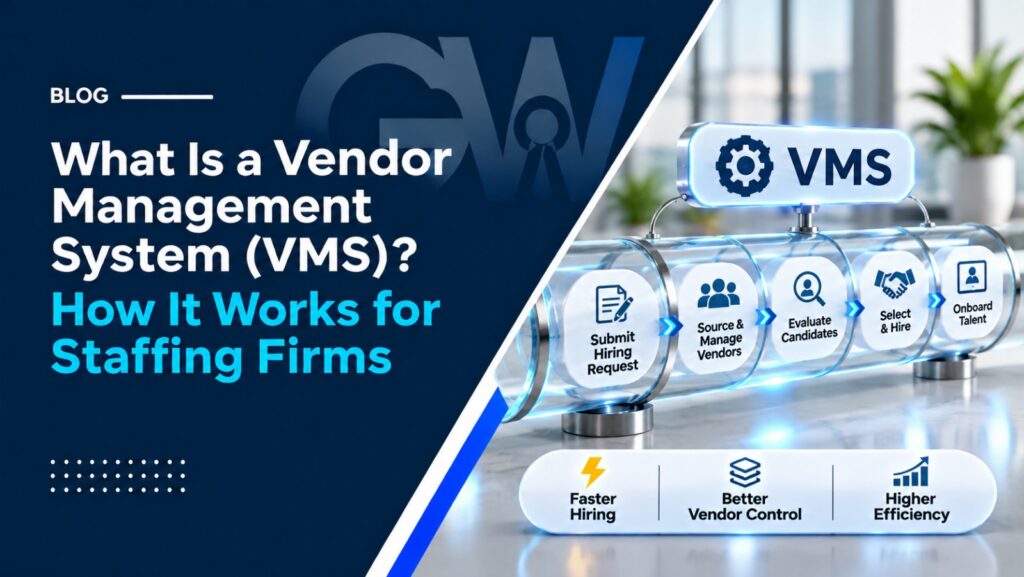
If you’ve ever worked with a large enterprise client, you’ve probably heard this line: “Please submit your candidates through our VMS.” For many staffing firms, that’s the moment hiring stops being about phone calls and emails and starts running through a software portal with its own rules, deadlines and scorecards.
So what exactly is a vendor management system, and why does it matter so much to staffing firms? In this guide, we explain what a VMS is, how it works from both sides, and what staffing partners can do to perform well inside one. At Get Workz, we support companies through our MSP & VMS solutions, so this guide comes from real hiring work, not just theory.
What Is a Vendor Management System? (Quick Answer)
A vendor management system (VMS) is cloud-based software that companies use to manage their contingent workforce: contractors, temporary workers, freelancers and consultants hired through staffing agencies. It puts everything in one place: job requests, supplier selection, candidate submissions, onboarding, timesheets, invoicing and reporting.
In simple words, a VMS is the central system that connects a company with all of its staffing vendors and keeps the whole process organized, compliant and trackable.
VMS vs MSP: What’s the Difference?
People often use these two terms together, but they are not the same thing.
Staffing Industry Analysts (SIA), a well-known research firm in the staffing industry, defines an MSP as a managed services provider that helps a company run its contingent workforce program, and a VMS as the technology used to manage that program.
So:
- VMS = the technology (the software platform)
- MSP = the people and process (the team that runs the program)
Many companies use both. The MSP manages suppliers, rates and compliance, while the VMS is the tool everyone works in. This is different from recruitment process outsourcing, where an external partner takes over all or part of a company’s permanent hiring. If you’re still comparing hiring models, our guide on RPO and traditional recruitment explains how each one works.
Why VMS Matters More Than Ever
VMS is no longer just a tool for a few big corporations. According to SIA’s latest research, total VMS spend reached $303 billion in 2025, up 7% from 2024. The same report shows that statement-of-work (SOW) spend made up 39% of that total, and growth in SOW spend was the biggest reason for the increase.
For staffing firms, this means one thing: a large share of contract hiring now passes through VMS platforms. If your firm can’t work well inside these systems, you may miss out on many enterprise opportunities.
For companies, the growing use of VMS shows that managing many staffing vendors manually is hard to scale. If your HR team is struggling with too many agencies, spreadsheets and email threads, it may be one of the signs it’s time to outsource your recruitment process.
How a VMS Works: Step by Step
Here’s how a typical hiring cycle moves through a vendor management system.
1. The hiring manager creates a requisition
A manager needs a contractor, for example a Java developer for six months. They raise a request in the VMS with the job details, budget, duration and approvals.
2. The job is released to approved suppliers
The VMS sends the requisition to pre-approved staffing vendors. Many programs use tiers, which means top-performing suppliers see the job first, and others get access later if the role is still open.
3. Staffing firms submit candidates
Suppliers upload candidate profiles, resumes and bill rates. Most programs limit how many candidates each vendor can submit per role, so quality matters more than volume.
4. Shortlisting and interviews
The hiring manager reviews submissions inside the VMS, gives feedback and schedules interviews. Everything is tracked with timestamps.
5. Offer and onboarding
Once a candidate is selected, the VMS handles the offer, background checks, compliance documents and the start date.
6. Time tracking and invoicing
Contractors log hours in the VMS, managers approve them, and invoices are generated automatically, often with consolidated billing.
7. Performance and offboarding
At the end of the assignment, the VMS manages offboarding. It also records supplier performance data, such as fill rate, time-to-submit and quality of hire.
How a VMS Works for Staffing Firms (The Supplier Side)
From a staffing firm’s point of view, working inside a VMS is very different from working with a client directly. Here’s what changes.
1. Speed becomes a competitive advantage
In a VMS, several suppliers often see the same requisition at the same time. The firm that submits strong, qualified candidates first usually has the best chance. This is especially true in fast-moving roles like those covered under IT recruitment, where good developers and engineers get multiple offers within days.
2. Rates are fixed in advance
Most VMS programs use rate cards that set maximum bill rates per role and location. Staffing firms can’t negotiate on every requisition, so they need to manage their margins carefully.
3. Compliance is non-negotiable
Every document, from licenses to background checks to right-to-work proof, must be uploaded and approved. In regulated industries, missing one document can stop a start date. That’s why firms offering healthcare recruitment need very strong credentialing processes when they work through a VMS
4. Scorecards decide your future
The VMS tracks your performance on every requisition. Fill rates, interview-to-offer ratio, time-to-submit and early turnover all appear in supplier scorecards. Strong scores can move you to a higher tier, while weak scores can reduce how many jobs you see.
Benefits of a VMS for Staffing Firms
Many recruiters see VMS programs as “extra rules,” but they also bring real advantages:
- Access to large enterprise clients that only hire contractors through VMS programs
- Steady job flow once you are an approved supplier
- Faster payments because invoicing is automated and standardized
- Clear performance data that helps you understand where your team is strong or weak
- A fair playing field, since smaller firms can compete with large agencies based on quality and speed
Common Challenges (And Why They Happen)
Working in a VMS is not always easy. These are the challenges staffing firms talk about most:
- High competition per requisition, with many vendors chasing the same role
- Short response windows, sometimes just 24 to 48 hours to submit
- Limited contact with hiring managers, because communication often goes through the system or the MSP
- Pressure on margins due to fixed rate cards and VMS fees
- Volume spikes, when a client suddenly opens dozens of roles at once
That last point is where many firms struggle. When a client needs 30 or 50 contractors quickly, firms that follow proven high-volume hiring practices can respond on time without dropping quality
Popular VMS Platforms You’ll Come Across
There are many VMS platforms on the market. Some names staffing firms often come across are SAP Fieldglass, Beeline, Workday VNDLY, Magnit and Coupa. Each platform works a little differently, but the core flow of requisitions, submittals, onboarding, timesheets and invoicing stays the same.
You don’t need to master every platform. However, it helps if your team understands the basics of the ones your key clients use: how requisitions are released, how submittals work, and how timesheets are approved.
How Staffing Firms Can Win More VMS Requisitions
Based on what we see in day-to-day hiring work, these practices make the biggest difference:
1. Build talent pipelines before the job opens
Don’t wait for a requisition to start sourcing. Keep warm pools of pre-screened candidates for roles your clients hire again and again. These smart candidate sourcing strategies can help you build a stronger pipeline.
2. Submit fewer, better candidates
Most VMS programs limit submittals. Two well-matched candidates are worth more than five average ones, and your interview-to-offer ratio will show it.
3. Respond within hours, not days
Set up alerts and assign clear owners for each client program so no requisition sits unnoticed. Using recruitment automation for tasks like scheduling and follow-ups frees recruiters to focus on sourcing and screening.
4. Keep compliance documents ready
Collect and verify documents early so your candidates can start on time.
5. Extend your recruiting hours
Many VMS roles in the US are released during US business hours. Some staffing firms use offshore recruitment support so sourcing and screening continue around the clock.
6. Reduce candidate drop-off
A candidate who disappears after submission hurts your scorecard. Clear communication and quick feedback keep candidates engaged until the start date.
7. Track your own scorecard
Review your fill rate, time-to-submit and early attrition every month. Don’t wait for the client to point out problems.
Is a VMS Right for Your Company?
If you are a company (not a staffing firm), a VMS usually makes sense when:
- You work with many staffing agencies at the same time
- You hire a large number of contractors, temps or SOW consultants
- You need better control over spending and bill rates
- Compliance and audit trails are important in your industry
- Different departments hire contractors in different ways and you want one standard process
If you only hire a few contractors a year, a VMS may be more than you need. In that case, a trusted staffing partner may be the simpler option. A clear workforce plan also helps you decide the right mix of permanent and contract talent.
Need Help Managing Your Contingent Workforce?
A vendor management system can bring order, speed and transparency to contract hiring, but only when the right people and processes support it. Whether you are a company trying to manage multiple staffing vendors or a firm that wants to perform better inside VMS programs, Get Workz can help.
Our team supports MSP and VMS programs with sourcing, screening and compliance-ready candidates for clients across the US, Canada and India. Talk to our team to find out how we can support your hiring goals.
Frequently Asked Questions
1. What is a vendor management system in staffing?
A vendor management system in staffing is software that helps companies manage contingent workers and the staffing agencies that supply them. It covers job requests, candidate submissions, onboarding, timesheets, invoicing and supplier performance in one platform.
2. What is the difference between VMS and MSP?
A VMS is the technology platform. An MSP is a service provider that runs the contingent workforce program, often using a VMS to do it.
3. Do staffing firms pay to use a VMS?
In many programs, yes. VMS fees are often deducted from supplier invoices as a small percentage, but the exact model depends on the client’s contract.
4. How do staffing firms get into a VMS program?
Usually through the client’s MSP or procurement team. Firms go through a supplier onboarding process that checks capabilities, compliance, insurance and past performance.
5. Can small staffing firms succeed in VMS programs?
Yes. A VMS judges suppliers on performance, so smaller firms with niche expertise, fast response times and strong candidate quality can compete with large agencies.
6. What industries use VMS the most?
According to SIA, finance and insurance is the biggest VMS user by share of spend at 23.8%, followed by business and professional services at 12.0% and technology and telecom at 11.0%