
A ghost job is a job post with no real opening behind it. Some are old ads that nobody took down. Others are posted to collect resumes or to test the market. Either way, candidates lose trust in the employer. The fix is simple: post only approved roles, be honest when you are building a talent pool, and remove ads quickly.
Think about the last time you applied for a job and heard nothing back. You probably wondered if anyone even read your application. Now imagine the role was never open at all. That is how a ghost job feels from the candidate’s side. In a 2026 ResumeBuilder survey, 86% of recent job seekers said they had seen a post they suspected was a ghost job. That figure measures suspicion, not proof, but it shows how much trust is at stake.
This guide explains what ghost jobs are, why they happen, what they cost you and how to stop them. We reviewed recent surveys and news reports for it. Most numbers come from surveys about people’s views, so we name the source each time and do not present them as exact industry counts.
What is a ghost job?
A ghost job is a job post that the employer does not plan to fill soon, or at all. Sometimes it is a mistake. Sometimes it is a choice. Both are common, and both leave candidates confused.
The most common type is the forgotten posting. A manager hires someone, but the ad stays live for months. Nobody is trying to mislead anyone. It is just a process gap, often because the person who posted the job and the person who filled it are not the same.
The second type is the pipeline posting. The company is not hiring today, but it wants resumes ready for later. The third is the unapproved role. The ad goes up before budget is signed off, and the job never gets funded. The fourth is the market test. The employer posts a role to see who applies, what salary people expect or what competitors are paying.
| Type | What it looks like |
| Forgotten posting | Role is filled or cancelled, but the ad stays live |
| Pipeline posting | No opening yet, ad collects resumes “just in case” |
| Unapproved role | Ad goes up before budget or approval |
| Market test | Ad checks interest, pay levels or competitors |
From the outside, all four look the same to a candidate. That is why the damage is similar even when the intent is different.
How common are ghost jobs?
Nobody knows the exact number, and you should be careful with any site that claims one. Surveys ask different groups of people, so each figure shows one angle.
A 2026 ResumeBuilder survey of 1,011 U.S. adults found that 86% had seen a job post they suspected was a ghost job. It also found that 58% had interviewed for a role they later suspected was not real.
There is an important limit here. ConsumerAffairs pointed out that this survey measured what applicants suspect, not what employers actually intended. So it does not prove that 86% of all listings are fake.
Resume Genius, in a separate report on hiring managers, found that 90% said they had intentionally posted ghost jobs, meaning listings they did not plan to fill right away. Both reports come from resume and software companies, so treat them as signals, not official statistics. The trend is still clear: this is a real problem, and candidates have noticed it.
Why do employers post ghost jobs?
Most employers do not do it to hurt anyone. A Fortune report in March 2026 gave the reasons recruiters shared when they admitted to posting roles they did not plan to fill.
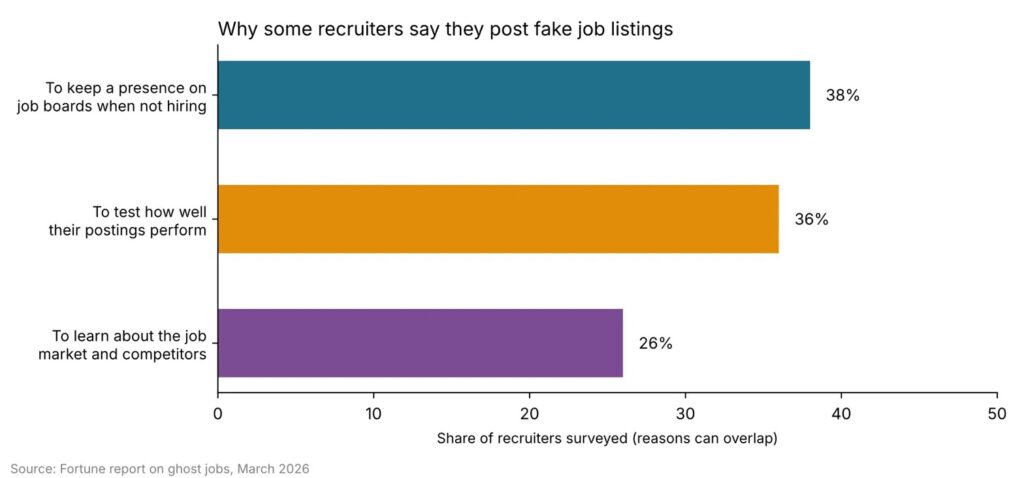
The top reason was to keep a presence on job boards when not hiring, at 38%. Next was to test how well job posts perform, at 36%. And 26% said they wanted to learn about the job market and competitors.
The Resume Genius report adds one more reason. Among hiring managers, 47% said they use these posts to build a pool of candidates for future openings.
These reasons make business sense. A pipeline is useful, and market data is useful. The mistake is pretending a role is open when it is not. Often the real root cause is weak planning. When a company has no clear view of which roles it needs and when, ads go live too early or stay live too long. Good workforce planning fixes this at the source, because you only post what you have already decided to hire.
What do ghost jobs really cost you?
A ghost job does not show up as a line on an invoice. The cost is trust, and trust is slow to rebuild.
The cost to candidates and your brand
The ResumeBuilder survey shows how candidates feel. About 39% said ghost jobs made them more stressed or frustrated. Around 32% said they trust employers less, and 20% said they felt less motivated to keep applying.
A candidate who feels tricked rarely applies again. They also tell friends and write reviews. The strongest people often have options, so they simply move on to a company that feels honest.
The cost inside your hiring team
Recruiters spend hours reading resumes for jobs that will never open. That time could go to real roles. Your numbers also get messy. If you count a fake opening in your data, your time-to-fill and cost per hire will look wrong, and you may make poor decisions from them.
Candidates are also getting smarter. In the same survey, 34% said they check when a job was first posted, and 32% verify the opening on the employer’s own career website. If your career page and job board do not match, people will notice.
Are ghost jobs illegal?
There is no single law that bans ghost jobs everywhere. But the rules around job postings are changing fast. This section is general information, not legal advice, so please check the rules in your own location.
In Canada, new Ontario rules took effect on 1 January 2026. Employers with 25 or more employees must include salary ranges in job postings and must reply to interviewed candidates within 45 days. They must also say when AI is used in hiring.
In the United States, 16 states plus Washington, D.C. had statewide pay transparency laws in effect as of 1 August 2026. These laws often cover what a job post must include. Some lawmakers have also looked at rules that would make employers state their hiring intent. A New York bill and a Pennsylvania bill were reported on by the IBTimes, but the details and status can change, so check before you act.
The direction is clear. More transparency is coming. Employers who post honestly today will be ready, whatever the final rules look like.
How can you avoid posting ghost jobs?
You do not need a heavy system. A short posting policy, followed every time, solves most of the problem.
- Approve before you post. Only publish a role that has a budget and a named hiring manager. If nobody owns the role, it should not be live.
- Be honest about future hiring. If you want a pipeline, say so. Use words like “Join our talent community” instead of a fake job title.
- Set an expiry date. Review every ad after a fixed time, such as 30 days. Remove it or renew it on purpose, not by default.
- Close roles fast. Take the ad down the same week the role is filled or paused. Make this part of your offer-accepted checklist.
- Share the pay range. Do this where the law requires it, and where you can even if it does not. It tells candidates the role is real.
- Reply to candidates. Tell interviewed people the outcome, even when it is a no. A short, kind message protects your name.
- Check every month. Compare your live ads to your real hiring plan and clean up what does not match.
Step 2 deserves the most attention. If your team wants a ready pool of talent, build one openly. Our guide to the best recruitment strategies for growing businesses shows ways to do this without posting roles that do not exist.
Also look at how you write requirements. A job post that asks for a long list of must-have degrees can sit open for months, because very few people fit it. That creates a “ghost-like” ad even when the role is real. Our comparison of skills-based vs degree-based hiring explains how to write requirements that match the real work.
Is AI making ghost jobs worse?
It can, but it can also help. AI tools make it very easy to create and repost job ads in seconds. That speed can fill job boards with stale or duplicate listings.
The same tools can also clean things up. For example, they can flag ads that have been open too long or roles that no longer match your plan. If you are deciding where to use automation, our article on what is actually working with AI in recruitment is a good place to start. The rule we suggest is simple: let AI help, but keep a person responsible for what gets published.
When can a recruitment partner help?
Many small teams post jobs but do not have time to manage them. Ads get forgotten, and replies to candidates slip. A recruitment partner can keep your postings current and your pipeline honest
If you are a smaller company and wonder whether outsourcing makes sense, read what is RPO for small businesses. If you work with several staffing vendors, MSP vs direct staffing explains how to choose a structure that keeps things organized.
Hard-to-fill roles are often where stale ads sit the longest. For these, a specialist service such as healthcare recruitment can reach skilled people who are not browsing job boards. And if you want full support across the whole hiring process, see our recruitment process outsourcing service.
How can candidates spot a ghost job?
Job seekers search for this topic too, and it helps to know what they look for. Knowing the signs helps you avoid them.
Candidates check the posting date, because very old ads are a warning sign. They look for the same role on the company’s own career page. They look for a pay range. They notice when the same role is posted again and again. And many now ask directly in the first call: “Is this role open now, and what is the timeline?” Be ready to answer that question honestly.
How Get Workz can help
Get Workz is a recruitment and outsourcing company. We help employers find, screen and hire talent through clear, flexible services. Honest job posts and a clean hiring process are part of hiring well.
Want help planning your hiring and keeping your pipeline honest? Book a call with our team and we will help you find the right approach.
Frequently asked questions
1. What is a ghost job?
A ghost job is a job listing that is not tied to a real, current opening. The role may be filled, cancelled or unapproved, or the ad may exist only to collect resumes.
2. Why do companies post ghost jobs?
In one report, recruiters gave reasons such as keeping a presence on job boards, testing how posts perform and learning about the market. In another report, hiring managers said they use them to build a candidate pool for later.
3. How common are ghost jobs?
There is no exact number. In one 2026 survey, 86% of recent job seekers said they suspected they had seen one. That shows suspicion, not proof.
4. Are ghost jobs illegal?
There is no single national U.S. law against them. But pay transparency and posting rules are growing, and some places are looking at rules on hiring intent. Check your local rules.
5. How can employers avoid ghost jobs?
Post only approved roles, label future hiring honestly, set expiry dates, close roles quickly and reply to interviewed candidates.