

If you are about to hire your first developer, the number on the offer letter is only the start. The real cost includes benefits, any recruiter fee, equipment, the weeks spent searching and the time it takes the new person to settle in.
This guide walks through each part with real numbers, so you can set a budget you can trust.
The short answer
For a US software developer paid the national median of $135,980, plan for roughly $194,000 in the first year once benefits and payroll costs are included. If you hire through a recruitment agency, add a fee of about 15% to 25% of salary. That brings the total to roughly $215,000 to $228,000. The search itself usually takes several weeks, and sometimes a few months.
These are estimates built from US government data, and every figure is sourced at the end. If you are earlier in the process and want the full how-to, start with our guide on how to hire a software developer.
Quick facts
- Median salary: $135,980 a year (US Bureau of Labor Statistics, May 2025)
- Typical spread: from $82,460 (lowest 10%) to $214,670 (highest 10%)
- Benefits and payroll costs: about 30% of total employer compensation (BLS, June 2026)
- Agency fee: usually 15% to 25% of first-year salary
- Time to hire: several weeks to a few months, and longer for senior or specialist roles
Why one developer costs $90K and another $200K
Asking “what does a developer cost?” is like asking “what does a car cost?” It depends on what you are buying. Five things move the price the most:
- Seniority. A junior and a senior developer can sit more than $100,000 apart.
- Specialism. Skills in short supply, such as security, cloud or machine learning, are priced higher than general web work.
- Location. Pay differs by city and country, and remote hiring widens your options.
- Industry. Software companies pay more than most other sectors (see below).
- How you hire. An employee, a freelancer, an agency and an offshore team all cost differently.
What US software developers earn
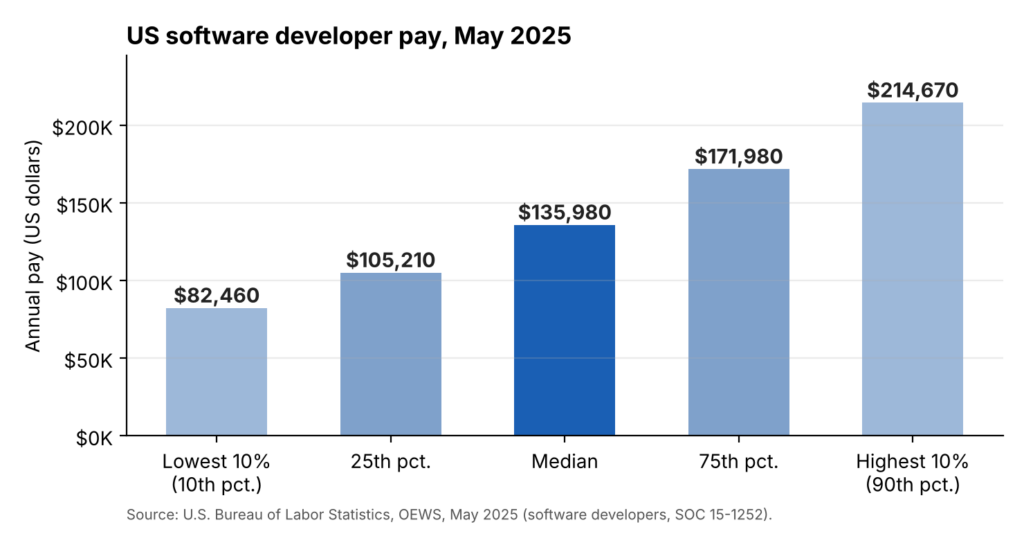
The BLS reports a median annual wage of $135,980 for software developers (May 2025). Half earn more than this and half earn less. Here is how pay is spread:
| Pay level | Annual pay | Approx. hourly |
| Lowest 10% | $82,460 | $39.64 |
| 25th percentile | $105,210 | $50.58 |
| Median | $135,980 | $65.38 |
| 75th percentile | $171,980 | $82.68 |
| Highest 10% | $214,670 | $103.21 |
Annual pay divided by 2,080 hours. This is a simple conversion, not a freelance rate
The industry a developer works in also matters. BLS median pay for software developers by industry:
- Software publishers: $164,550
- Manufacturing: $136,330
- Management of companies: $135,680
- Finance and insurance: $135,460
- Computer systems design: $132,050
The same person could cost you about $30,000 more at a software publisher than at a design services firm. Budget with your own industry in mind, not just the national number.
The costs that sit on top of salary
Salary is what the developer sees. Your finance team sees more.
The BLS Employer Costs for Employee Compensation report for June 2026 shows that US private employers paid $46.89 per hour in total compensation. Of that, $32.82 (70%) was wages and $14.07 (30%) was benefits, such as insurance, paid leave and payroll taxes.
Applying that ratio to a median developer salary gives these estimates:
- Total yearly cost to employ: about $194,300
- Benefits and payroll costs: about $58,300
Treat this as a planning figure. Your own health plan, state taxes and company policies will move it up or down.
Then there are the quieter costs that never show up on an offer letter:
- Equipment and tools: laptop, cloud accounts and software licences.
- Interview time: every hour your engineers spend interviewing is an hour they are not building.
- Ramp-up: a new developer needs weeks to get up to speed, and someone has to guide them.
- The hiring process itself. SHRM reported an average cost per hire of nearly $4,700 in its 2022 benchmarking, and technical roles usually run higher. You can work out your own figure with our guide to calculating and reducing cost-per-hire.
What recruiters charge
If you work with an agency, the fee is usually a percentage of the candidate’s first-year salary. Three models are common:
- Contingency: you pay only if you hire. Typical fees run 15% to 25%, and mid-level software engineers often fall at 20% to 25%. Very in-demand specialisms can reach 25% even at mid-level.
- Retained: you pay in stages for a dedicated search, mostly for senior or leadership roles.
- Flat fee: a fixed amount per hire, sometimes used for lower-salary roles.
On a median salary of $135,980, the fee works out like this:
- 15%: $20,397
- 20%: $27,196
- 25%: $33,995
When you compare agencies, do not look at the percentage alone. Ask about the replacement guarantee, how technical skills are screened and how many candidates you can expect to meet. If you are unsure whether an agency or a long-term partner suits you better, read our breakdown of recruitment agency vs RPO.
The first-year cost of one hire, in one table
| Cost item | Estimate | Basis |
| Base salary (median) | $135,980 | BLS, May 2025 |
| Benefits and payroll | about $58,300 | 30% of total compensation |
| Total employment cost | about $194,300 | Salary ÷ 0.70 |
| Agency fee (optional) | $20,400 to $34,000 | 15% to 25% of salary |
| Total with an agency | about $214,700 to $228,300 | Employment cost + fee |
What to put in your hiring budget
Before you open the role, write down every line below. A budget that covers only salary will almost always run short.
- Base salary range, based on level and skills
- Benefits and payroll costs (about 30% of total compensation is a sensible starting estimate)
- Recruiter fee, if you plan to use an agency
- Equipment, software and access
- Time your team will spend interviewing and onboarding
- A buffer for a longer search than planned
Employee, freelancer, agency or offshore?
The cheapest option on paper is not always the cheapest in practice. Here is how the routes compare:
- Full-time employee. Highest commitment and the strongest long-term fit. You carry salary, benefits and any recruiter fee. This is best when the product is the heart of your business.
- Freelancer. No benefits, and you pay only for the work. It suits small, well-defined projects, but hourly rates are higher and continuity is less certain.
- Development agency. You buy a finished result rather than a person. The price is usually higher, but you skip the hiring and the day-to-day management.
- Recruitment partner or RPO. You still employ the developer, but someone else runs the search. If you hire often, this can lower your cost per hire. Our guide on choosing the right RPO partner explains what to check first.
- Offshore team. Pay levels can be much lower in some countries, but you need strong processes, clear communication and a trustworthy partner.
A look at offshore pay
The Stack Overflow Developer Survey 2025 reports these median yearly earnings for back-end developers (in US dollars):
| Country | Median yearly pay |
| United States | $175,000 |
| United Kingdom | $108,913 |
| Germany | $87,011 |
| France | $71,929 |
| India | $22,086 |
A word of caution. These numbers are self-reported, include bonuses and are before tax. They also compare very different job markets, so treat them as a signal, not a price list. The sticker price is only part of offshore hiring. Management time, time zones and quality control matter just as much.
If this route interests you, our checklist of 15 questions to ask an offshore recruitment partner is a good starting point. Offshore support is also about more than saving money. We explain why in why global companies are choosing India for recruitment support and how offshore recruitment support helps US staffing firms save costs.
How long does hiring take?
Longer than most people expect. Technical roles generally take several weeks to a few months to fill, and senior or specialist roles take longer. The biggest factors are how fast you decide, how many interview rounds you run and how competitive the market is for the skills you need.
A realistic search often looks like this (timings are illustrative):
- Week 1: agree the role, the budget and the job post
- Weeks 2 to 3: source and shortlist candidates
- Weeks 3 to 5: screening, a practical test and interviews
- Week 6: references and offer
- After the offer: notice period and onboarding
Waiting has a price. While the seat is empty, work piles up on your current team and good candidates accept offers elsewhere. We cover this in the hidden cost of slow hiring. To track your own numbers, see the recruitment metrics every HR leader should track.
The most expensive mistake: the wrong hire
A wrong hire rarely costs “just one salary”. You pay for months of work that does not land, code that has to be rewritten, your manager’s time and a second search. For a developer building your core product, weak code can slow every feature that comes after.
That is why a paid test task and proper reference checks are cheap insurance. A few extra days of care at the start usually cost far less than fixing a bad hire later.
Seven ways to spend less without lowering quality
- Write a clear brief. A vague job post brings in the wrong people and wastes interview time.
- Hire for skills, not just degrees. A wider pool often gives better value.
- Keep the process short. Fewer rounds and quicker decisions cut the time cost and stop you losing good candidates.
- Ask for referrals. Your network can find strong people without a fee.
- Match the level to the need. Don’t pay for a senior developer where a mid-level one is enough, and don’t hire a junior with nobody to review their work.
- Compare fees and guarantees. Look at the percentage, the replacement period and how technical screening is done.
- Consider a partner if you hire often. A steady partner can lower your cost per hire. We share more ideas in how to reduce recruitment costs without compromising quality.
How Get Workz can help
Hiring a developer should not feel like guesswork. Our IT recruitment team finds and screens technical talent, so you only meet people who fit your brief and your budget. If you are building a team across borders, our overseas hiring service supports you from sourcing to joining. And if hiring is a regular need for your business, our RPO service can run the process as an extension of your team.
Tell us what you are building and the skills you need, and we will give you an honest view of the market. Get in touch with the Get Workz team.
Final thoughts
The real cost of a software developer is salary plus benefits, any recruiter fee, equipment, onboarding and the weeks it takes to find the right person. For a median-paid US developer, that is roughly $194,000 in year one without an agency, and $215,000 to $228,000 with one.
Be clear about what you need, hire at the right level, and test real work before you decide. That is the most reliable way to keep costs sensible without compromising on the person you bring in.
FAQs About Cost to Hire a Software Developer
1. How much does it cost to hire a software developer in the US?
The median salary is $135,980 a year (BLS, May 2025). With benefits and payroll costs, the yearly cost to the employer is about $194,000. An agency fee of 15% to 25% adds roughly $20,400 to $34,000.
2. How much do recruiters charge for software developers?
Most contingency recruiters charge 15% to 25% of first-year salary. Mid-level software engineers are often at 20% to 25%, and specialist roles can cost more.
3. How long does it take to hire a software developer?
Usually several weeks to a few months. Senior and specialist roles can take longer.
4. Is a freelancer cheaper than a full-time developer?
For a small, clear project, often yes, because you pay only for the work. For ongoing product development, a full-time developer is usually better value, since freelance hourly rates are higher and continuity is less certain.
5. How much do benefits add to a developer’s salary?
Benefits made up 30% of total employer compensation in US private industry in June 2026 (BLS). On a median salary, that is roughly $58,000 a year as an estimate.
6. Is hiring offshore cheaper?
Reported pay is lower in some countries. Stack Overflow’s 2025 survey shows a median of $22,086 for back-end developers in India versus $175,000 in the US. But the data is self-reported and not like-for-like, and you must also budget for management and communication.
7. How can a small company hire a developer on a tight budget?
Write a clear brief, hire at the right level, use referrals, keep the process short and compare recruiter fees. For a small, defined project, a freelancer may be the most affordable route.
8. What is the biggest hidden cost of hiring a developer?
A wrong hire. Rework, lost time and a second search can cost more than the salary itself.