Quick Summary
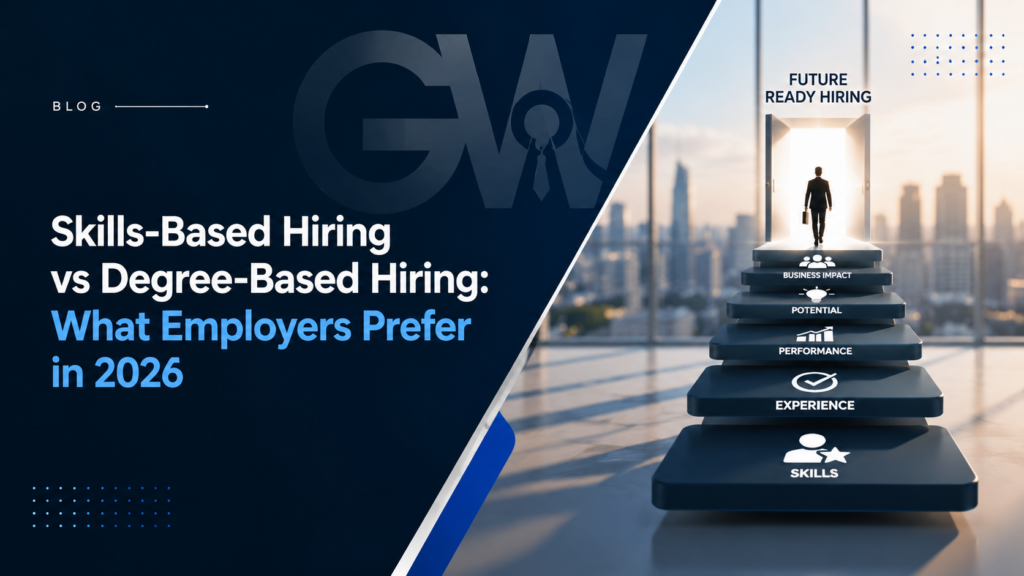
Skills-based recruitment is gaining favour in 2026 over degree-based hiring because it helps organizations to hire faster while tapping into a larger pool of applicants. According to research by SHRM, LinkedIn, and Gartner, proven abilities rather than degrees are emerging as the most powerful indicators of professional success.
In sectors where there is licensing and regulation, like healthcare, law, and engineering, degrees continue to be important. However, for any other position outside those regulated sectors, skill-based hiring combined with education is proving more effective than both strategies on their own.
Why Skills-Based Hiring Is Transforming Talent Acquisition in 2026
The talent acquisition professionals begin the year 2026 with the same challenge that has been haunting recruitment for quite a while – having too many job openings and not enough applicants that would match those jobs. The way out has come up in the form of skills-based hiring. In the process, companies are moving from looking for specific degrees in CVs to evaluating candidates based on their skills through various forms of assessment, work samples, and structured interviews.
It does not mean that education is being undervalued. It means that companies are trying to widen the recruiting pipeline by not filtering away competent individuals because of one requirement that does not really affect their capacity to do the job. As found by LinkedIn’s research on the Future of Recruiting, the majority of recruiters have already recognized this approach as one of the key hiring priorities. And according to SHRM’s 2026 Talent Trends, the majority of HR teams are still having trouble filling full-time positions through traditional hiring. Knowing when to prioritize skills over the degree has become an essential aspect for any HR director, recruitment manager, or business owner when making workforce decisions in 2026.
What Is Skills-Based Hiring?
Skills-based Hiring Definition: Skills-based hiring is a hiring strategy that focuses more on assessing an individual’s competency, certifications, and experience, rather than a formal educational background. This type of recruitment process includes assessing the candidate based on tests, work sample assessment, and a structured interview. In skills-based recruitment, the hiring decision is made by testing the candidate’s ability to carry out his/her responsibilities irrespective of how he/she acquired that skill.
Organizations adopting this approach often combine it with Recruitment Process Outsourcing (RPO) to streamline sourcing, assessments, and hiring workflows.
In skills-based recruitment, the degree in an individual’s CV does not have as much significance as a coding test, a work sample, a certification, and completed project. The recruiters develop a scorecard for the particular skill set needed for the job position and thereby lessen their dependence on factors such as alma mater, title, or seniority.
Skills-Based Hiring vs Degree-Based Hiring
| Criteria | Skills-Based Hiring | Degree-Based Hiring |
| Focus | Demonstrated abilities and practical competencies | Formal education and academic credentials |
| Candidate Evaluation | Assessments, work samples, structured interviews | Resume screening, degree verification |
| Hiring Speed | Faster – candidates are pre-qualified by skill | Slower – often bottlenecked by credential checks |
| Diversity | Wider, more diverse talent pool | Narrower, filtered by access to higher education |
| Job Readiness | High – tested directly against real tasks | Variable – depends on coursework-role alignment |
| Learning Agility | Assessed directly through practical exercises | Assumed from academic performance |
| Cost | Lower cost-per-hire, fewer mis-hires | Higher cost from extended sourcing and mis-hires |
| Best Use Cases | Tech, sales, creative, operations, customer-facing roles | Regulated professions: healthcare, law, engineering, finance |
Source: analysis based on SHRM, LinkedIn, and Gartner talent acquisition research, 2025–2026.
Why Employers Are Shifting to Skills-Based Hiring in 2026
- Skilling gap is growing: As per WEF’s report on Future of Jobs 2025, around 39% of core skills of the workforce will change in the next five years.
- Technology and AI revolution: Research by Gartner shows that nine out of ten organizations already use or plan to adopt skills-based talent management. Rapid AI adoption continues to widen the skills gap. Learn more in our guide on How AI Is Transforming Recruitment in 2026.Learn how AI is reshaping recruitment in our guide on How AI Is Transforming Recruitment in 2026.
- Mis-hire cost is growing: McKinsey found that skills-based hiring predicts job performance far better than education. It is nearly five times more effective and more than twice as predictive as experience of employee job performance than hiring for education, and more than twice as predictive as hiring for experience.Reducing cost per hire has become a major priority for HR leaders.
- Agility of the workforce: Business needs change faster than academic curricula. As a result, employers want professionals they can test, reskill, and redeploy quickly, and therefore organizations now want individuals who can easily be tested, redeployed, and reskilled.
- Diversity and Inclusion: According to SHRM’s report on Skill-First approach, in 2025, 78% of HR professionals used skilled credentials in their hiring compared to 72% in 2021.
- Corporate priority: According to LinkedIn’s research on Future of Recruiting, 75% of recruiters consider this approach as one of their hiring priorities.
When Degree-Based Hiring Still Matters
For professions where regulation and safety are critical, employers cannot ignore formal qualifications. Careers in medicine, nursing, law, aviation, accounting, and licensed engineering require recognized degrees or government-approved licenses before professionals can enter these fields. No skills assessment can replace these mandatory qualifications. In research-intensive and scientific careers, higher degrees demonstrate advanced subject knowledge that interviews alone cannot measure.
Benefits of Skills-Based Recruitment
- Higher quality of hire: Employers evaluate candidates based on their skills instead of relying only on academic credentials.
- : less effort devoted to credential validation and more to assessing fit for the position.
- Wider recruiting net: Employers expand the talent pool by hiring self-taught professionals, career changers, and certified candidates. They no longer depend only on traditional degree requirements.learned the skills through self-study, career shifters, and certification holders that would have been weeded out otherwise.
- Greater retention: Organizations retain employees longer when they hire candidates whose skills match the role. A better job fit also improves employee satisfaction.
- Lower recruiting costs: a lower number of incorrect hires leads to fewer hiring cycles and reduced downtime.
Challenges of Skills-First Hiring
Validation remains the greatest challenge. In the absence of a well-structured testing library, “skills-based” may end up being just a name, and no substantial changes will be made in the recruitment process. Employers must develop standardized tests for every role, train interviewers, and use consistent evaluation criteria. a standardized test for each position, train the interviewer on how to grade answers consistently, and ensure that there is a consistent process that minimizes subjectivity in the reviewers’ part. Many organizations overcome these challenges by partnering with an experienced Recruitment Process Outsourcing provider.
Building a Skills-Based Hiring Strategy
1. Capture key skills: Identify and document the essential skill sets for each position, based on more than just the current position title.
2. Redefine job postings: Write job postings using competency-based criteria instead of assuming an educational requirement.
3. Skill assessments: Create and introduce a skills-based test at the top of the funnel.
4. Train interviewers: Give your interviewers the tools needed to conduct a structured interview process free from bias.
5. Evaluate the results of the hiring process: Evaluate data such as quality of hire and retention.
How Get Workz Supports Skills-Based Hiring
Building an effective skills-based hiring system requires proper validation and structured interviews. Recruiters also need a clear understanding of the competencies required for every role.
Organizations deciding where degrees matter and where skills should take priority can rely on Get Workz. We build structured hiring pipelines that adapt to changing technologies and business needs.
The Future of Skills-Based Hiring
Job requirements continue to evolve every year. Skills-based hiring helps organizations build stronger and more adaptable teams. Degrees remain essential for regulated professions. However, assessing practical skills gives employers access to a wider talent pool and improves hiring outcomes.
Ready to Modernize Your Hiring Strategy?
If degree requirements are limiting your talent pool, it may be time to adopt a skills-first hiring strategy. Get Workz helps HR teams design and implement structured recruitment processes through RPO, Executive Search, IT Recruitment, and Healthcare Staffing. Our professionally designed assessments help businesses hire qualified candidates faster.
Get in touch with Get Workz to schedule a recruiting strategy session.
FAQs About Skills-Based Hiring & Degree-Based Hiring
1. What is skills-based hiring?
Skill-based recruitment is an approach to recruiting in which the candidate’s skills, tests, and experience, rather than the candidate’s educational credentials, are considered to make hiring decisions. It involves the use of work examples, certifications, and interview techniques to determine whether the candidate is able to do what is needed for the job.
2. Skills-based hiring vs degree-based hiring – which is better?
Neither of the two models fits all roles. The skills model will prove more effective in jobs involving creativity, operations, and technical aspects, where skills can be assessed directly. The degree model is still vital when it comes to licensed professions, including law, medicine, and engineering.
3. Why are employers moving towards skills-first hiring?
The change is occurring since this method increases the candidate pool, reduces time to hiring, and, as per McKinsey, is more indicative of performance on the job than education. Moreover, the constant shortage of skilled people and changing technology are forcing organizations to hire for flexibility and not credentials.
4. How can Get Workz help businesses implement Skills-Based Hiring?
Get Workz facilitates skills-based hiring by designing job-based hiring solutions, evaluating candidates using practical skills assessment, and simplifying the entire process of hiring. By offering Recruitment Process Outsourcing, Executive Search, and Talent Acquisition, among other services, Get Workz facilitates quick and efficient hiring