

You have a product idea, a growing business or a process that needs software, and you need someone to build it. There is one problem: you cannot judge code. How do you know whether a developer is good before you spend months and thousands of dollars finding out?
This guide is written for exactly that situation. It explains, in plain steps, how to define what you need, choose the right type of developer, pick a hiring route, understand the cost, find candidates, test their skills without technical knowledge, and set them up to succeed. You do not need to learn to code. You need a clear process.
Key takeaways
- Write a one-page brief of the problem before you write a job post.
- Choose the type and level of developer that fits your first version, not your final dream product.
- Decide the route first: freelancer, agency, full-time hire, recruitment partner or offshore team.
- Budget for the salary, the cost of finding the person and the cost of a wrong hire.
- Test real work with a small paid task, not only an interview.
- Plan the first 90 days so the new developer can deliver early.
Why This Hiring Decision Matters So Much
Demand for developers is high. The US Bureau of Labor Statistics projects that employment of software developers, quality assurance analysts and testers will grow about 10% from 2025 to 2035. More companies competing for the same talent means good developers receive several offers and decide quickly.
For a non-technical founder, the risk is bigger. A developer builds the core of your product, and you may not notice problems in the code until they become expensive to fix. A careful hiring process is your best protection.
Step 1: Start With the Problem, Not the Job Title
Most hiring mistakes begin with a vague request like “Looking for a full-stack developer with 5 years of experience.” The post is unclear, so the replies are unclear.
Before you speak to anyone, write a one-page brief in plain language. Answer these questions:
- What are we building? Describe it in two or three sentences, as if explaining it to a friend.
- Who will use it? Customers, staff or both?
- What must work on day one? Separate the must-haves from the nice-to-haves.
- What already exists? An old website, a half-built app, a design file or nothing yet?
- How will we know it is done? For example, “a customer can sign up, pay and see their order.”
- What are the budget and the deadline? Be honest. Developers can only tell you what is possible when they know the limits.
This brief becomes your job post, your interview guide and your test task. It also protects you later, because everyone works from the same page. If you need help turning it into a clear job post, read our guide on writing better role descriptions for successful hiring.
Step 2: Understand the Types of Developers
“Developer” is a broad word, like “doctor.” You would not visit a heart surgeon for a skin problem. The table below shows the common types and when you need each one.
| Type of developer | What they build | Good fit when you need |
| Front-end | What users see and click: pages, buttons, forms | A website or app screens that look and feel right |
| Back-end | The logic behind the scenes: databases, payments, user accounts | Data, logins, orders, links to other tools |
| Full-stack | A mix of front-end and back-end | An early-stage product, a first version, a small team |
| Mobile (iOS / Android) | Apps for phones and tablets | A customer app that lives on the phone |
| DevOps / cloud | Hosting, security, speed and uptime | A product that is growing and must stay online |
| Data / AI engineer | Reports, data pipelines, machine learning | Dashboards, forecasting, AI features |
For a first version of a product, a strong full-stack developer is often the most practical choice. You can add specialists as you grow.
When you describe the role, focus on what the person must do and the skills that matter, rather than only on degrees or years of experience. Our article on skills-based hiring vs degree-based hiring explains why this approach often finds stronger people.
Step 3: Decide the Level You Need
The right level depends on your situation, not on a wish to hire “the best.”
- Junior developers are earlier in their careers. They cost less and learn quickly, but need guidance and review. They work best inside a team that already has a senior person.
- Mid-level developers can work on their own on defined tasks and need little supervision. They suit most growing companies.
- Senior developers can design the system, make technical decisions and guide others. If you are building the first version alone, with no technical person to check the work, a senior or lead developer is usually the safer choice.
A common founder mistake is hiring a junior developer to save money and then having no one who can review the work. The savings disappear when the code has to be rewritten.
Step 4: Choose How You Will Hire
You have more than one route. Each one trades off cost, speed and control.
| Route | Best for | Watch out for |
| Freelancer | Small, clear projects and short-term work | Availability can change; less backup if they leave |
| Development agency | A full product built by a team | Higher cost; the team that sells is not always the team that builds |
| Full-time employee | Long-term product work you want to own | Slowest to hire; salary plus benefits and taxes |
| Recruitment partner | Finding full-time or contract developers faster, with screening done for you | Fees; quality depends on the partner you choose |
| Offshore team or staff augmentation | Extending your team at a lower cost | Time zones; needs clear communication and management |
Employee or contractor? Employees work under your direction and are part of your company. Contractors work on defined projects and manage their own time and tools. Rules on how to classify workers differ by country and state, so speak to a lawyer or accountant before you decide.
Using a recruitment partner. If you expect to hire more than one or two developers in a year, a partner can save a lot of time. Before signing, read our guide on how to choose the right RPO partner for questions to ask.
Hiring offshore. Building a team in another country can widen your talent pool and lower cost, but it works only with clear processes and the right partner. Our list of 15 questions to ask an offshore recruitment partner is a useful checklist before you start.
Step 5: Know What It Will Really Cost
Cost is more than a salary. Plan for four parts: the pay, the cost of finding the person, the cost of a wrong choice and the cost of everything around the hire.
The salary
The US Bureau of Labor Statistics reports that software developers earned a median of $135,980 per year in May 2025. That is the middle of the market, so a junior developer will earn less and a senior or specialist will earn more. Pay also changes by city, industry and whether the role is remote.
The cost of finding the person
If you use a recruitment agency, the most common model is a contingency fee, paid only when you hire someone. Most agencies charge around 15% to 25% of the first-year salary, and high-demand technical roles can reach 30%. Some firms charge a flat fee instead. The chart below shows what different fee percentages mean on the median salary above.
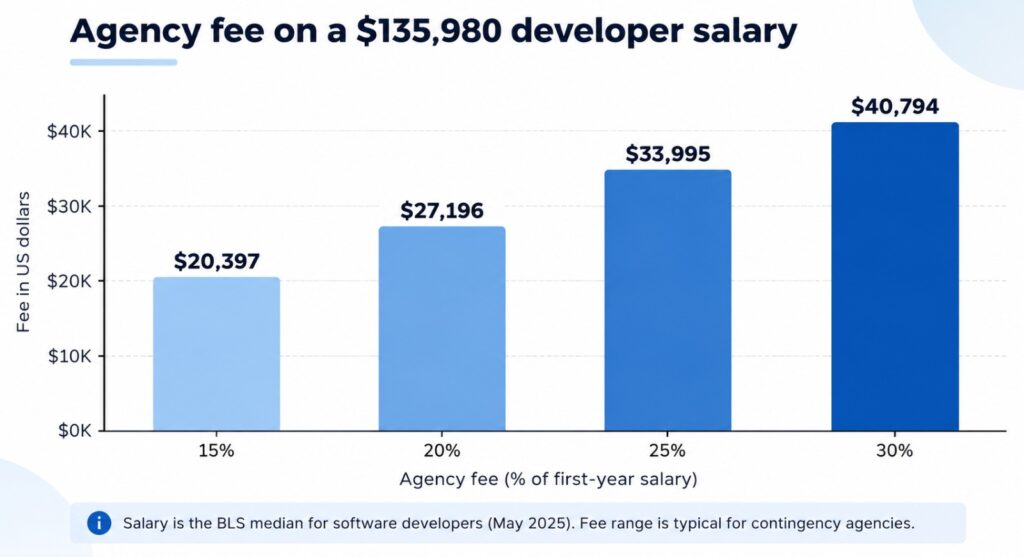
This is an example based on the median salary. Your own numbers will depend on the role and the agency.
If you are watching your hiring budget, our guide on how to reduce recruitment costs without compromising quality has practical ideas.
The cost of a wrong hire
A wrong hire costs far more than one salary. You pay for months of work that does not deliver, for rework when code has to be rewritten, for the manager’s time and for starting the search again. This is the main reason it pays to test skills properly before you decide.
The costs around the hire
Remember to budget for tools and software licences, equipment, hosting and security, your own time spent on interviews and management, and the weeks it takes a new developer to reach full speed.
Step 6: Plan for the Time It Takes
Hiring a developer is slower than most founders expect. Technical roles usually take longer to fill than average roles, often several weeks to a few months, and senior or specialist roles take longer still.
Delay has a real cost, because your product waits while you search. We explain how this adds up in the hidden cost of slow hiring.
A simple example of how a search can run (the timings are illustrative and will vary by role):
- Week 1: Write the brief and the job post, and agree the budget.
- Weeks 2 to 3: Source candidates and shortlist.
- Weeks 3 to 5: Screening calls, the paid test and interviews.
- Week 6: References, decision and offer.
- After the offer: Notice period for the candidate, and onboarding.
Founder tip: Good developers do not stay on the market for long. If your process has five rounds and two weeks of silence between them, the best candidates will accept another offer.
Step 7: Find Candidates
Where you look depends on the route you chose. These are the most common places:
- Your own network. Ask other founders and advisers who they would hire again. Referrals are often the highest quality.
- Job boards and LinkedIn. Wide reach, but you will receive many unsuitable applications. A sharp job post helps filter them out.
- Freelance platforms. Useful for short projects. Read reviews and past work carefully.
- Developer communities. GitHub, Stack Overflow and local meetups show how people actually work.
- A recruitment partner. They search and screen for you, which saves time when you have no technical background.
Developers also look at who you are before they reply. Clear values, honest pay ranges and a modern, respectful process make a difference. See our tips on employer branding strategies.
Step 8: Write a Job Post That Attracts the Right People
A good job post saves time on both sides. Include:
- A clear title that matches the real role, such as “Full-Stack Developer for a Customer Booking Platform.”
- A short description of the product and the problem to solve.
- The main responsibilities in four to six bullet points.
- Must-have and nice-to-have skills, kept separate.
- Pay range and work mode (on-site, hybrid or remote).
- The hiring steps, so candidates know what to expect.
Publishing the pay range attracts serious candidates and reduces back-and-forth later.
Step 9: Check Skills When You Cannot Read Code
This is the part that worries non-technical founders most. You do not need to be an expert. You need a process that makes quality visible.
Review real work
- Ask for live projects, apps or websites they built, and open them yourself. Do they load fast? Do they work on a phone?
- Ask what they did in each project and what the rest of the team did.
- Look for a pattern of finishing projects, not just starting them.
Be careful with resumes and remote interviews
Resumes do not always tell the full story. Our article on why 40% of tech resumes are inflated explains how to spot the gaps. For remote interviews, also read about candidate fraud and deepfake interviews, which is a growing hiring risk.
Run a small paid test
A short, paid task of 3 to 8 hours is one of the fairest ways to see how someone works. Use a slice of your real project and pay for the time, so good candidates are happy to do it. You are looking for clear communication, good questions about what is unclear, and work that does what the brief asked.
Ask questions you can judge without technical knowledge
| Question | What a good answer sounds like | Warning sign |
| “Tell me about a project that went wrong.” | Explains what happened and what they changed | Blames others and learns nothing |
| “How would you explain this feature to a customer?” | Uses simple words and examples | Hides behind jargon |
| “How do you estimate time?” | Breaks work into parts and mentions risks | Gives a fast number with no reasoning |
| “How do you make sure your work does not break something else?” | Mentions testing and reviews | Says “I don’t make mistakes” |
| “What do you need from me in the first two weeks?” | Asks for access, priorities and a contact person | Needs nothing or asks nothing |
Use a technical friend for one hour
If you know a developer you trust, ask them to join one interview or review the test result. An hour of their time can prevent a costly mistake. If you do not know one, a recruitment partner with an IT team can do this screening for you.
Watch for warning signs
- Promises that sound too good, such as “I can build all of it in two weeks.”
- No examples of past work, or work they cannot explain.
- Pressure to pay a large amount upfront.
- Vague answers about who owns the code when the project ends.
- Slow or unclear replies during the hiring process, which usually gets worse after the hire.
Keep the candidate’s experience smooth too. A confusing process loses good people, as we cover in improving candidate experience during hiring.
Step 10: Check References and Make the Offer
Before you offer, speak to one or two previous clients or managers. Ask what the developer did well, how they handled problems and whether they would work with them again.
When you have chosen someone, put the key points in writing. Whether you hire an employee or a contractor, confirm these before work begins:
- Scope and deliverables: What will be built and by when.
- Pay and payment schedule: For contract work, tie larger payments to finished milestones.
- Ownership of the code: The agreement should state that your company owns the work.
- Access and security: Keep your code, hosting and accounts under company logins, not personal ones.
- Confidentiality: Protect your ideas, data and customer information.
Have a lawyer review the contract. Employment and contractor rules vary by state and country, so do not copy a template without checking.
Step 11: Set Up the First 90 Days
The hire is not finished when the offer is signed. A clear start helps a developer deliver sooner.
- Week 1, get set up: Give access to tools, share the brief, introduce the team and agree how you will communicate.
- Days 2 to 30, first small win: Assign a small, real task and review progress every week.
- Days 31 to 60, steady delivery: Agree on priorities, check quality and ask for feedback on the process.
- Days 61 to 90, review: Look at what was delivered, what slowed things down and what to change.
Step 12: Measure Whether the Hire Is Working
You can judge progress without reading code. Ask these questions every month:
- Is the work delivered when promised?
- Can the developer explain progress in simple words?
- Do features work when you test them yourself?
- Does the developer raise problems early instead of hiding them?
- Is the work documented, so someone else could continue it?
If the answers are mostly no after the first 60 days, talk about it early. A short, honest conversation is easier than fixing a long delay.
Common Mistakes Non-Technical Founders Make
- Hiring on price alone. The cheapest quote often costs more after fixes and rewrites.
- Skipping the brief. Without it, every conversation starts from zero.
- Hiring a junior with no one to review the work. Savings disappear when code has to be redone.
- Giving access to everything at once. Share what is needed and keep admin control.
- Not testing real work. A good interview does not always mean good output.
- Moving too slowly. Strong developers have options.
- Having no plan for the first month. A bad start can cost you a good hire.
How Get Workz Can Help
At Get Workz, we help companies find the right people without the long, uncertain search. Our IT recruitment team sources and screens developers for you, so you meet only candidates who match your brief and your budget. If you want to build a team in another country, our overseas hiring service can support you from sourcing to joining. And if you expect to hire several people over the coming year, our RPO service can run the whole process as an extension of your team.
Need a Developer? Talk to Get Workz
Share your project, the skills you need and your timeline, and we will tell you what the market looks like. Contact the Get Workz team to start the conversation.
Final Thoughts
Hiring a developer does not have to feel risky. Define the problem, choose the right type, level and route, test real work, and plan the first 90 days. A founder who follows these steps does not need to read code to hire well.
If you do only one thing today, write the one-page brief from Step 1. Everything else gets easier once you have it.
FAQs on Hiring a Software Developer
1. How do I hire a software developer if I am not technical?
Start with a clear one-page brief, choose the right type and level of developer, look at real past work, run a small paid test and, if possible, ask a technical friend or a recruitment partner to help review candidates.
2. How much does it cost to hire a software developer?
Software developers earned a median of $135,980 per year in the US in May 2025, according to the Bureau of Labor Statistics. Add the cost of finding the person, which is typically 15% to 25% of first-year salary through an agency, plus onboarding and management time.
3. How long does it take to hire a developer?
Technical roles usually take longer than average roles, often from several weeks to a few months. Senior and specialist roles can take even longer.
4. Should I hire a freelancer or a full-time developer?
Hire a freelancer for a small, clear project. Hire full-time when the product is central to your business and needs ongoing work.
5. Should I hire a junior or a senior developer first?
If no one in your company can review the code, a senior or lead developer is usually safer. Juniors work best when there is a senior person to guide them.
6. What is a fair way to test a developer?
A short paid task of a few hours based on your real project. It shows communication and quality of work better than an interview alone.
7. Is it worth using a recruitment agency?
It can be, especially if you are not technical, you need to move quickly or you want pre-screened candidates. Compare fees and ask how the agency screens technical skills.
8. Can I hire a developer from another country?
Yes. It can widen your talent pool and lower cost, but you need clear communication, agreed working hours and a reliable partner or contract.