
If your company hires temporary staff, contractors or agency workers, you have probably heard the terms MSP and VMS. They sound alike, and people often mix them up. They are not the same thing, and choosing the wrong one can leave you with software nobody uses or a service you do not need.
This guide explains both in plain words and helps you decide which one fits your business.
The short answer
A VMS (Vendor Management System) is software. It helps you manage staffing suppliers, job requests, timesheets and invoices in one place.
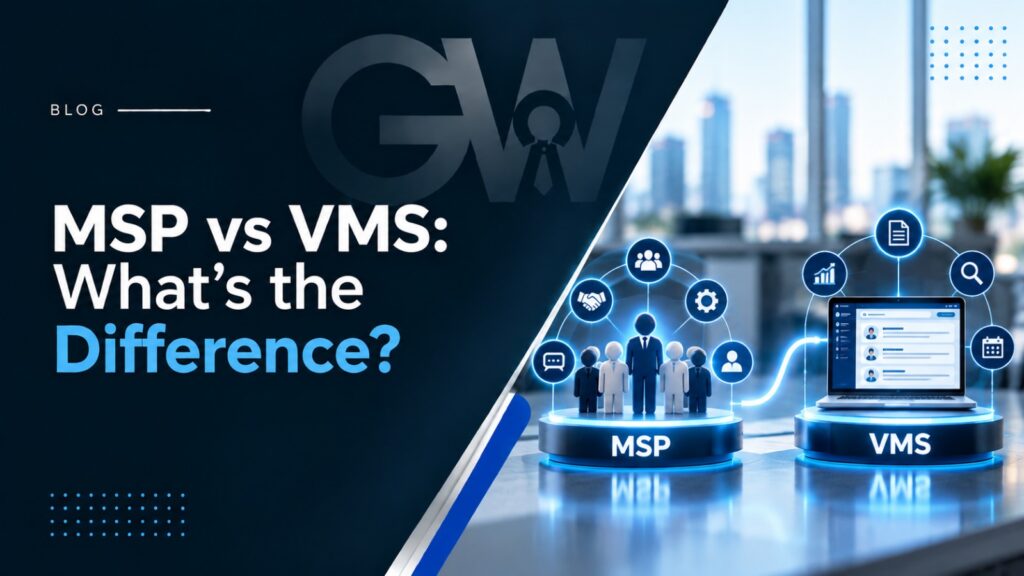
An MSP (Managed Service Provider) is an outside team. It runs your temporary and contract workforce programme for you, usually with the help of a VMS.
In simple terms, a VMS is the tool, and an MSP is the team that runs the process. Many companies use both together.
MSP vs VMS at a glance
| glance | MSP | VMS |
| What it is | A service run by a team | A software platform |
| Who does the work | The MSP’s team manages the programme | Your own team uses the software |
| Main job | Runs the full contingent workforce process | Tracks orders, suppliers, approvals and billing |
| Control | You hand over day-to-day management | You keep hands-on control |
| Best for | Busy teams or large, complex programmes | Teams with strong in-house HR or procurement skills |
| Cost style | Percen tage of spend, fixed fee or mix | Usually a software fee |
What is a contingent workforce?
Both terms are about the contingent workforce. These are workers who are not permanent employees, such as temps, contractors, freelancers and agency staff. Companies use them for busy seasons, special projects and hard-to-fill roles.
The more of these workers you have, and the more agencies you use, the harder it is to keep track of rates, contracts and invoices. MSPs and VMS platforms exist to solve that problem.
What is a VMS?
A Vendor Management System is a platform that helps
In most systems you can:
- Send a job request to all your approved suppliers at once
- Track candidates and headcount
- Manage supplier rates
- Handle timesheets, approvals and one combined invoice
- See reports on spend and supplier performance
Your own team logs in and runs the process. The software handles routine tasks, but it does not find workers or negotiate with suppliers for you. That is why a VMS works best when you have people with the time and skills to manage it.
What is an MSP?
A Managed Service Provider is an outside company that manages part or all of your contingent hiring. A good MSP typically looks after the process from the first request to the worker’s last day. That can include:
- Working with your staffing suppliers and keeping them accountable
- Sending out job requests and managing responses
- Checking that rates and contracts follow your rules
- Handling onboarding and offboarding
- Reporting on cost, quality and speed
Most MSPs run their work on a VMS, either their own or one you already use. So you are not choosing between a person and a tool. The MSP adds the people, the process and the supplier management on top of the technology. If you want to compare this with hiring suppliers directly, read our guide on MSP vs direct staffing.
How do they differ?
- Software vs service. A VMS is a system. An MSP is a team that uses systems.
- Who does the work. With a VMS, your staff do the work inside the software. With an MSP, their staff do much of it for you.
- Control. A VMS gives you direct control. An MSP takes the load off you, though you still set the rules.
- Skills needed. A VMS needs capable people in-house. An MSP brings its own experience, which helps small or stretched teams.
- Cost. A VMS usually means a software fee. An MSP usually charges based on spend, a fixed fee, or a mix.
How much do they cost?
Prices vary by provider and scope, so be careful with anyone who quotes one fixed number for everyone.
MSP fees are commonly set as a percentage of workforce spend, a fixed monthly or annual fee, a per-transaction fee (for example, each worker onboarded) or a hybrid. One provider guide says the percentage fee is usually around 2% to 3.5% of contingent spend, with up to 5% being rare. Treat this as a rough guide only, since it comes from a single provider.
Who pays the MSP? This surprises many buyers. In a supplier-funded programme, the staffing suppliers pay the fee and you pay nothing directly. In a client-funded programme, you pay the MSP yourself. Always ask which model applies and how it affects supplier rates.
VMS fees may be included in supplier pricing, charged separately or bundled into an MSP package. Advanced reporting and integrations with your HR or finance systems may cost extra.
Which one is right for you?
A VMS may fit if:
- You have a strong internal HR or procurement team
- You want direct control over suppliers and spend
- Your programme is small or fairly simple
An MSP may fit if:
- Your team is small or already stretched
- You use many staffing agencies and cannot keep track
- Your contingent workforce is large or growing fast
- You want one partner accountable for the whole process
Can you use both? Yes, and many companies do. An MSP can run your programme on its own VMS, work with one you already have, or help you choose a new one.
Common mistakes to avoid
- Buying software without a plan to run it. A VMS needs owners, rules and regular reviews.
- Choosing on fee alone. Look at service quality, supplier fit and reporting too.
- Ignoring your suppliers. If your agencies do not understand the new process, they may stop sending good candidates.
- Starting too big. Begin with one team or region, then expand.
- Leaving the scope unclear. Decide whether the MSP covers all worker types or only some.
Supplier numbers matter here too. Many employers are cutting the number of agencies they use, which we explain in why companies are consolidating staffing vendors in 2026. Pricing pressure is also changing how suppliers work, as you can read in bill rate compression and shrinking staffing margins.
How Get Workz can help
Choosing between an MSP and a VMS is easier when you look at your own numbers: how many contingent workers you use, how many suppliers you work with and how much time your team spends managing them.
Our MSP & VMS Solutions help you run your contingent workforce through one clear process, so you spend less time chasing suppliers. If you hire in large numbers, our bulk hiring service can support that volume. And if you want to outsource your whole hiring process, see our RPO service or compare it in RPO vs traditional recruitment.
Not sure which model fits your business? Tell us how many contingent workers you use and how you manage them today, and we will help you find the right setup. Contact Get Workz today.
Final thoughts
MSP and VMS are two parts of the same puzzle. A VMS gives you the system. An MSP gives you the team that runs it. Before you decide, count your contingent workers and suppliers, check how much time your team can spare and decide how much control you want to keep.
If it still feels unclear, a short conversation with an expert can save time and cost. Get in touch with Get Workz and we will help you find the right fit.
FAQs
1. What is the main difference between MSP and VMS?
A VMS is software for managing staffing suppliers, orders, timesheets and invoices. An MSP is an outside provider that manages your contingent workforce programme for you. The VMS is the tool. The MSP is the service.
2. Is a VMS part of an MSP?
Often, yes. Many MSPs run programmes on a VMS, either tFheir own or yours. But you can also buy a VMS on its own.
3. Do I need both an MSP and a VMS?
Not always. A small, simple programme may only need a VMS. A complex programme with many suppliers often benefits from an MSP that uses a VMS.
4. How much does an MSP cost?
It depends on the provider and scope. Common models are a percentage of spend, a fixed fee, a per-transaction fee or a mix. One provider guide puts percentage fees at around 2% to 3.5% of spend, but ask for a quote based on your own programme.
5. Who pays the MSP fee?
It depends on the model. In a supplier-funded programme, suppliers pay the fee. In a client-funded programme, you pay the MSP directly.
6. Is a VMS enough for a small business?
It can be, if someone on your team has the time and skills to run it. If your team is small and busy, an MSP can take much of the work off your hands.
7. What is a contingent workforce?
Workers who are not permanent employees, such as temps, contractors, freelancers and agency staff.