
Quick Summary
Markup and margin are two essential measures in staffing pricing, but they tell different stories. Markup shows how much a staffing agency adds to a worker’s pay rate to calculate the client bill rate. Gross margin shows the percentage of revenue remaining after direct employment costs are covered.
Understanding this difference helps staffing firms protect profitability and employers evaluate staffing costs more accurately. This guide explains the formulas, bill rate components, pricing examples, and decisions that influence staffing rates.
Why Markup and Margin Matter in Staffing
A staffing agency quotes a bill rate of $45 per hour for a contract employee earning $30 per hour.
The employer sees a $15 difference and may assume the agency is making $15 in profit.
But that difference must also cover payroll taxes, workers’ compensation, benefits, insurance, and other employment-related costs.
This is where staffing pricing becomes more complicated than a simple calculation.
For staffing firms, setting the wrong bill rate can reduce profitability even when placements increase. For employers, misunderstanding markup can make a reasonable staffing proposal appear unnecessarily expensive.
Both sides need to understand what goes into the final rate.
The challenge is especially important when organizations are dealing with tighter hiring budgets, specialized talent requirements, and increasing pressure to control workforce costs.
As discussed in our article, Bill Rate Compression: Why Staffing Firm Margins Are Shrinking in 2026, pressure on bill rates can create financial challenges when employment costs do not decline at the same pace.
What Is Markup in Staffing?
Staffing markup is the percentage added to a worker’s hourly pay rate to determine the rate charged to the client.
It represents the difference between the employee’s pay and the agency’s bill rate, expressed as a percentage of the employee’s pay.
Staffing Markup Formula
Markup (%) = [(Bill Rate − Pay Rate) ÷ Pay Rate] × 100
For example:
- Employee pay rate: $30/hour
- Client bill rate: $45/hour
- Difference: $15/hour
Markup = ($45 − $30) ÷ $30 × 100
Markup = 50%
The agency applies a 50% markup to the employee’s hourly pay rate.
However, that does not mean the agency earns a 50% profit.
The markup must cover additional employment expenses and contribute toward the agency’s operating costs.
This distinction is important when evaluating staffing proposals or comparing vendors.
What Is Gross Margin in Staffing?
Staffing gross margin is the percentage of billable revenue remaining after the agency pays the direct costs of employing the worker.
These costs generally include wages and applicable payroll burden.
Gross margin is different from net profit. Agencies still need to pay for recruiters, technology, office operations, sales, and other business expenses from their gross profit.
Staffing Gross Margin Formula
Gross Margin (%) = [(Bill Rate − Direct Labor Cost) ÷ Bill Rate] × 100
Direct labor cost generally includes employee wages and applicable employer-related costs.
Consider the same staffing assignment:
- Employee pay rate: $30/hour
- Payroll burden: $6/hour
- Total direct labor cost: $36/hour
- Client bill rate: $45/hour
Gross profit = $45 − $36 = $9/hour
Gross margin = $9 ÷ $45 × 100
Gross Margin = 20%
Although the agency charges a 50% markup on employee pay, its actual gross margin is 20% after direct labor costs.
That $9 per hour must still support the agency’s operating expenses before any net profit remains.
Markup vs Margin in Staffing: Key Differences
Markup and margin use different calculation bases.
Markup is measured against the worker’s pay rate or another explicitly defined cost base. Gross margin is measured against revenue after direct labor costs.
| Factor | Staffing Markup | Staffing Gross Margin |
|---|---|---|
| Meaning | Percentage added to worker pay | Percentage of revenue remaining after direct labor costs |
| Calculation base | Employee pay rate | Client bill rate |
| Primary purpose | Establish the client bill rate | Measure gross profitability |
| Includes payroll burden? | Must be covered by the markup | Deducted as part of direct costs |
| Used by | Sales, pricing, and procurement teams | Finance, operations, and leadership teams |
| Main question | How much is added to employee pay? | How much revenue remains after direct costs? |
The key takeaway: A higher markup does not automatically guarantee a healthy gross margin.
Two staffing agencies may apply identical markups but generate different margins because their payroll costs, insurance requirements, and service delivery expenses differ.
Why the Difference Matters
Suppose two staffing firms charge the same $45 hourly bill rate for workers earning $30 per hour.
Agency A has $4 in hourly payroll burden, while Agency B has $8.
Agency A retains $11 in hourly gross profit.
Agency B retains only $7.
Both agencies apply the same 50% markup, but their gross margins are approximately 24.4% and 15.6%, respectively.
This is why staffing companies should evaluate the actual cost of delivering each assignment rather than relying on a standard markup alone.
How Are Staffing Bill Rates Calculated?
A staffing bill rate is the amount an employer pays a staffing agency for each billable hour worked by a temporary or contract employee.
It is generally calculated by applying an agreed markup to the worker’s hourly pay rate or by working backward from a target gross margin.
Method 1: Calculate Bill Rate Using Markup
Bill Rate = Pay Rate × (1 + Markup Percentage)
Example:
Employee pay rate = $35/hour
Markup = 40%
Bill rate = $35 × 1.40
Final Bill Rate = $49/hour
This approach is straightforward and commonly used when negotiating staffing rates.
However, the agency must still confirm that the resulting rate covers its employment costs and profitability requirements.
Method 2: Calculate Bill Rate Using Target Gross Margin
A staffing firm can also start with its fully loaded direct labor cost and determine the bill rate needed to achieve a target gross margin.
Bill Rate = Direct Labor Cost ÷ (1 − Target Gross Margin)
For example:
- Direct labor cost: $40/hour
- Target gross margin: 25%
Bill rate = $40 ÷ 0.75
Required Bill Rate = $53.33/hour
This approach helps staffing firms understand the minimum pricing needed to support a defined gross margin target.
The calculation assumes no additional revenue-based program fees. Where MSP, VMS, or other fees apply, those costs must also be incorporated into the pricing model.
What Goes Into a Staffing Bill Rate?
A staffing bill rate is not simply the employee’s salary plus agency profit.
It reflects several costs associated with recruiting, employing, and managing a contract worker.
1. Employee Pay Rate
The employee’s hourly wage is the foundation of most temporary staffing pricing models.
Pay rates depend on job responsibilities, required skills, experience, location, and labor market conditions.
Specialized positions may require higher compensation because qualified candidates are more difficult to source.
For example, employers recruiting experienced software engineers may face different pricing considerations than those hiring general administrative employees.
Our guide, How Much Does It Cost to Hire a Software Developer? (Salary, Fees, Time), explores the broader cost factors involved in technical hiring.
2. Payroll Taxes and Statutory Costs
Staffing agencies acting as employers of record may be responsible for applicable employer payroll taxes and statutory employment costs.
In the United States, these can include employer Social Security and Medicare contributions and applicable unemployment taxes.
Actual costs vary by jurisdiction, employment classification, and applicable law.
These expenses must be considered before a staffing agency determines its gross margin.
3. Workers’ Compensation and Insurance
Insurance costs depend on the type of work, workplace risks, location, and coverage requirements.
A warehouse assignment may carry different insurance costs from an office-based accounting role.
Using identical pricing assumptions for both assignments can create inaccurate margin projections.
4. Benefits and Employment-Related Expenses
Depending on the employment arrangement, direct costs may include eligible benefits, paid leave, onboarding requirements, and other worker-related expenses.
The accounting treatment of individual expenses can vary between staffing firms.
What matters is that agencies use a consistent, documented cost model.
5. Recruitment and Operational Costs
Recruitment delivery also requires investment.
Agencies may need to fund candidate sourcing, screening, recruiter salaries, applicant tracking systems, compliance processes, and client management.
Many of these costs are operating expenses rather than direct labor costs, so they are generally supported by gross profit rather than deducted in the gross margin calculation.
Organizations seeking to improve recruiting efficiency can explore How to Reduce Recruitment Costs Without Compromising Quality for practical cost-control approaches.
6. MSP and VMS Program Fees
Some employers manage contingent staffing through a Managed Service Provider (MSP) or Vendor Management System (VMS).
These programs may involve supplier fees, standardized rate cards, reporting requirements, and contractual service expectations.
For staffing agencies, program fees can reduce the revenue retained from an assignment.
Employers should understand how those fees are treated when comparing vendor proposals.
Learn more about Get Workz’s MSP & VMS Solutions and how structured contingent workforce programs can support workforce management.
Staffing Bill Rate Breakdown: A Practical Example
Consider a hypothetical contract staffing assignment with the following hourly costs.
| Component | Amount per Hour | Share of Bill Rate |
|---|---|---|
| Employee pay | $30 | 66.7% |
| Employer payroll burden | $6 | 13.3% |
| Gross profit | $9 | 20.0% |
| Total client bill rate | $45 | 100% |
Markup on employee pay: 50%
Gross margin after direct labor costs: 20%
This example demonstrates why the difference between pay rate and bill rate should never be treated as pure agency profit.
The $9 gross profit still needs to cover operating expenses, including recruiter compensation, technology, administration, and business development.
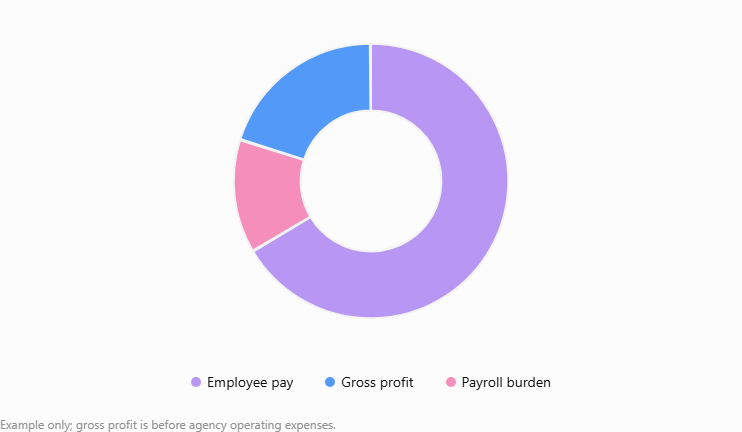
Note: These figures are illustrative calculations, not industry averages or Get Workz pricing.
What Factors Influence Staffing Markup and Bill Rates?
Staffing agencies rarely use a single pricing model for every position.
Several factors influence the final rate.
1. Skill Availability and Job Complexity
Roles requiring specialized technical knowledge, professional certifications, or uncommon experience may involve higher sourcing and screening costs.
For employers, the challenge is not simply finding the lowest rate. It is finding qualified talent within the required timeline.
2. Hiring Volume
Large hiring programs can create opportunities for more efficient recruitment delivery.
However, volume discounts should reflect actual operational efficiencies rather than automatic reductions in agency margins.
Businesses managing large recruitment requirements can consider Bulk Hiring solutions to support workforce scaling.
3. Assignment Duration
Longer assignments may reduce repeated sourcing and onboarding costs.
Short-term assignments can involve greater recruitment effort relative to the number of billable hours.
Staffing firms should account for these differences when negotiating rates.
4. Geographic Location and Employment Regulations
Pay rates, employer taxes, insurance, and statutory requirements vary across regions.
A pricing model developed for one location may not accurately reflect the costs of another.
This becomes particularly important for businesses operating across multiple countries.
5. Workforce Risk and Compliance
Assignments involving additional screening, credential verification, safety requirements, or regulatory obligations may carry higher delivery costs.
Healthcare staffing is one example where qualifications, compliance, and workforce availability can significantly influence pricing.
Employers evaluating these challenges can explore Get Workz’s Healthcare Recruitment services.
How Staffing Firms Can Protect Margins Without Simply Raising Bill Rates
Increasing the client bill rate is not always possible.
Employers face budget limitations, procurement requirements, and competitive pressure.
Staffing firms therefore need to improve the efficiency of their operations while maintaining service quality.
1. Improve Recruitment Productivity
A structured sourcing and screening process can reduce unnecessary recruitment effort.
Clear role requirements, stronger candidate qualification, and consistent communication help recruiters focus on candidates who are more likely to succeed.
2. Reduce Unnecessary Hiring Delays
Long hiring cycles can increase recruitment costs and lead to candidate withdrawals.
Better coordination between recruiters and hiring managers can improve hiring efficiency.
Our article, The Hidden Cost of Slow Hiring: Why Time-to-Hire Matters, explains why hiring delays can create wider business costs.
3. Use Recruitment Technology Strategically
Applicant tracking systems, workflow automation, and recruitment analytics can improve operational visibility.
However, technology investments should be evaluated against measurable outcomes such as recruiter productivity, candidate quality, and time-to-fill.
4. Review Pricing at the Assignment Level
An agency’s overall gross margin may appear healthy while individual assignments underperform.
Tracking direct labor costs, billable hours, client-specific fees, and gross profit per assignment helps identify pricing problems earlier.
5. Consider Scalable Recruitment Support
Staffing companies with fluctuating hiring demand may benefit from flexible recruitment support.
A well-structured recruitment process outsourcing model can provide additional sourcing capacity without requiring the same level of permanent internal expansion.
Explore Get Workz’s RPO (Recruitment Process Outsourcing) services to understand how recruitment support can align with changing hiring requirements.
What Should Employers Check Before Accepting a Staffing Bill Rate?
The lowest staffing bill rate does not always represent the best value.
Employers should evaluate pricing alongside service quality, workforce reliability, and hiring outcomes.
Before approving a staffing proposal, ask these questions:
- What is included in the quoted bill rate? Confirm whether the rate covers payroll burden, insurance, screening, and other agreed services.
- How is the markup calculated? Clarify whether the percentage is based on employee pay or fully loaded labor cost.
- Are there additional fees? Review MSP/VMS fees, overtime charges, conversion fees, and other contractual costs.
- What service commitments are included? Evaluate screening quality, replacement policies, compliance responsibilities, and reporting.
- Can pricing change during the assignment? Understand how wage adjustments, statutory cost changes, and contract renewals are handled.
Organizations using multiple staffing vendors may also benefit from reviewing their overall supplier strategy.
Our article, Why Companies Are Consolidating Staffing Vendors in 2026, explores the operational considerations behind staffing vendor consolidation.
Markup or Margin: Which Metric Should Staffing Firms Prioritize?
Staffing firms need both metrics, but they serve different purposes.
Markup is useful for quoting and negotiating rates.
Gross margin is essential for understanding whether those rates support sustainable operations.
The strongest pricing approach connects the two.
A staffing agency should begin by understanding the worker’s pay rate, calculating all applicable direct employment costs, and identifying the gross margin required for the assignment.
Only then should it finalize the client bill rate.
Employers should use the same logic when reviewing proposals. Rather than comparing markup percentages in isolation, they should examine the services, responsibilities, and employment costs included in each rate.
The goal is not simply to charge more or pay less. It is to establish a staffing rate that supports reliable workforce delivery and long-term commercial value.
TALK TO OUR TEAM
Better Staffing Decisions Start With a Clearer Understanding of Cost
A competitive bill rate should do more than fit a budget. It should support qualified talent, dependable delivery, and a staffing model that works as hiring needs change.
At Get Workz, we help businesses navigate recruitment and workforce challenges through staffing and recruitment support solutions tailored to their requirements.
Whether you are reviewing staffing vendors, scaling contract hiring, or exploring a more structured recruitment model, our team can help you evaluate the right approach.
Let’s build a smarter staffing strategy for your business.
Final Thoughts
Markup and margin may appear to describe the same financial relationship, but they answer two different questions.
Markup explains how a staffing bill rate is established. Gross margin reveals how much revenue remains after the direct costs of employing a worker.
For staffing agencies, understanding both is essential to protecting profitability and building sustainable client relationships.
For employers, the distinction creates greater transparency when comparing staffing proposals and evaluating workforce costs.
Ultimately, effective staffing pricing is not about choosing the highest markup or the lowest bill rate.
It is about understanding the true cost of workforce delivery and making informed decisions that benefit both the business and the people it hires.
FAQs About Staffing Markup and Margin
1. What is the difference between markup and margin in staffing?
Markup is the percentage added to an employee’s pay rate to calculate the client bill rate. Gross margin is the percentage of revenue remaining after direct labor costs are deducted. Markup is calculated using the pay rate, while gross margin is calculated using the bill rate.
2. How do you calculate a staffing agency’s bill rate?
A common formula is: Bill Rate = Employee Pay Rate × (1 + Markup Percentage). For example, a $30 hourly pay rate with a 50% markup produces a $45 hourly bill rate. Agencies should also verify that the rate covers direct employment costs and supports their target margin.
3. Is a 50% staffing markup the same as a 50% profit margin?
No. A 50% markup on a $30 hourly pay rate produces a $45 bill rate. The $15 difference must cover employer-related costs. If direct labor costs total $36 per hour, the agency’s gross margin is 20%, not 50%.
4. What is a good gross margin for a staffing agency?
There is no universal gross margin target. The appropriate margin depends on the staffing segment, employee costs, client requirements, competition, and operating model. Agencies should calculate margins using their actual direct costs and compare performance against relevant business and industry benchmarks.
5. Why do staffing agencies charge different markup rates?
Markup rates vary because staffing assignments have different costs and risks. Skill availability, employment regulations, insurance, hiring volume, assignment length, and service requirements can all influence pricing.
6. How can staffing agencies improve gross margins?
Staffing firms can improve gross margins by managing direct labor costs, reviewing assignment-level pricing, reducing unbillable time, monitoring program fees, and improving recruitment efficiency. They should also evaluate whether existing bill rates reflect current employment costs.