
Quick Summary
Critical thinking is the one thing that differentiates the problem solvers from the order takers. With the advent of AI taking over routine work, companies require workers who can think critically for themselves. Here is a quick list of five methods that have been used by HRs in the past to develop critical thinking skills among their team members, a comparison chart, statistics from the industry, and a basic framework for decision-making all based on a futuristic approach like that of a Future-Ready Workforce Strategy.
Every manager can recall the times when his or her team members were responsible for making an unnecessary mistake, not because of any slackness but because of lacking critical thinking skills. With AI automating all the repetitive work tasks, the employees who are going to be really valuable for a company are those who will be able to question their assumptions, analyse the situation, and make an appropriate decision on their own. As AI continues to reshape hiring and workforce management, organizations also need to understand how AI is transforming recruitment while ensuring employees continue to develop human skills such as critical thinking, adaptability, and sound decision-making. Most companies still educate people in using the right processes and tools while neglecting the importance of developing analytical skills.
It is even more important for organizations that are growing fast through mass hiring methods and require their new hires to make sound decisions right from the start. The following are the five tested methods of developing this skill.
What Are Critical Thinking Skills?
Critical thinking involves being able to examine information in an objective manner, question premises, assess evidence, and draw logical conclusions prior to action. In a work environment, this implies that the employee is not only following orders but also analysing information, considering alternatives, and predicting the outcome of actions taken.
Why Critical Thinking Skills Matter in Today’s Workplace
It is crucial to possess critical thinking skills as they influence the quality, speed, and risk associated with decision-making. Thinking critically means making fewer mistakes, adapting faster to changes, and requiring less assistance from management in this regard.
According to the World Economic Forum’s Future of Jobs Report 2025, analytical thinking was rated by more than 69% of employers as the most important core skill among those considered, surpassing even many technical skills. In addition, LinkedIn’s 2025 Workplace Learning Report states that about 48% of learning professionals consider that executives fear that people do not have the necessary skills for business strategy implementation.
Developing critical thinking is not just about improving individual performance. It also plays a key role in creating a workforce that can adapt to technological change, solve complex business challenges, and support long-term organizational growth. These capabilities are essential when building a future-ready workforce.
5 Practical Ways to Build Critical Thinking in Employees
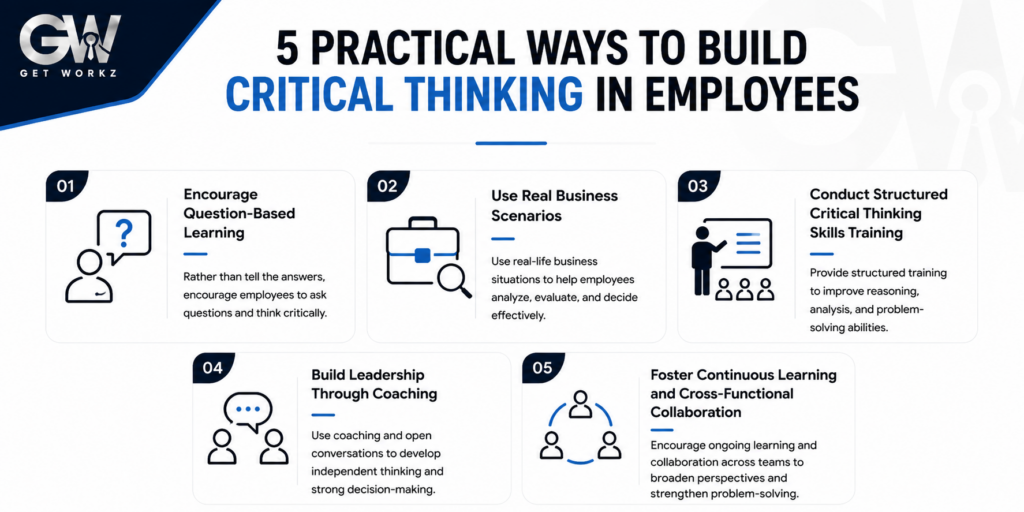
1. Encourage Question-Based Learning
Rather than tell your employees the answer, ask what they would do and why. Coaching that asks questions such as, “What assumptions are we making?” or “What happens if we’re wrong?” teaches people to think about things logically rather than rely on their reflexes.
2. Use Real Business Scenarios
“Exercises based on real company cases perform better than generic ones because in case-study exercises workers analyze real-life decisions on pricing or deadlines and, thus, practice evaluating evidence within the limits that exist for them on their job.”
3. Conduct Structured Critical Thinking Skills Training
Skills training on critical thinking involves teaching reasoning skills, the ability to recognize biases, and structured problem-solving skills. The best approach is not just one long training session a year but rather shorter sessions done repeatedly.
Organizations that combine structured learning with skills-based hiring often build teams that adapt faster, solve problems more effectively, and deliver stronger long-term business outcomes.
4. Build Leadership Through Coaching
Leadership coaching, which is an approach that entails managing through coaching rather than giving directives, promotes independence. Continuous one-on-one sessions involving questions such as “How did you come up with that decision?” help foster a culture of reflection, which is a key element of leadership development.
5. Foster Continuous Learning and Cross-Functional Collaboration
Rotating employees through cross-functional projects exposes them to different ways of solving problems. Paired with ongoing access to learning resources, this keeps analytical thinking sharp instead of static.
Continuous learning becomes even more effective when organizations measure progress using recruitment metrics instead of relying solely on assumptions.
Traditional Employee Training vs. Critical Thinking Training
| Aspect | Traditional Training | Critical Thinking Training |
| Purpose | Teach a fixed process | Build independent judgment |
| Learning Style | Passive, one-way | Interactive, scenario-based |
| Employee Impact | Follows instructions | Solves problems proactively |
| Long-Term Value | Consistency | Adaptability and innovation |
Industry Insights (2024–2026)
| Metric | Latest Data | Source |
| Employers rating analytical thinking essential | 69% | WEF Future of Jobs Report 2025 |
| L&D professionals citing exec concern over skills gaps | ~49% | LinkedIn 2025 Workplace Learning Report |
| Gen Z & millennials valuing soft skills like critical thinking over technical skills | 80%+ | Deloitte 2025 Gen Z & Millennial Survey |
| Employers planning to prioritize upskilling through 2030 | 85% | WEF Future of Jobs Report 2025 |
Practical Decision-Making Framework
Identify Problem → Gather Evidence → Analyze Information → Evaluate Alternatives → Make Decision → Review Results → Continuous Improvement
Decision Checklist
✔ Employees challenge assumptions before acting
✔ Teams use data, not opinion, to decide
✔ Managers ask questions instead of giving answers
✔ Continuous learning is built into everyday workflows
✔ Employees solve problems without escalating everything
Common Mistakes
| Problem | How to Fix It |
| Treating it as a one-time workshop | Build recurring practice into regular workflows |
| Rewarding speed over sound reasoning | Recognize good decision-making, not just fast answers |
| Giving employees answers instead of asking questions | Coach with questions to build independent thinking |
Conclusion
The need for developing critical thinking skills is no longer a choice; rather, it is an intelligent investment in the future of your organization.
The development of such skills among the employees makes them capable of analyzing, questioning, solving problems, and making effective decisions. As a result, the organization will be able to innovate, produce, and become more resilient to change.
In other words, by investing in the development of your employees’ abilities, your organization will be able to create smart and flexible teams in the future.
Empower Your Workforce with Get Workz
An effective workforce is not only about having the right people on board, but also equipping them with the right competencies. Get Workz assists companies in building effective teams by providing workforce solutions that include recruitment, talent acquisition, and workforce development services.
From business expansion to investments in the professional development of your people, our experience will assist you in creating a workforce that will be able to apply their critical thinking skills to achieve business success.
Businesses looking to strengthen their hiring process can also benefit from choosing the right RPO partner to support long-term workforce development.
Contact Get Workz now to find out how we can provide your company with effective workforce solutions.
FAQs About Critical Thinking Skills
1. What are examples of critical thinking skills?
Some examples of critical thinking include reviewing data before making a decision, challenging assumptions, considering multiple options, identifying bias in data, and thinking about the implications of a decision. At work, this is manifested through an instance where an employee analyzes the underlying cause of a problem rather than a quick-fix solution.
2. How do you train employees to think critically?
Combine structured training with real scenarios, coaching, and feedback. Ask open-ended questions instead of giving direct answers, and give employees room to make decisions and learn from the outcome.
3. Why is critical thinking important in the workplace?
This not only ensures good decision-making but also avoids unnecessary mistakes as well as creating individuals who can work without the need for continuous monitoring. As AI takes care of the mundane jobs, interpretation and making decisions become the key differentiators.
4. How can Get Workz help organizations develop critical thinking skills in employees?
Get Workz helps companies by linking them with competent professionals and workforce solutions that enhance employee development efforts. Apart from recruitment solutions, firms can form effective teams through developing critical thinking, learning, and problem-solving at work.