
Quick answer:
Staffing agencies charge in two main ways. For temporary and contract workers, they add a markup to the worker’s pay, usually about 25% to 50% in published guides. For permanent hires, they charge a one-time placement fee, usually 15% to 25% of the first-year salary. Senior executive searches cost more, at about one-third of first-year pay. Your real price depends on the role, the pay level and your contract.
Key takeaways
- Temporary staff are billed by the hour. Permanent hires are billed once, as a percentage of pay.
- A markup is not all profit. In an American Staffing Association (ASA) example, net profit was only 3.3% of the bill rate.
- Most placement fees come with a replacement guarantee. Always ask how long it lasts.
- Compare the total cost of each quote, not just the percentage.
Staffing prices can feel confusing at first. One agency quotes a markup. Another quotes a percentage of salary. A third wants a payment before the search even starts. This guide explains each fee in simple words, with real examples and a checklist of questions to ask before you sign.
How we put this together:
we compared five published pricing guides and one ASA factsheet. The numbers below are ranges from those sources. Sources do not always agree, so we name who said what.
How do staffing agencies charge?
There are four common fee models. Which one applies depends on whether you are hiring temporary staff, permanent staff or a senior leader.
| Fee model | Used for | How it works | Range in published guides |
| Markup | Temporary and contract workers | Added on top of the worker’s hourly pay | About 25% to 50%. Some guides go higher for hard-to-fill roles |
| Contingency fee | Permanent hires | One-time fee, paid only when you hire | About 15% to 25% of first-year pay |
| Retained fee | Senior and executive roles | Paid in parts, during the search | About 30% to 35% of first-year pay |
| Conversion fee | A temp worker becomes permanent | One-time fee, often reduced over time | Set in your contract |
How much is the markup on temporary and contract staff?
With temporary and contract roles, the agency pays the worker and bills you a higher hourly rate. That bill rate is the worker’s pay plus a markup.
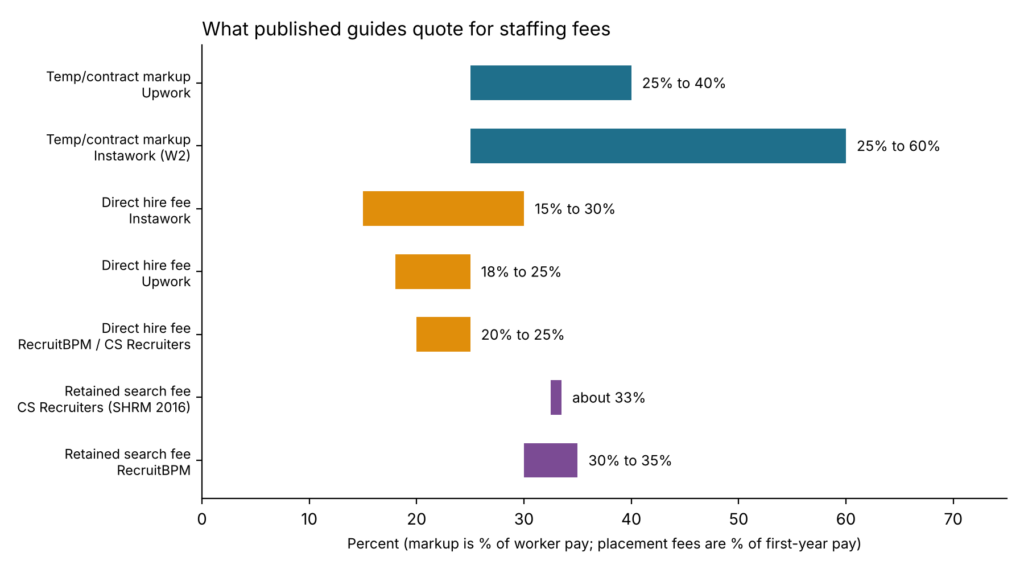
Upwork says markups for contract and temp-to-hire roles are usually 25% to 40%, and can reach 75% for specialized or hard-to-fill roles. Instawork lists 25% to 60% for W2 workers and 13% to 40% for 1099 workers. It also says W2 workers cost about 10% more, because the agency pays payroll taxes, workers’ compensation and benefits.
Here is a simple example. A worker earns $20 an hour and the agency adds a 40% markup.
- Bill rate: $20 × 1.40 = $28 per hour
- Over 13 weeks at 40 hours a week (520 hours), you pay $14,560 in total
- The worker earns $10,400 of that. The other $4,160 is the markup
People often mix up markup and margin. Markup is a percentage of the worker’s pay. Margin is a percentage of the bill rate. A 40% markup is not a 40% margin. Our guide on markup vs margin in staffing shows how to switch between the two
Where does the staffing markup actually go?
Most of the markup is not profit. It pays for taxes, insurance and the cost of running the agency. The ASA published a factsheet that breaks down one hourly bill rate. The pay rate comes from an ASA survey of nearly 12,000 temporary and contract workers, and the profit figure comes from ASA’s operations benchmarking survey.
| Item | Per hour | Share of bill rate |
| Worker pay rate | $17.00 | 66.0% |
| Payroll taxes (FICA, FUTA, SUTA) | $2.08 | 8.1% |
| Workers’ compensation | $0.34 | 1.3% |
| General and administrative costs | $5.49 | 21.3% |
| Net profit | $0.85 | 3.3% |
| Bill rate | $25.76 | 100% |
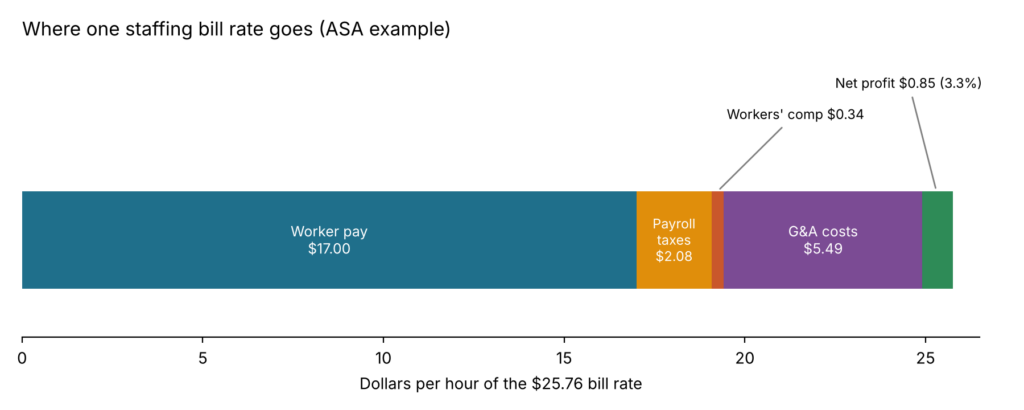
The bill rate is 51.5% above the pay rate. That sounds high, until you see that only $0.85 of the $8.76 extra per hour is profit. The factsheet carries a 2019 notice, and tax and insurance rates change by state and year. Use it to understand how the money is split, not to predict your own bill rate.
How much do agencies charge for permanent placements?
For permanent roles, most agencies work on contingency. You pay a one-time fee only when you hire a candidate they sent. The fee is a percentage of the first-year salary. Upwork quotes about 18% to 25%. RecruitBPM and CS Recruiters both quote 20% to 25%. Instawork gives a wider 15% to 30%
Here is what that looks like for a $60,000 role.
| Fee rate | Placement fee |
| 15% | $9,000 |
| 20% | $12,000 |
| 25% | $15,000 |
Check what the percentage is based on. Some agencies use base salary only. Others include bonus and other pay. CS Recruiters warns that you should check how “compensation” is defined in the agreement, because it can change the fee by thousands of dollars.
Most agencies also include a replacement guarantee. If the hire leaves or does not work out within a set time, the agency replaces them or refunds part of the fee. Upwork and RecruitBPM both say 30 to 90 days is typical for contingency placements.
The fee is only one part of what a hire costs you. To see the full picture, read our guide on cost per hire.
How much does executive search cost?
Senior roles are usually filled through retained search. You pay in stages during the search, not only at the end. The fee is higher because the search takes longer and the agency commits more time to it.
RecruitBPM puts retained fees at 30% to 35% of total first-year pay, including bonus and incentives. It says the fee is usually paid in three equal parts: at contract signing, at a mid-search milestone and when the person is placed. CS Recruiters says the common standard is about one-third of salary, bonus and signing bonus, citing a 2016 SHRM article. That figure is older, so treat it as a long-standing norm rather than current data
| When you pay | Only when you hire | In three parts: signing, mid-search, placement |
| Typical fee | 20% to 25% | 30% to 35% |
| Fee based on | First-year pay | Total first-year pay, including bonus |
| Typical guarantee | 30 to 90 days | Often 12 months |
Source for the table: RecruitBPM.
For example, a leader with a first-year package of $150,000 would cost about $50,000 at one-third. That is three payments of about $16,700. At 30% to 35%, the range is $45,000 to $52,500.
Not sure which route is right for your search? Our comparison of executive search vs contingency recruiting explains when each one makes sense. If you already know you need a leader, see our executive search service.
What is a conversion fee in temp-to-perm hiring?
Sometimes you start with a temp and later want to hire them directly. The agency may charge a conversion fee, because it did the sourcing work. Upwork says some agencies charge a one-time fee to cover their costs, but it does not give a number. Instawork says some agencies waive the fee after 120 to 450 hours worked. Top Echelon gives examples where the fee is a share of first-year pay, such as 25%, and reduced based on time worked.
There is no standard here, so your contract is what matters. Ask for the conversion terms before the first day of work, not when you decide to hire.
If you work with several agencies at once, a managed service provider can handle terms like this across all of them. Our guide on MSP vs VMS explains how that setup works.
What should you ask before you sign?
The percentage is only one part of the deal. These questions help you compare quotes fairly.
| Question | Why it matters |
| How long is the replacement guarantee, and what does it cover? | It protects you if the hire leaves early |
| Is the fee based on base salary or total pay? | Total pay can raise the fee a lot |
| What are the conversion terms for temp-to-perm? | Fees may drop or disappear after a set number of hours |
| How is overtime billed? | Overtime changes your hourly cost |
| Are there minimum fees or advance payments? | Some agreements include them |
Get every answer in writing. If two quotes look different, turn both into a total cost for the same role over the same period.
When is an agency fee not the best option?
For one or two hires a year, a placement fee is simple and often fair. It looks different when you hire all the time. Paying 20% on every hire adds up, and managing many agencies takes time.
For steady hiring, outsourcing the process can be easier to plan. With recruitment process outsourcing (RPO), a partner runs sourcing and screening for you. Our guide to RPO pricing models shows how those fees work, and recruitment agency vs RPO helps you choose between the two. If you hire engineers or other tech roles, take a look at our IT recruitment service.
How Get Workz can help
Get Workz is a recruitment and outsourcing company. We help employers find, screen and hire talent through clear, flexible services, including recruitment process outsourcing, executive search, and IT and healthcare recruitment. We agree pricing with you before we start, based on the role and the scope of work.
Not sure which fee model fits your hiring plan? Book a call with our team and we will help you compare your options.
Frequently asked questions
1. How much do staffing agencies charge per hour?
They bill you the worker’s pay plus a markup. Published guides commonly quote markups of about 25% to 50% for temporary and contract staff. A worker paid $20 an hour with a 40% markup costs you $28 an hour.
2. Is the staffing markup all profit?
No. In the ASA example, only $0.85 of the $25.76 bill rate was net profit, which is 3.3%. The rest covered the worker’s pay, taxes, insurance and agency costs.
3. What is a placement fee?
It is a one-time charge, usually a percentage of the first-year salary, that you pay when you hire a candidate an agency sent you. Most guides put it between 15% and 25%.
4. What is a replacement guarantee?
It is a promise that the agency will replace the hire, or refund part of the fee, if the person leaves or does not work out in a set period. For contingency placements, 30 to 90 days is commonly reported.
5. Can I negotiate agency fees?
Yes, it is reasonable to ask. Rates depend on the agency, the role and the volume, so raise it early if you plan to hire often.