
Hiring the right candidate is not always about finding the person who performs best in an interview.
One candidate communicates confidently. Another has stronger technical skills. Someone else may have the right experience but struggle to explain their achievements.
So, how do hiring managers compare candidates fairly?
An interview scorecard template makes this process more structured. It helps hiring teams evaluate candidates using the same job-related criteria, scoring system, and evidence.
Instead of relying on memory or first impressions, hiring managers can document what each candidate demonstrated during the interview.
In this guide, you’ll find a free interview scorecard template, a simple scoring method, practical examples, and tips for making more consistent hiring decisions.
Quick Summary
- An interview scorecard is a structured form used to evaluate candidates against predefined job requirements.
- A good scorecard includes competencies, a rating scale, interview notes, and a final recommendation.
- A 1–5 scoring system helps interviewers assess candidates consistently.
- Different positions require different evaluation criteria.
- The free template below can be customized for technical, healthcare, finance, leadership, and other roles.
- Structured scorecards support better hiring discussions, but they do not replace professional judgment.
What Is an Interview Scorecard?
An interview scorecard is a standardized evaluation form that hiring managers use to assess a candidate’s skills, experience, and job-related competencies.
It usually includes interview questions, scoring criteria, numerical ratings, and space for supporting notes.
For example, instead of writing “Good problem-solving skills,” an interviewer might record:
“The candidate explained how they identified a production issue, compared possible solutions, and reduced repeated errors.”
This provides specific evidence that the hiring team can review later.
Interview scorecards are particularly useful when multiple interviewers assess the same candidate or when businesses are hiring for several similar positions.
They also support a more structured recruitment process by connecting interview feedback to actual job requirements.
Why Hiring Managers Should Use an Interview Scorecard
Interviews can become subjective when every interviewer uses different standards.
One manager may prioritize experience, while another focuses on communication. Without a shared framework, comparing candidates becomes difficult.
An interview scorecard helps address this challenge.
1. Make Candidate Comparisons More Consistent
When every candidate is evaluated against the same essential criteria, hiring managers can identify meaningful differences in their qualifications.
For example, two applicants may have similar experience, but only one demonstrates the problem-solving abilities required for the position.
A scorecard makes those differences easier to document and discuss.
2. Reduce Subjective Hiring Decisions
First impressions can influence hiring decisions.
A confident speaker may appear more capable, even when another candidate demonstrates stronger job-related skills.
Structured scoring encourages interviewers to focus on observable evidence rather than personal preferences.
However, scorecards do not automatically eliminate bias. Interview questions and evaluation standards must also be designed fairly.
3. Improve Collaboration Between Interviewers
When several people participate in interviews, feedback can become inconsistent.
One interviewer may focus on technical knowledge, while another concentrates on teamwork.
A shared scorecard creates a common framework for discussing candidate strengths, concerns, and missing information.
4. Support Faster Hiring Decisions
Hiring managers sometimes spend days reviewing interview notes because the original feedback was unclear.
A completed scorecard makes it easier to identify which competencies were assessed and where further evaluation is needed.
This can reduce unnecessary discussions without rushing important decisions.
Our guide on The Hidden Cost of Slow Hiring: Why Time-to-Hire Matters explains how recruitment delays can affect hiring outcomes.
5. Maintain Better Hiring Records
Interview scorecards provide a record of the criteria used, evidence collected, and reasons behind a hiring recommendation.
These records can help HR teams review their recruitment processes and identify opportunities for improvement.
Interview notes should remain job-related and be stored according to applicable privacy requirements and company policies.
Free Interview Scorecard Template for Hiring Managers
You don’t need expensive recruitment software to start evaluating candidates more consistently.
The following free interview evaluation form provides a simple framework that hiring managers can copy into Excel, Google Sheets, or Word.
Interview Scorecard Template
Interview Scorecard Template
Evaluate candidates using consistent, job-related criteria.
| Evaluation Criteria | Score (1-5) |
|---|---|
| Job-related Knowledge | |
| Problem-solving | |
| Communication | |
| Collaboration | |
| Role-specific Experience |
What Should an Interview Scorecard Include?
A useful interview scorecard should contain six essential elements:
- Candidate information: Name, position, interview date, and interviewer.
- Evaluation criteria: Skills and competencies required for the role.
- Interview questions: Questions designed to assess each competency.
- Rating scale: Clear definitions for different performance levels.
- Evidence-based notes: Specific examples supporting each rating.
- Final recommendation: A documented decision about the next hiring step.
The evaluation criteria should be established before interviews begin.
Changing the standards after meeting candidates can make comparisons less reliable.
How to Score Candidates Using a 1–5 Interview Rating Scale
A scoring system only works when interviewers understand what each number represents.
The following rubric can be used as a starting point.
| Score | Rating | Meaning |
| 1 | Below requirements | Below requirements Does not demonstrate the required competency |
| 2 | Limited | imited Shows partial understanding or significant gaps |
| 3 | Meets expectations | Demonstrates the competency at the required level |
| 4 | Strong | Provides clear evidence of above-standard capability |
| 5 | Exceptional | Demonstrates comprehensive, highly relevant capability |
A score of 3 is not necessarily a negative result. It means the candidate meets the established requirement.
Interviewers should also have a “Not Assessed” option when a competency was not adequately covered.
This prevents missing information from being treated as poor performance.
Interview Scorecard Example: Comparing Two Candidates
Imagine a company is hiring a project coordinator.
The hiring team identifies five important competencies and evaluates two candidates using the same scoring system.
| Evaluation criteria | Candidate A | Candidate B |
| Job-related knowledge | 4 | 5 |
| Problem-solving | 3 | 4 |
| Communication | 5 | 3 |
| Collaboration | 4 | 4 |
| Relevant experience | 3 | 5 |
| Total score | 19/25 | 21/25 |
Interview Scorecard: Candidate Comparison
Example scores for two hypothetical candidates.
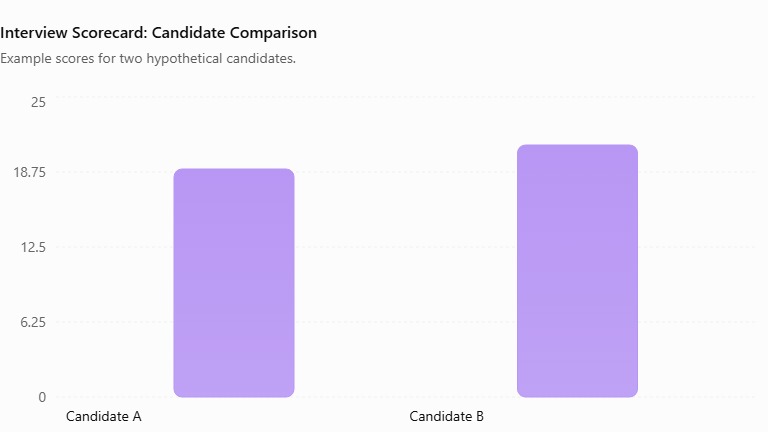
Candidate B has a higher total score, but that doesn’t automatically make them the best choice.
Candidate A demonstrates stronger communication, which may be essential for a stakeholder-facing position.
Hiring managers should review the evidence behind each score and consider the role’s most important requirements.
An interview scorecard supports better judgment. It should not replace it.
How to Create an Interview Scorecard in 6 Steps
Step 1: Identify the Role’s Essential Skills
Start with the job description.
Separate essential skills from qualifications that would be helpful but are not necessary.
For example, a software developer may need programming knowledge, debugging ability, and experience collaborating with development teams.
A customer support manager may need conflict resolution, coaching, and operational problem-solving skills.
Clear requirements make it easier to evaluate candidates fairly.
Our article on How to Write Better Role Descriptions for Successful Hiring? explains how employers can define job expectations more effectively.
Step 2: Choose Four to Six Evaluation Criteria
Avoid creating a scorecard with too many categories.
A shorter list of meaningful competencies is easier to use consistently.
For each competency, define what successful performance looks like.
For example, problem-solving might involve identifying an issue, evaluating alternatives, and explaining the reasoning behind a decision.
Step 3: Prepare Structured Interview Questions
Ask candidates interviewing for the same role a consistent set of core questions.
For example:
“Tell me about a time you had to solve a difficult problem with limited information. What steps did you take?”
This question can help assess how a candidate approaches uncertainty and makes decisions.
Follow-up questions can clarify responses, provided they remain relevant to the position.
A structured interview process also contributes to a more predictable candidate journey. Our guide on How to Improve Candidate Experience During the Hiring Process explores practical ways to improve communication and consistency throughout recruitment.
Step 4: Define Scoring Standards Before the Interview
Agree on what qualifies as a score of 1, 3, or 5 for each competency.
Where possible, include examples of expected evidence.
This helps interviewers evaluate candidates against the same standards rather than relying on personal impressions.
Step 5: Record Evidence Before Group Discussions
Interviewers should complete their individual evaluations before joining a group discussion.
This reduces the possibility of one person’s opinion influencing everyone else’s ratings.
Notes should focus on specific responses, demonstrated skills, and relevant examples.
Step 6: Review Scores and Make a Documented Decision
Compare the completed scorecards and discuss differences in ratings.
Look at the evidence behind each score rather than focusing only on the final total.
If a candidate meets most requirements but has an important assessment gap, consider whether a focused follow-up interview or work sample could provide the missing information.
Interview Scorecard Templates for Different Job Roles
A general interview scorecard is a useful starting point, but the evaluation criteria should reflect the position being filled.
| Job role | Suggested evaluation criteria |
| Software Develope | Technical knowledge, debugging, code quality, collaboration, problem-solving |
| Sales Executive | Customer discovery, communication, objection handling, negotiation |
| Registered Nurse | Clinical judgment, patient safety, documentation, teamwork |
| Finance Professional | Accounting knowledge, accuracy, analytical thinking, compliance awareness |
| Team Manager | Coaching, decision-making, conflict resolution, accountability |
Interview Scorecard for IT Recruitment
Technical interviews should assess practical capabilities rather than relying entirely on resumes or certifications.
For example, software developers may be evaluated on debugging, technical reasoning, code quality, and collaboration.
Employers hiring specialized technology professionals can explore Get Workz’s IT Recruitment services.
Interview Scorecard for Healthcare Recruitment
Healthcare interviews require careful evaluation of role-specific competencies.
Depending on the position, hiring managers may assess clinical judgment, patient communication, teamwork, and safety awareness.
However, interview scores should complement—not replace—credential verification, licensing checks, and appropriate clinical assessments.
Learn more about Get Workz’s Healthcare Recruitment services.
Interview Scorecard for Leadership Positions
Leadership interviews should evaluate strategic thinking, decision-making, team development, and organizational priorities.
Hiring managers may also use case discussions or structured leadership scenarios.
For organizations hiring senior professionals, Get Workz provides Executive Search services.
Common Interview Scorecard Mistakes to Avoid
Even a well-designed template can produce unreliable feedback when used incorrectly.
1. Using the Same Criteria for Every Role
Different positions require different capabilities.
A generic scorecard may overlook skills that are essential for successful job performance.
Customize the evaluation criteria for each role or job family.
2. Rating Personality Instead of Job-Related Behavior
Terms such as “good personality” or “culture fit” can be vague.
Replace them with observable, job-related criteria.
For example, assess how clearly a candidate explains decisions rather than whether their communication style resembles the interviewer’s.
3. Giving Scores Without Supporting Evidence
A rating of 5 means little without an explanation.
Encourage interviewers to include specific examples from candidate responses.
This makes hiring discussions more productive.
4. Treating the Highest Score as the Automatic Winner
Not every competency carries equal importance.
A candidate who scores highly overall may still lack a critical requirement.
Establish minimum standards for essential skills before evaluating applicants.
5. Depending Entirely on Automated Evaluation
AI-powered interview tools may help organize information, but automated assessments can introduce additional risks.
Hiring teams should understand how these systems work, review their outputs, and assess relevant legal and fairness requirements.
Our guide on How to Use AI Ethically in Your Recruitment Process explores responsible approaches to AI-supported hiring.
How Interview Scorecards Support Skills-Based Hiring
Traditional hiring processes often place considerable emphasis on job titles, educational qualifications, and years of experience.
However, these details do not always show how effectively someone can perform the actual work.
A skills-based approach focuses more directly on relevant capabilities.
Interview scorecards support this by connecting each evaluation criterion to a specific job requirement.
For example, instead of judging a software developer only by previous employers, an interviewer can assess how effectively they solve a relevant technical problem.
This approach is closely connected to Skills-Based Hiring vs Degree-Based Hiring: What Employers Prefer in 2026, which explores different ways organizations assess candidate qualifications.
It also reflects the broader discussion in The End of Resume-Based Hiring? Why Skills-Based Hiring Is Reshaping Recruitment in 2026.
The goal is not to ignore education or experience when they matter. It is to evaluate candidates using evidence that is relevant to successful job performance.
Can Interview Scorecards Improve Recruitment Performance?
Interview scorecards can support a more organized hiring process, but their impact should be measured rather than assumed.
HR teams can evaluate whether structured interviews are helping them make timely, consistent, and effective decisions.
Useful recruitment metrics include:
- Time-to-hire: The time between entering the hiring process and accepting an offer, according to the organization’s chosen definition.
- Interview-to-offer ratio: The number of interviewed candidates compared with offers made.
- Offer acceptance rate: The percentage of job offers accepted.
- Quality of hire: A measure based on relevant post-hire outcomes, such as performance and retention.
- Interviewer agreement: How consistently interviewers evaluate the same competencies.
Our guide on Recruitment Metrics Every HR Leader Should Track in 2026 explains how hiring teams can monitor recruitment performance.
These metrics should be interpreted alongside job complexity, hiring volume, and market conditions.
A scorecard alone will not eliminate recruitment delays or guarantee stronger hires.
However, it can help teams identify unclear evaluation standards and improve the quality of their feedback.
How Get Workz Helps Employers Build a More Structured Hiring Process
An interview scorecard is useful, but effective recruitment starts before the first interview.
Employers also need clear job requirements, relevant candidate sourcing, organized screening, and consistent communication.
Get Workz supports businesses looking to improve recruitment efficiency while maintaining a focus on candidate quality.
Through our Recruitment Process Outsourcing (RPO) services, organizations can access recruitment support aligned with their hiring needs.
For businesses deciding whether to manage hiring internally or work with an external provider, our article on Recruitment Agency vs RPO: What’s the Difference and Which Is Right for Your Business? offers additional context.
A structured hiring approach helps teams connect candidate evaluation with broader recruitment goals.
TALK TO OUR TEAM
Better Interviews Start With Better Hiring Decisions
A strong candidate should be evaluated on what they can contribute, not simply how confidently they answer questions.
An effective interview scorecard helps your team ask better questions, document meaningful evidence, and make more consistent decisions.
But if your organization is struggling with candidate quality, slow screening, or an overloaded hiring team, improving the interview form may be only part of the solution.
Get Workz helps employers build more structured recruitment processes and find talent aligned with their business needs.
Final Thought
A good interview does more than create a positive impression. It gives hiring managers useful information for making an important decision.
An interview scorecard template brings structure to that process by helping teams define expectations, evaluate job-related skills, and document their findings.
Whether you’re hiring your first employee or managing recruitment across multiple departments, a consistent evaluation framework can make interview feedback more meaningful.
Start with the free template, customize the criteria for your next opening, and focus each interview on the capabilities that matter most.
Because better hiring decisions begin with better questions and clearer evidence.
FAQs About Interview Scorecards
1. What is an interview scorecard template?
An interview scorecard template is a standardized evaluation form used to assess candidates against job-related criteria. It usually includes competencies, interview questions, a rating scale, evidence-based notes, and a final recommendation.
2. How do you score a candidate during an interview?
Start by defining the skills required for the position. Ask structured questions, record evidence from the candidate’s responses, and rate each competency using a consistent scale, such as 1–5. Review the results alongside essential job requirements before making a decision.
3. What should an interview evaluation form include?
An interview evaluation form should include candidate details, job title, interviewer information, evaluation criteria, rating definitions, evidence-based notes, and a final recommendation. It should also allow interviewers to mark competencies that were not assessed.
4. Can I use the same interview scorecard for every position?
You can use the same basic format, but the evaluation criteria should change based on the role. Technical, healthcare, finance, and leadership positions require different competencies.
5. Do interview scorecards help reduce hiring bias?
Structured scorecards can help interviewers focus on consistent, job-related evidence rather than general impressions. However, reducing bias also requires appropriate questions, clear scoring standards, interviewer training, and regular review of hiring practices.
6. Is this interview scorecard template free?
Yes. The template provided in this guide is free to copy and customize for internal hiring use. It includes five evaluation criteria and a simple 1–5 scoring system.